What camp lights do you need, and what colour should they be?
The short answer
Light a camp by job, and use the least light that does each job. You need white task light for cooking and repairs, aimed down and switched off when the job is done; low light on the ground around the vehicle for walking; and a dim, warm light for sitting out, which is most of the evening. For that last one, red or amber is the better colour. It draws fewer insects: in a 2026 field study amber LEDs caught 45 to 51 percent fewer than cool white LEDs of similar output. It also costs your eyes less of their adjustment to the dark. Insect catches rise with intensity at every colour tested, and a bright light of any colour undoes the half hour your eyes need to adapt. Power is the smallest concern: a two-colour LED camp light on its brightest white setting uses about 2 amp-hours over a five-hour evening.
What lights does a camp need?
Three, sorted by what you are doing. Most camp lighting advice is a list of products. The useful question is what the light is for, because the three jobs want different colours, different brightness and different amounts of time switched on.
| Job | Light | Where it points | How long it is on |
|---|---|---|---|
| Cooking, repairs, finding gear | White, 4000 to 5000 K, as bright as the task needs | Down at the work, shielded from everyone else | Minutes |
| Walking around the vehicle | Low and aimed at the ground: rock lights or a lantern set down low | At the ground | While you are moving |
| Sitting out, eating, the tent | Dim red or amber, or warm white at 2200 to 3000 K | Down or away from faces | Most of the evening |
The row that runs longest is the one that should be dimmest.
How does an expedition team set theirs up?
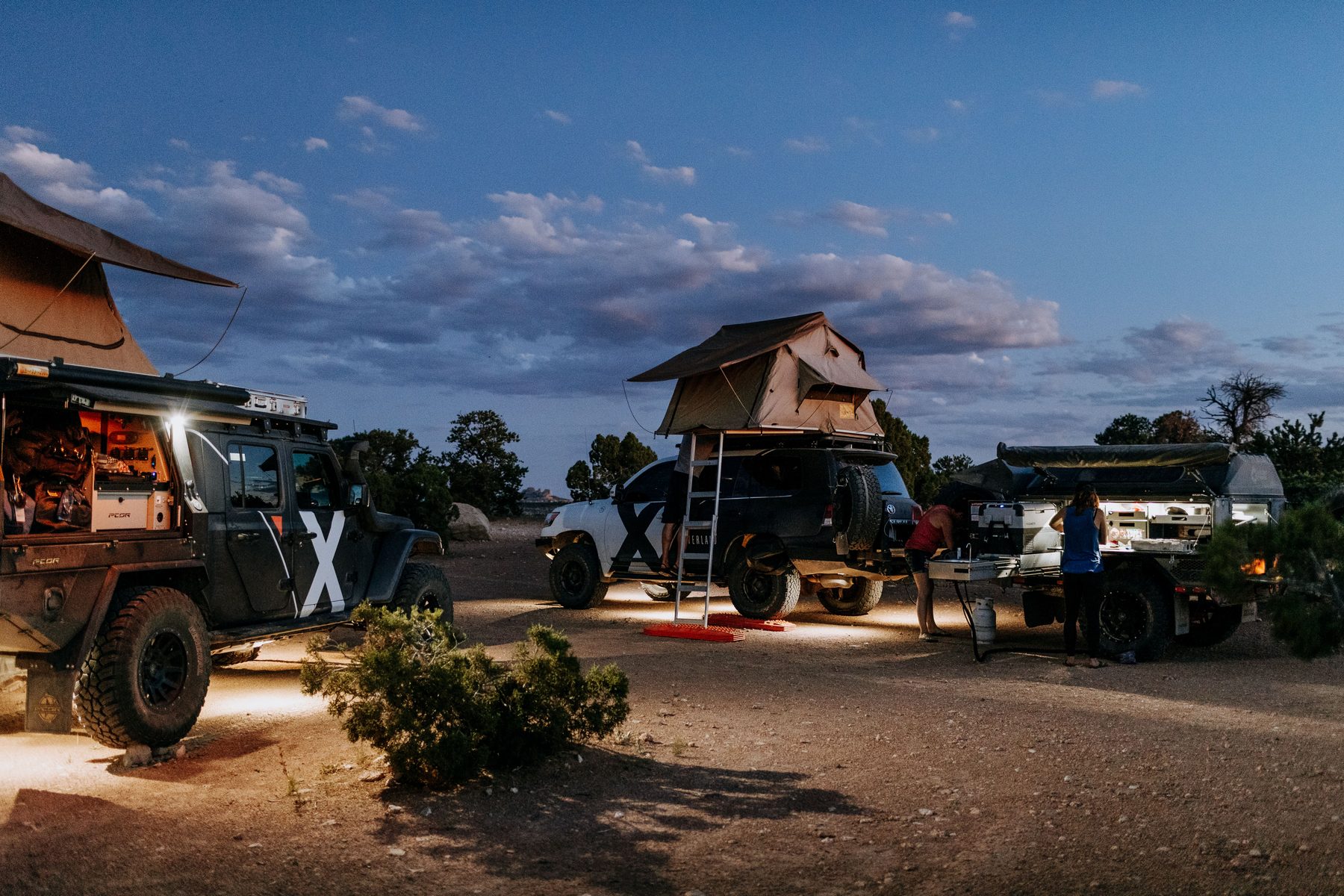
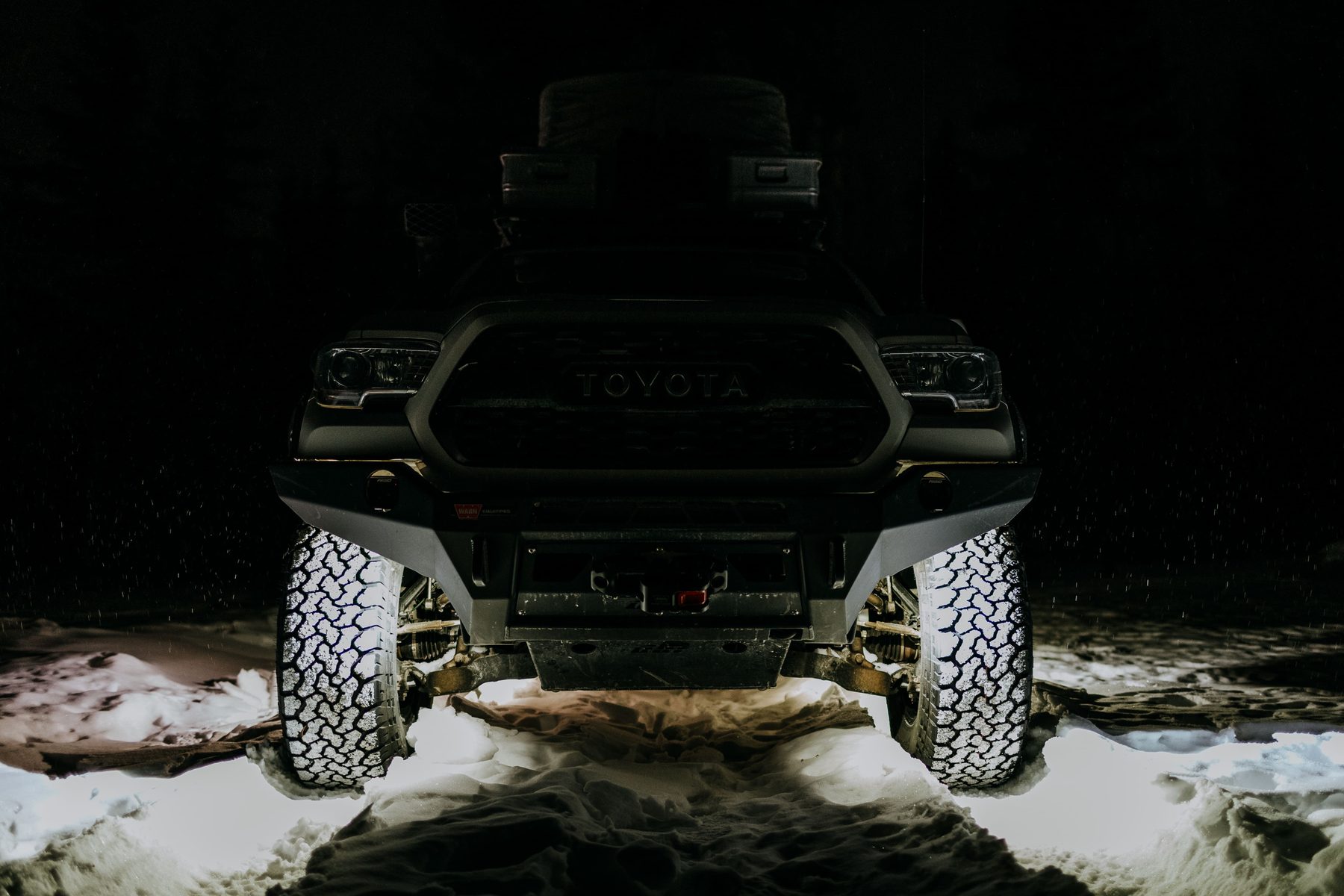
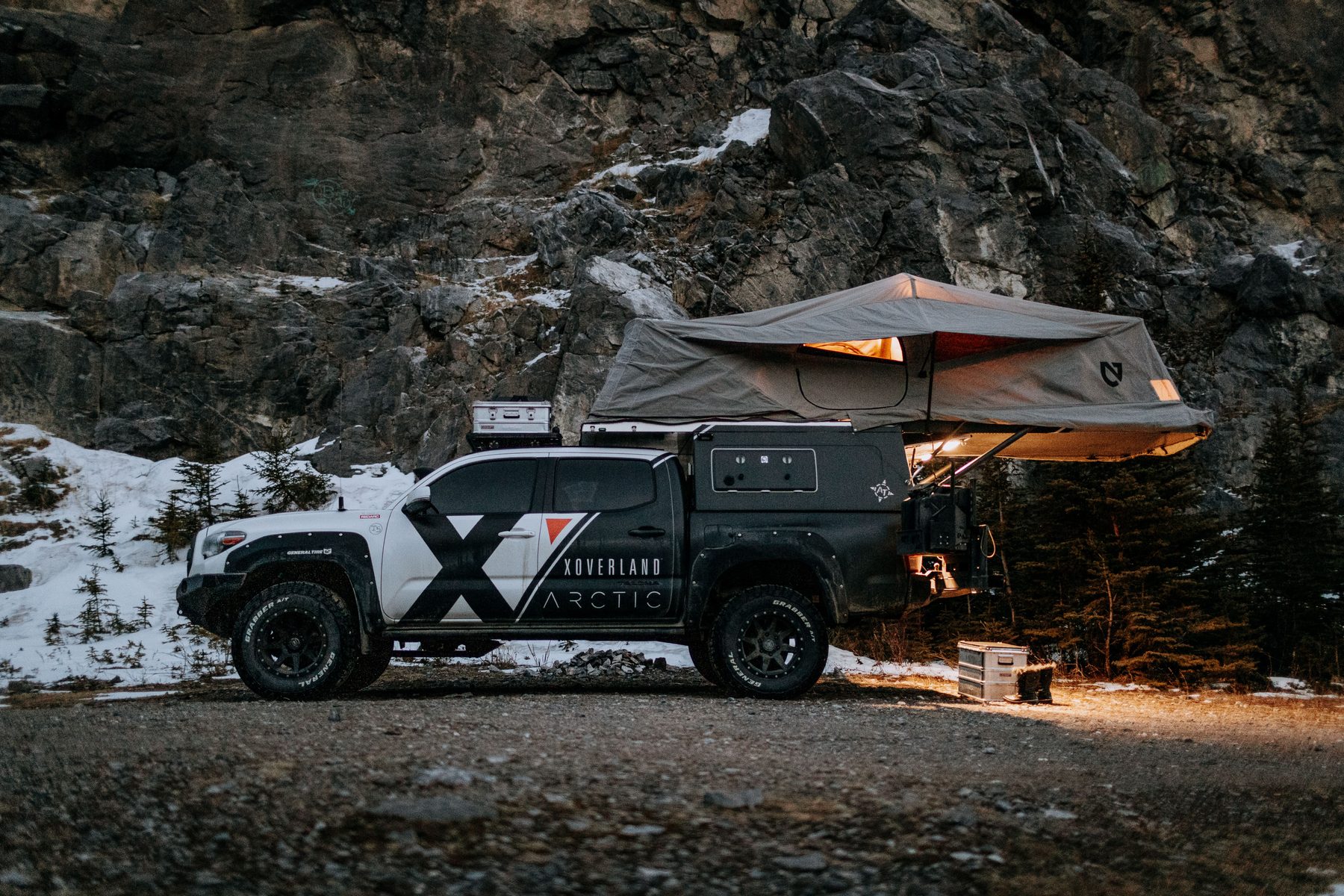
Expedition Overland has filmed long vehicle expeditions since 2010 and runs a fleet of Toyotas. Its lighting guide sorts lights the same way, by function: driving lights, utility lights and camp lights. The utility layer is rock lights, small lamps under the body aimed at the ground, and the team fits them to every truck: "These rock lights have worked so well we’ve outfitted every vehicle in our fleet with a set of six." The reason given is that "they draw hardly any power and they’re very versatile and durable."
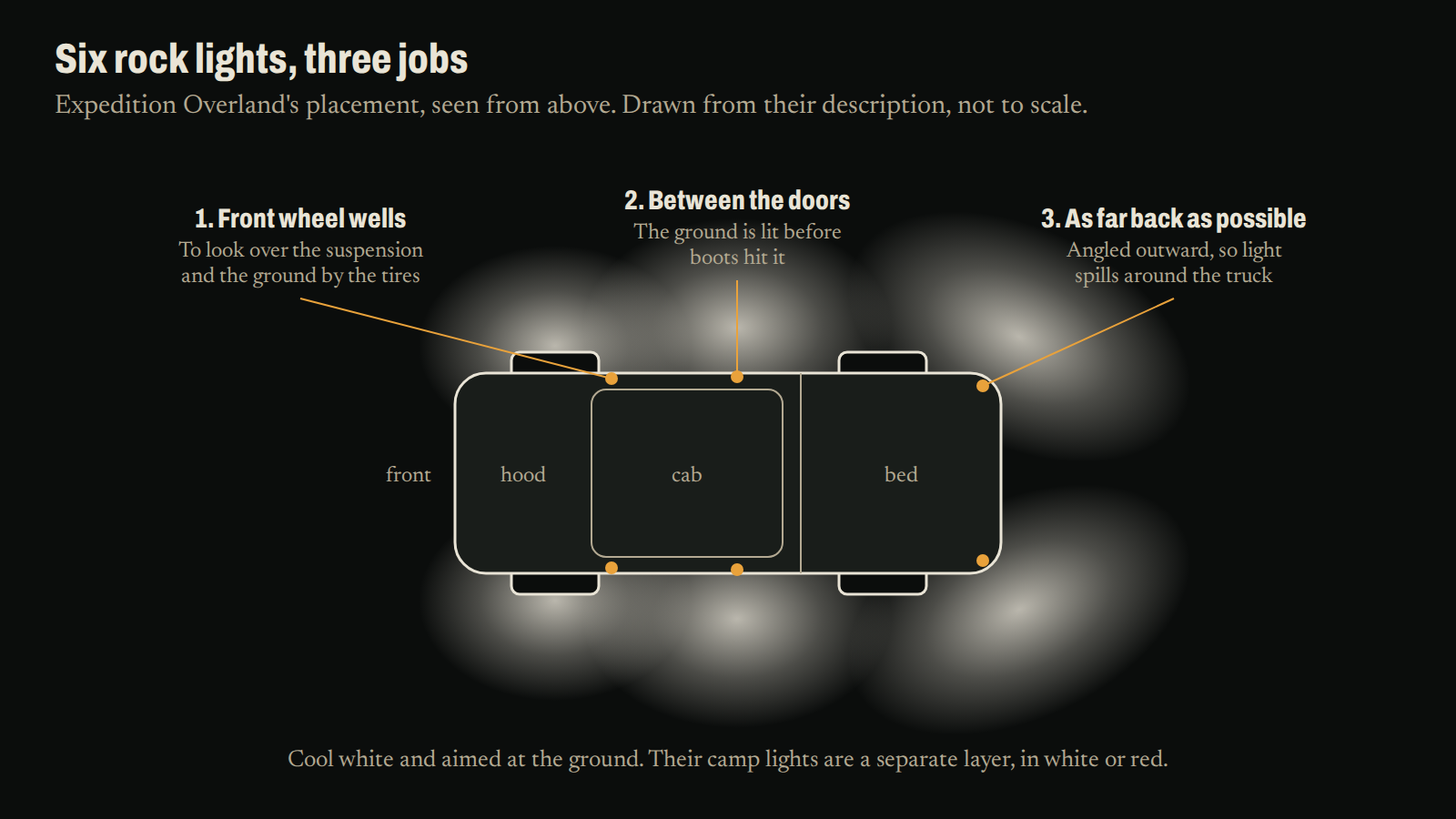
The six go on as three pairs, and each pair has a job. One pair sits in the front wheel wells. A second sits between the front and rear doors: "This is great for passengers exiting vehicles at night as the surrounding ground is lit before boots hit the ground." The third goes as far back as it can, turned out: "We try to angle them outward so that light spills around the truck, resulting in a 360-degree illuminated path that eliminates the need for a headlamp." Under the hood of each Toyota is a pair of small flush scene lights, chosen because their diffused glow lights an engine bay without shining in the eyes of the person working in it.
The camp layer is separate. In the camper the team uses National Luna touch lights, whose pad "offers different beam options, including low, medium and high white or red", with one white scene light on the outside of the camper for when more is wanted. The guide's advice for this layer is about colour: "Be sure to consider red and amber lights, as they keep a low camp profile (the military has used them for years) and do not attract bugs as bright white lights do."
Read together, that is a split by job. The lights under the truck are cool white, because they are for seeing the ground and the suspension clearly for a short time. Red is kept for the place people sit. That is our reading of what the team fits where, and the guide does not put it that way. The research below supports the same split.
How does a family that has lived on the road do it?
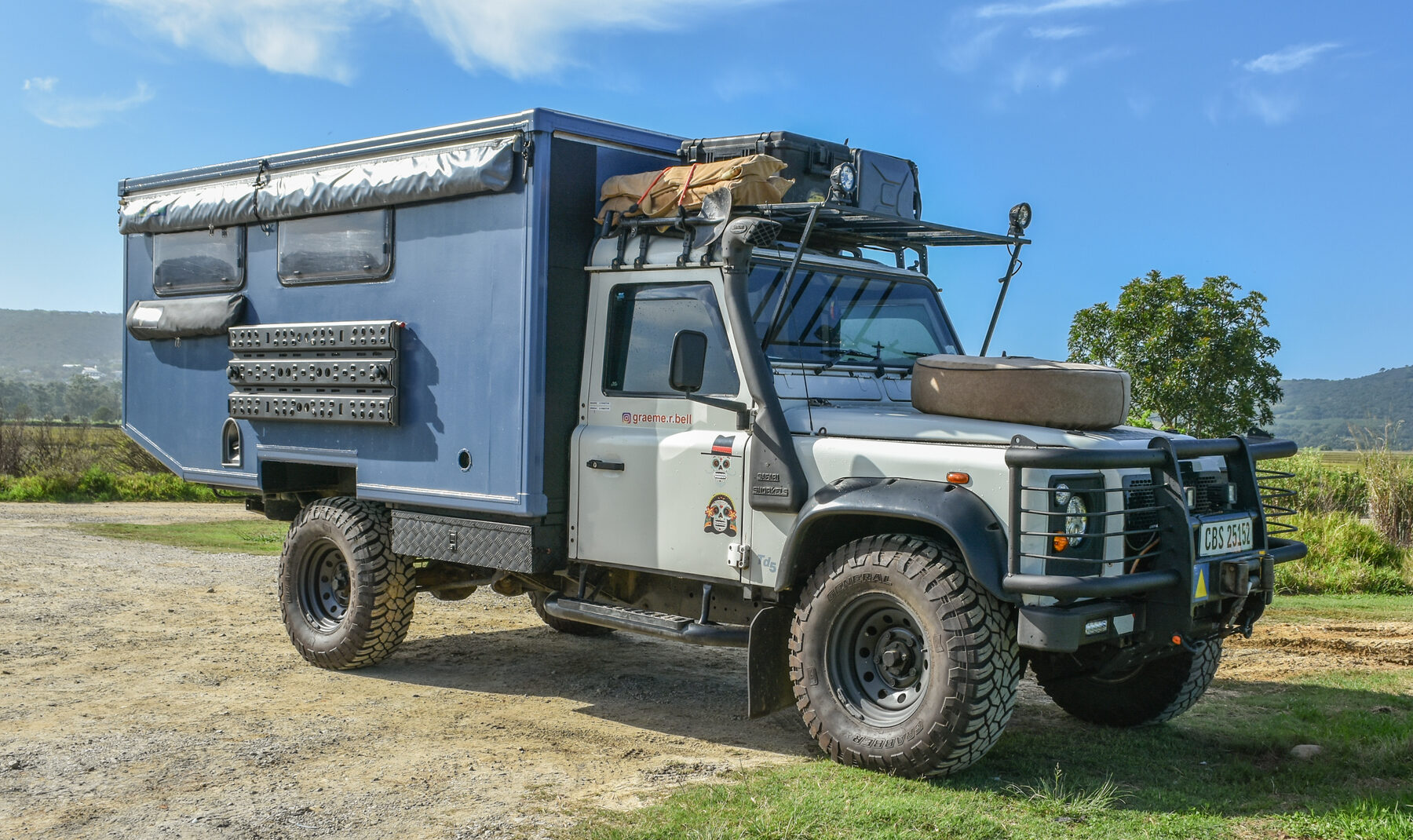
Differently, and with less fixed to the vehicle. Graeme and Luisa Bell have travelled for more than a decade in a Land Rover Defender 130, which we have written up for its electrical system. Their camp kit is string lights for a long stay, a magnetic light bar, head torches, and coloured lights under the vehicle that they call their pool lights, which they describe as "practical in places with scorpions or snakes".
Their rule is restraint: "Use only as much light as you need." Bright light has its place, for cooking, sorting gear or watching children, and "even then, keep them task-specific, angled downward, and shielded." The reason they give is other people. "Harsh white beams easily penetrate tent mesh, thin camper curtains, and RV window coverings."
They also have the story that makes the insect point better than a study does. Camped on a fuel station forecourt in Gabon, they watched a swarm gather round the station's security lights while the family sat in the camper with the windows open. Then the generator stalled. The camper's interior lights were now the only lights for some distance, and the swarm moved in through the windows. Insects go to the brightest thing around, and at a dark campsite that is you.
At a dark campsite, the brightest light for a mile is yours. Every insect that steers by light is steering by it.
What colour light attracts the fewest bugs?
Red, then amber, and both far fewer than white or blue. No colour attracts none. Many night-flying insects respond most strongly to ultraviolet, blue and green light and weakly to long wavelengths. A 2025 study set narrowband LED traps in Dutch forest and found ultraviolet drew the most insects, then blue, then green, with red drawing significantly fewer, though the pattern differed between insect groups. A 2026 study at German railway stations compared street lights of broadly equal output: amber LEDs at 1800 K caught 45 to 51 percent fewer insects than cool white LEDs at 4000 K.
Two findings in those papers apply most at a campsite. In the forest study, catches rose with brightness at every colour, and the authors concluded that the answer is "longer wavelengths of low light intensity". And at the stations, every lit lamp, amber included, caught significantly more than no lamp. So a dim red or amber light is the best case, a bright amber one gives much of the benefit back, and the only light that attracts nothing is one that is off. Our page on rock lights goes through the same evidence for lamps under the truck.
Does red light save your night vision?
Dim red costs your eyes less than white does, and dimness is doing at least as much of the work as redness. Seeing in the dark depends on the rods, the retina's low-light cells, and they are slow to recover after bright light. The FAA's handbook for pilots puts it this way: "The rods can take approximately 30 minutes to fully adapt to darkness. A bright light, however, can completely destroy night adaptation". One look into a white work light and the half hour starts again.
Red helps because rods respond poorly to long wavelengths. Clinical tests of dark adaptation rely on this: a 2025 review describes red light at about 650 nanometres as one that "primarily stimulates cones", the daylight cells, while blue-green light near 500 nanometres is what reaches the rods. A deep red lamp lets the cones see the table while the rods go on adapting.
The same FAA chapter checks how far to take that. Its advice to flight crews is about intensity: keep flightdeck lighting "as low as possible", and to read a chart "use a dim white light flashlight". It does not tell pilots to use red. So the order is dim first, then red. A bright red lantern is still a bright light, and a low warm one will keep more of your night vision than a red one turned all the way up.
Warm white or cool white?
Warm for sitting, cool for working. Colour temperature, in kelvin, describes how blue a white light is: lower numbers are warmer and more amber, higher ones cooler and bluer. The Bells' working figures are 2200 to 3000 K for general camp light and 4000 to 5000 K for task light such as food preparation or mechanical work, or as they put it, "Cool white helps you see; warm white helps you relax".
The insect evidence lines up with that. The lamp that halved the catch at the railway stations was a very warm white, 1800 K, with little blue in it, and the one it was compared with was a 4000 K white of the kind most LED work lights use. If red is more than you want to sit under, the warmest white you can buy, turned down, gets much of the benefit.
How much power do camp lights use?
Very little, which makes power the wrong thing to choose a camp light by. The two-colour touch light Expedition Overland uses is listed with these figures at 12 volts.
| Setting | Light | Current | Five-hour evening |
|---|---|---|---|
| White, high | 547 lumens | 0.39 A | 1.95 Ah |
| White, medium | 284 lumens | 0.20 A | 1.0 Ah |
| White, low | 75 lumens | 0.05 A | 0.25 Ah |
| Red, high | 99 lumens | 0.196 A | 0.98 Ah |
| Red, low | 15 lumens | 0.026 A | 0.13 Ah |
Against a 100 amp-hour house battery, the brightest setting for a whole evening is about two percent. A fridge uses many times that in a day. The table also shows that red is not the efficient choice: at the same current, the red setting gives about a third of the light of the white one. You choose red for what it does to insects and eyes, and it costs nothing worth counting either way.
Rock lights are the larger draw because there are more of them and they tend to be left on. Our rock lights page works one example through: six lamps rated at 0.4 amps each, on all night, use about 19 amp-hours.
How do you keep your light in your own camp?
Aim it down, shield it, and switch it off when the task ends. The Bells' three tests for a camp light are that it "stays within your own site, does not spill out, and is gentle on the surrounding environment and fellow campers". In practice that means lamps mounted above head height should point at the ground and not out across the site, a light bar or a roof-mounted scene light is for setting up and packing and not for the evening, and interior lights count too: "Interior lights often spill outward for convenience, but they also attract insects."
This is where low-mounted light earns its place. A lamp at knee height or under the vehicle lights the ground you walk on and nobody's eyes, yours included, which is the reason the under-truck lights on both of these very different rigs are the ones their owners keep using.
What goes wrong?
The wiring, more often than the lights. Every layer is another circuit, and Expedition Overland's guide says so about its own trucks: before the team moved to a single switch controller, "our wiring was horrendous and most of our lighting failures occurred due to poor wiring." The controller they use, an sPOD, lets them run "between six and eight different switches, condensed into a single line". The makers are friends of the team, by the guide's own account, and the guide gives no fuse, relay or wire sizes, so take it as a lesson about workmanship and not a wiring plan: a camp lit by three modest circuits that are fused and properly grounded will outlast one lit by eight that are not.
The guide's other warning is about cheap lamps, which it says fail early and "draw a lot of power, which could lead to a drained battery." For camp lights the figures above suggest the battery risk is small. The failure you will meet first is a corroded connector or a lamp that has let water in.
What we do not know
Nobody we found has counted insects at a camp lantern. One study used traps in a forest and the other street lights on poles, and the red or amber setting on a camp light is not the narrowband LED or the 1800 K lamp those studies tested. The direction is well supported; the size of the effect at your table is not known.
We have not read a study that measures how much dark adaptation people keep under a dim red lamp compared with a dim white one. The mechanism is established and the FAA's emphasis on dimness is clear, and the sentence that red light preserves night vision is repeated far more often than it is sourced. The lamp figures come from a retailer's copy of the maker's table. Expedition Overland's guide speaks for the company and names no author, and it does not show the camp lights themselves in any photograph, so the pictures here show the result.
Seen on
- Out of the roof tent: a family of four builds a hard-side pod onto their Defender 130Graeme and Luisa Bell and their two children lived out of a roof tent on a Land Rover Defender 130 for five years, camping about 330 nights a year. At the end of 2016 they cut everything behind the front doors off the truck and built a composite pod in its place, with a walk-through from the cab and a roof that lifts. The pod bought shelter. It also bought weight and body roll, and the decisions they made against those are the part worth copying.
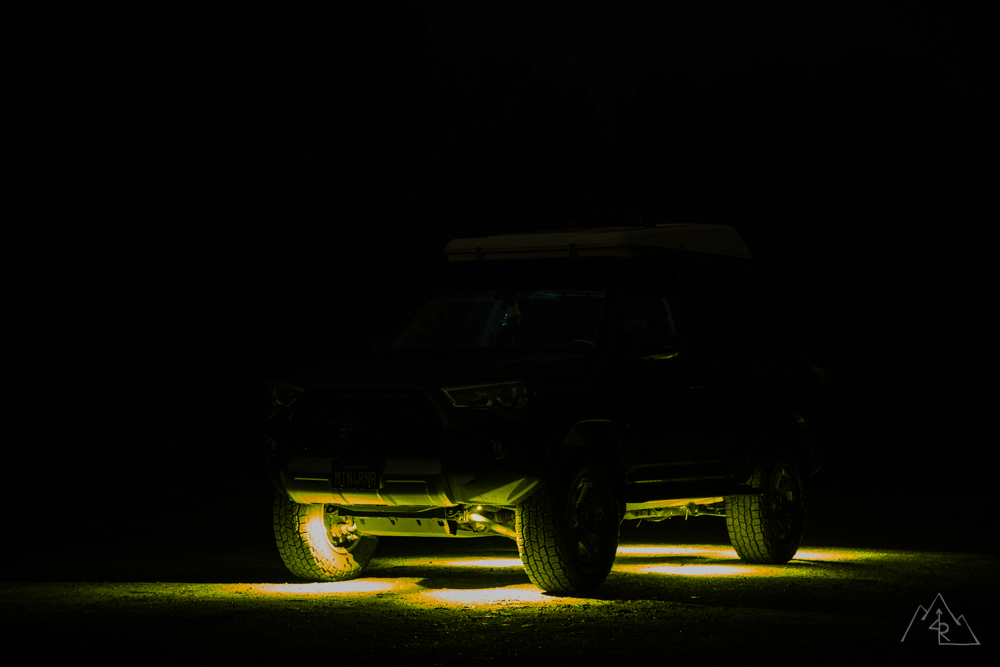
- Light where your feet are: Max Sheehan's six amber rock lightsMost rock-light installs are sold on crawling. Max Sheehan wrote his up as camp lighting first: six amber lights under a 4Runner, pointed at the ground, so there is light where people walk and none in their eyes. He put down why each choice was made, from the colour to a bracket stuck on with tape so it would let go before the light broke.
Also in the field guide
Sources
- Exterior Lighting for Your Overland Vehicle, Expedition Overland, read 2026-11-25Published March 2021 and updated September 2025, under a company byline. The page calls the owners of sPOD, whose switch controller it recommends, good friends, and the lighting makers it names sponsor the show.
- Light It Up by Graeme Bell and Luisa Bell, Expedition Portal, read 2026-11-25February 2026. The site refuses a plain fetch and opens in a browser.
- Pilot's Handbook of Aeronautical Knowledge, chapter 17, Aeromedical Factors, Federal Aviation Administration, FAA-H-8083-25, read 2026-11-25The sections on dark adaptation and night vision protection. Written for pilots, and the eye is the same one.
- Dark Adaptometry as a Diagnostic Tool in Retinal Diseases: Mechanisms and Clinical Utility by Bakdalieh, Khawaja and Yu, Journal of Clinical Medicine 14(11):3742, 2025, read 2026-10-13A clinical review, open access. It supports the mechanism: which cells recover slowly and which wavelengths reach them. It does not test camp lights.
- Intensity and colour of artificial light at night affect insect attraction in a taxon-dependent manner by Charvalakis, Stavenga, Visser, Spoelstra and Hut, Insect Conservation and Diversity, 2025, read 2026-10-13Peer-reviewed, open access. Narrowband LED traps in Dutch forest; amber was not among the colours tested.
- Optimised light sources reduce nocturnal insect attraction at railway stations by Carmen Ludreschl, Christoph Scherber and colleagues, Biological Conservation 321 (2026) 111964, read 2026-10-13Peer-reviewed, open access under CC BY. Street lights on station platforms over two seasons, compared at broadly equal output.
- National Luna 18+12 LED touch light, clear and red, Vivid Racing, a retailer reproducing National Luna's table, read 2026-10-13The lumen and current figures for the two-colour touch light. National Luna's own page for the lamp returned an error, so the maker's sheet is unread.