
Do you need a dual battery system?
By Chad Sig · Published
The short answer
You need a dual battery system if you run a fridge, or anything else for hours, with the engine off. A starter battery is built for a short, heavy burst to crank the engine and wears out quickly when it is drained deeply, and if it goes flat at camp you cannot drive anywhere. A second, deep-cycle house battery takes those loads, and the starter battery is kept separate so it is always ready. If all you run is a few LED lights and phone chargers, one healthy battery is often enough, and a single lithium dual-purpose battery is now a real alternative for a fridge. To charge the second battery, an isolator works with an older fixed-voltage alternator; a vehicle with a smart, variable-voltage alternator, or a lithium house battery, needs a DC-DC charger.
What does a second battery protect?
The battery that starts your truck. A starter battery is designed, in Battery University's words, "to crank an engine with a momentary high-power load lasting a second or so", and then be recharged straight away by the alternator. It is built with many thin plates for power rather than capacity, and "does not allow deep cycling." A fridge running all night does exactly that.
| How far you drain it | Starter battery | Deep-cycle battery |
|---|---|---|
| 100% (flat) | 12 to 15 cycles | 150 to 200 cycles |
| 50% | 100 to 120 cycles | 400 to 500 cycles |
| 30% | 130 to 150 cycles | 1,000 and more |
Drained halfway every night, a starter battery is worn out in about four months of camping. A deep-cycle battery of the same chemistry lasts roughly four times as long doing the same job. A dual battery system puts the camp loads on the deep-cycle battery and keeps the starter battery out of it, so the worst a cold night can do is flatten the fridge's battery, not strand you.
Can you get by with one battery?
Often, yes. Take The Truck, who run a truck-camping site, put the line plainly: if you need no more than "a few LED lights, charging your phone(s), and the occasional laptop", your existing starting battery may be enough. A fridge and a vent fan were what pushed them to a second battery.
Two things now make one battery go further. Many 12 volt fridges have a low-voltage cut-off that switches the fridge off before it drains the battery too far to start the engine; the Bells' Snomaster on their Defender 130 has one, with a remote that shows the battery's voltage. And lithium dual-purpose batteries, built both to crank an engine and to be cycled deeply, have arrived as a drop-in replacement for the starter battery. Take The Truck's 2025 update calls them "a viable alternative to dual battery systems" for a fridge and a fan, and they have used one in their own truck for three years.
Isolator or DC-DC charger?
It depends on your alternator. A battery isolator is a switch: when the engine runs, it connects the second battery to the alternator so both charge; when the engine stops, it disconnects them so the camp loads cannot drain the starter. That works when the alternator holds a steady voltage, which REDARC puts at "usually anywhere from mid 13V to low 14V" for a fixed-voltage alternator.
Newer vehicles often have a smart alternator, controlled by the engine computer, that lowers its voltage or switches off when the starter battery does not need it, to save fuel and cut emissions. Victron's manual describes them as delivering "a variable output voltage" and being "shut down when they're not needed." A second battery fed through an isolator from one of these may never fully charge. REDARC's rule: "Vehicles with variable voltage from smart alternators must use a DC-to-DC charger". They add that vehicles newer than 2015 are more likely to have one, and some older ones do too.
A DC-DC charger takes whatever the alternator gives and turns it into a proper charge for the house battery, in the stages that battery wants. It also suits a lithium house battery, which Take The Truck notes typically needs one in place of an isolator to charge safely at a controlled current, usually 20 to 60 amps. Good ones detect when the engine is running, so they do not drain the starter battery when the alternator stops.
| Your vehicle and battery | What to charge it with |
|---|---|
| Fixed-voltage alternator, lead-acid house battery | An isolator works; a DC-DC charger charges more fully |
| Smart, variable-voltage alternator | A DC-DC charger |
| Lithium house battery, any alternator | A DC-DC charger |
What do solar and shore power add?
Charge when the engine is off. The alternator only charges while you drive, so if you camp for days without moving, the house battery runs down however big it is. A solar panel tops it up during the day. Take The Truck found a 100 watt panel usually offset their fridge's use while stationary. Shore power charges it from a mains hookup at a campsite or a house.
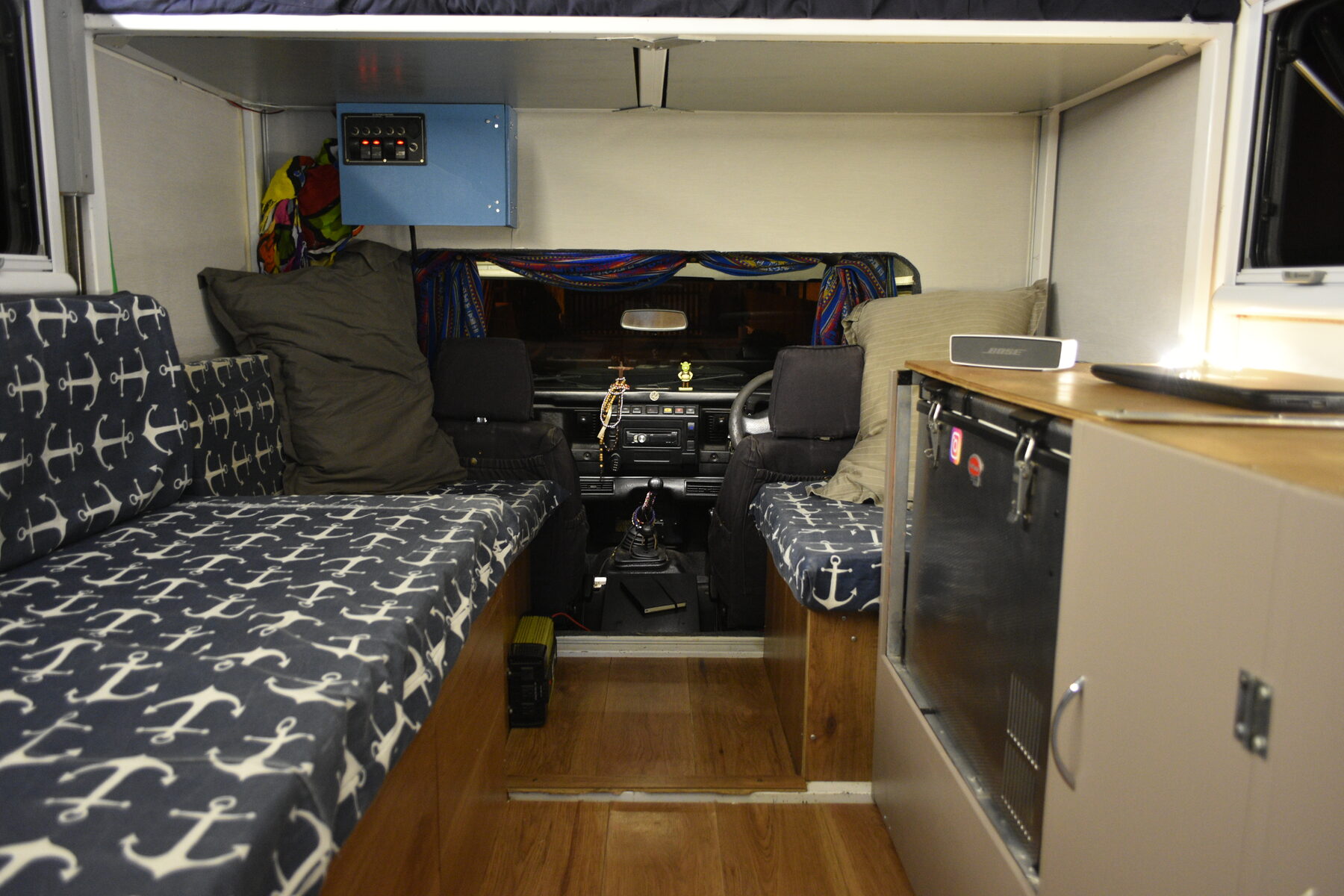
Graeme and Luisa Bell, who live and work full time with their two children in a Defender 130, named all three in one sentence when they planned their camper: "a solar system which would be complimented by a dual battery with split charging system and a trickle charge option from shore power." Driving, parked in the sun, and parked at a socket are three different situations, and a household that never goes home needs to charge in all of them.
How big should the house battery be?
Add up a day. For each device, multiply the amps it draws by the hours it runs; the sum is the amp-hours you use in a day. Fridges cycle on and off, so use the maker's daily consumption figure if it gives one. Then size the battery so a day's use stays within what it can give without harm: on lead-acid, the table above is the argument for using no more than about half its rated capacity. Add days without charging if you camp without driving or sun.
Capacity has a weight. Batteries are heavy, and a large bank counts against payload like everything else. OVR's Land Cruiser 100 carries two 150Ah lithium batteries inside the cabin; Kristen Bor's second Sprinter van sagged at the rear partly because of a heavy battery bank in the garage over the rear axle.
How do the builds on this site do it?
| Build | House battery | Charging | Runs |
|---|---|---|---|
| a2a Expedition, Defender 130 | A second battery; type and size not published | Split charging from the alternator, solar, and shore power | A 60 litre fridge with a low-voltage cut-off; the rest not itemised |
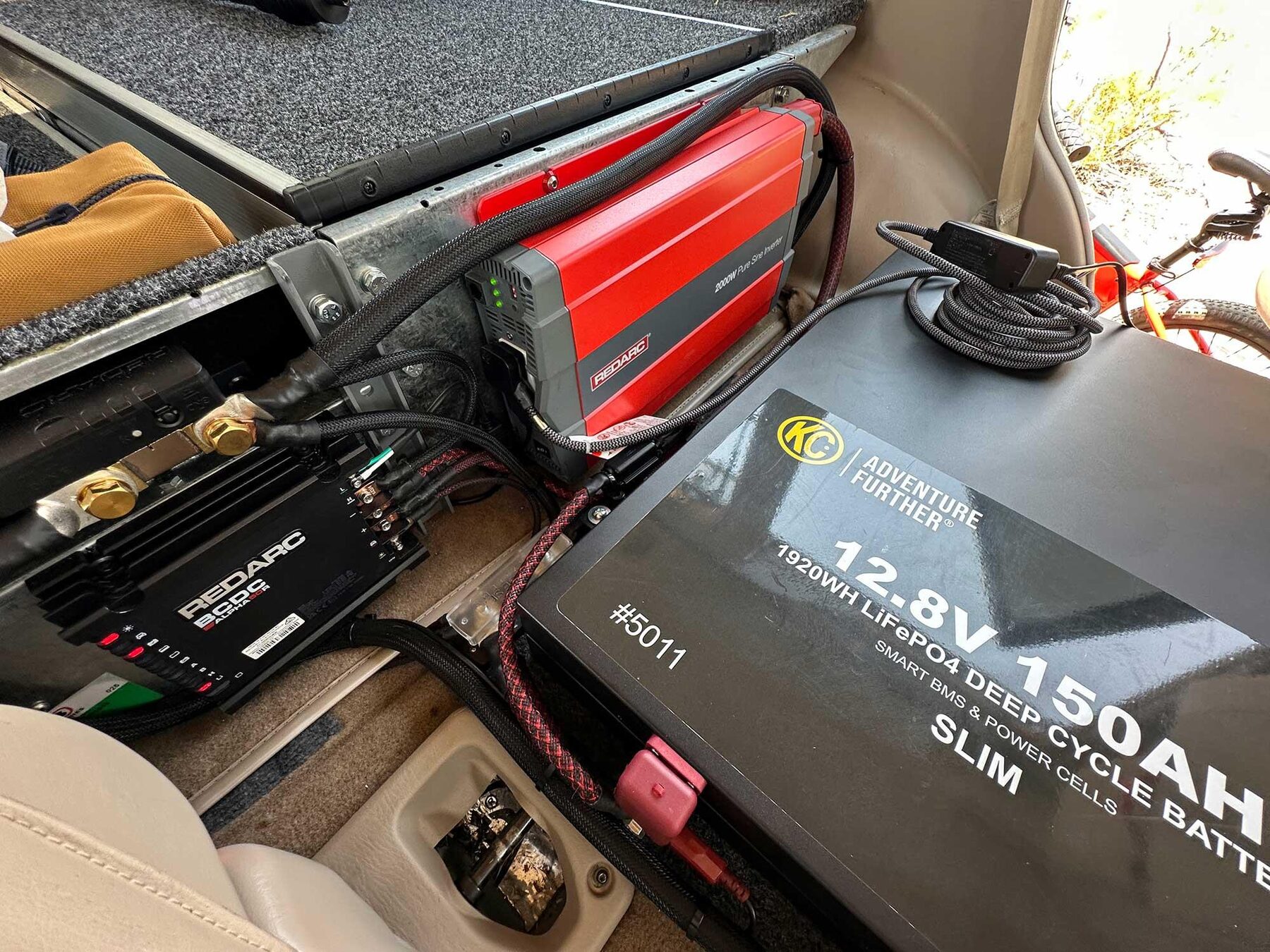
| OVR Land Cruiser 100 | Two 150Ah KC lithium inside, plus the original dual AGM | REDARC BCDC Alpha50 R 50A DC-DC for the lithium; a BCDC 25A for the AGM | Fridge, Starlink, e-bikes and a 2000W inverter; the AGM runs exterior lights and the compressor |
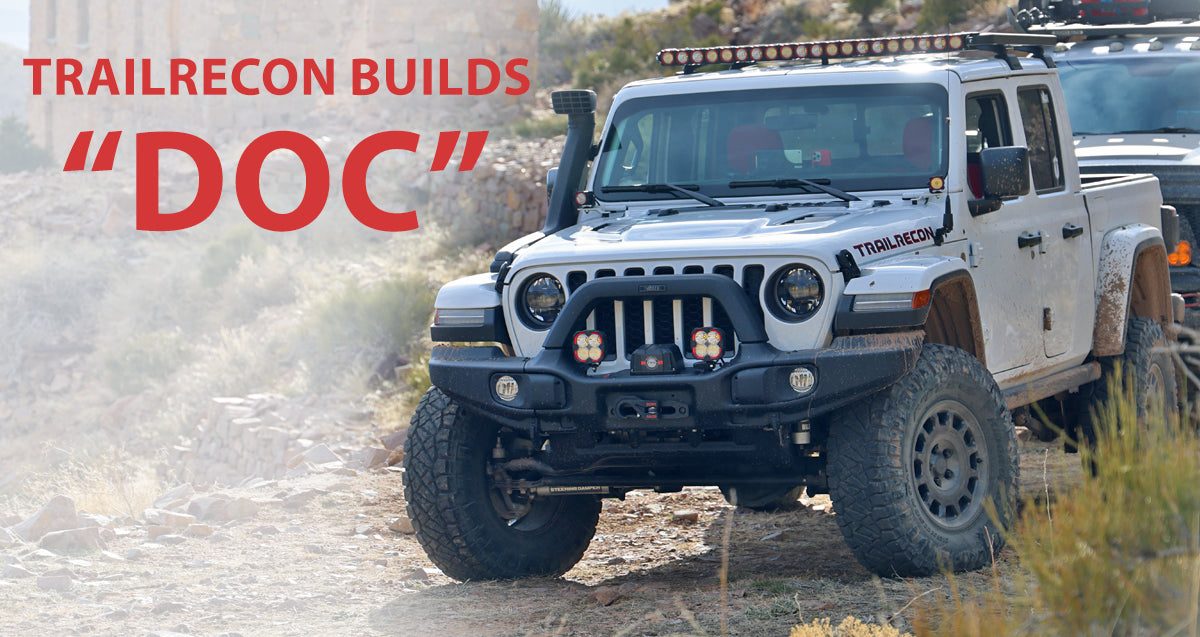
| Trail Recon Gladiator | REDARC Alpha150, 150Ah lithium | REDARC dual-input 50A DC-DC charger | Not itemised on the parts list |
| Take The Truck, current truck | None: one lithium dual-purpose battery | The vehicle's own alternator | A 12 volt fridge and a vent fan |
The Land Cruiser shows the most common path. Its first setup, a dual AGM system, "worked fine for short trips" but ran out once a fridge, Starlink, camera gear and e-bike charging all drew from it. Rather than replace it, OVR kept it for the exterior loads and added a lithium bank inside for the rest. Load decides the system, and loads grow.
Seen on
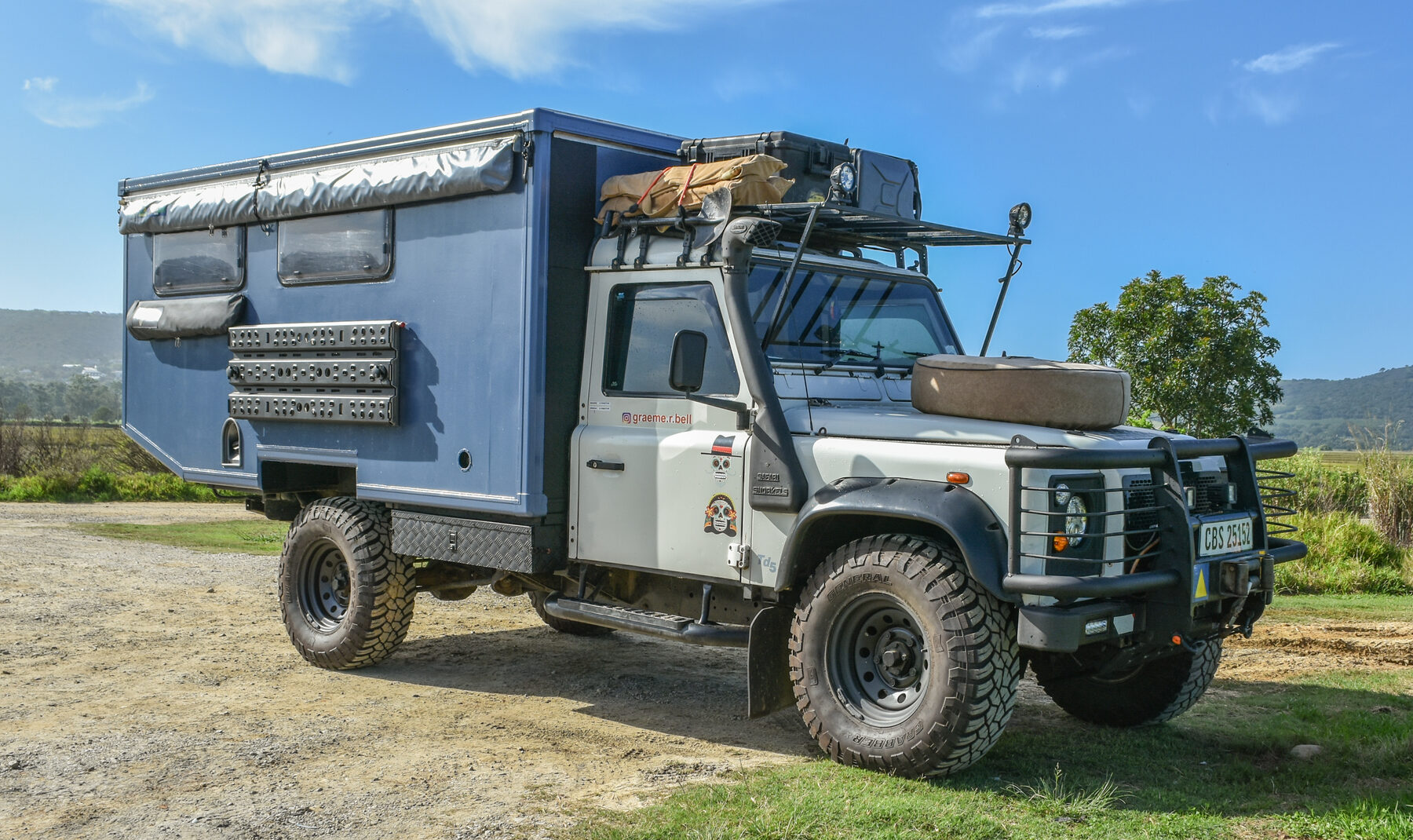
- Out of the roof tent: a family of four builds a hard-side pod onto their Defender 130Graeme and Luisa Bell and their two children lived out of a roof tent on a Land Rover Defender 130 for five years, camping about 330 nights a year. At the end of 2016 they cut everything behind the front doors off the truck and built a composite pod in its place, with a walk-through from the cab and a roof that lifts. The pod bought shelter. It also bought weight and body roll, and the decisions they made against those are the part worth copying.
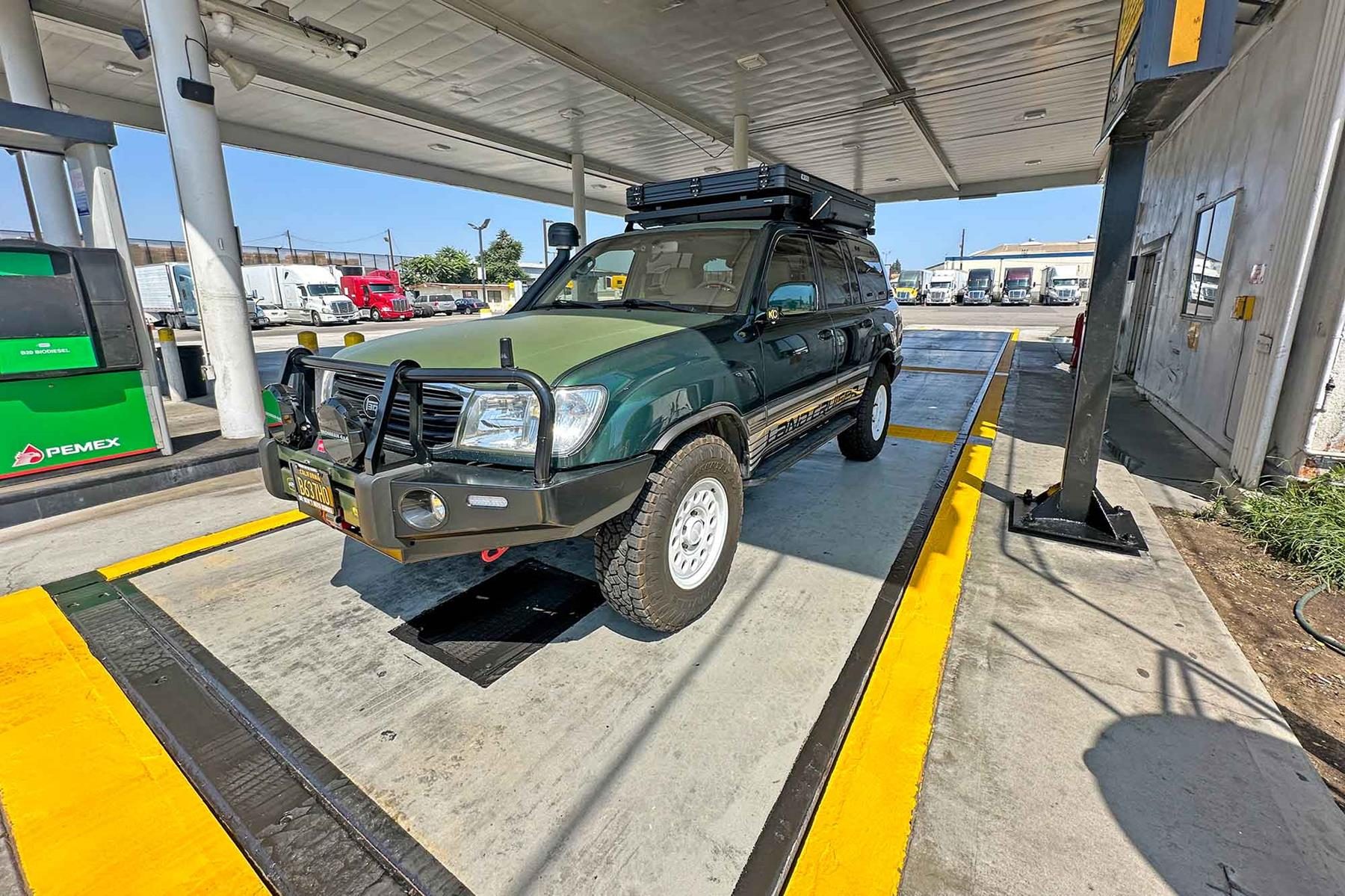
- The truck that got weighed, twiceA 300,000-mile Land Cruiser under $15,000, a 150 lb tent on the roof, and two public scale tickets eleven months apart showing it over its weight rating both times. What makes this build worth reading is the response: not a stiffer spring, but taking the weight back out.
- The truck built around the worst dayAlmost every overland build is organised around getting somewhere. Brad Kowitz spent 26 years as a Navy corpsman and built a Gladiator organised around what happens after you arrive at a bad scene. Fifteen months later he published a video saying he had it backwards.
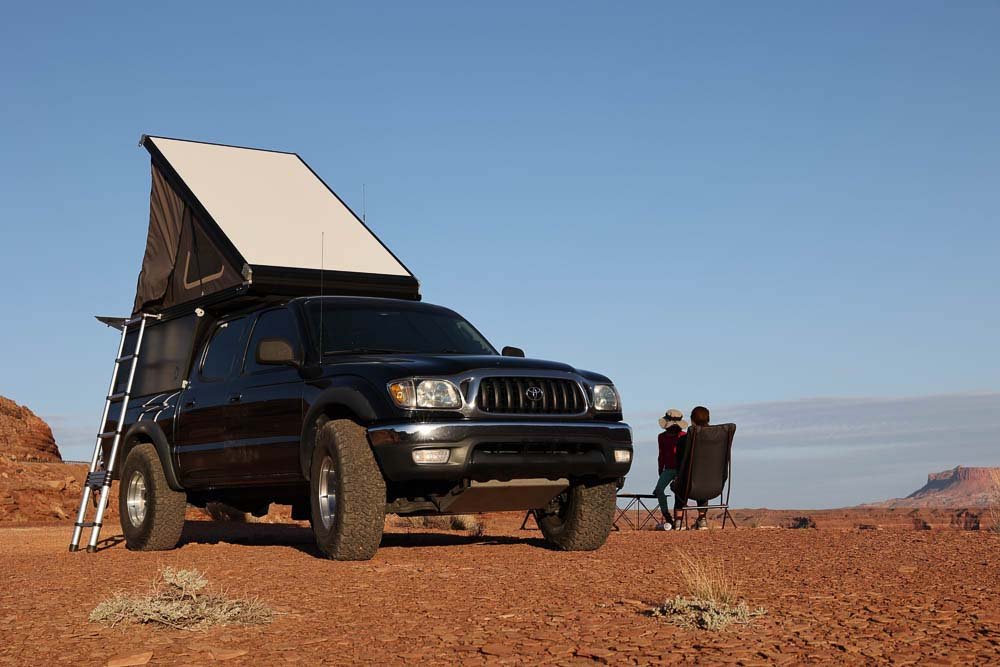
- The lights that stayed lowPatrick of Take The Truck had a free, easy place to mount a pair of Baja Designs LP9 Pros, high on the front of his camper. He turned it down over glare in bad weather and spent an afternoon making brackets instead. A first-generation Tacoma built by someone who writes down what his decisions cost.
Also in the field guide
Terms on this page
Sources
- BU-201: How does the Lead Acid Battery Work?, Battery University (Cadex Electronics), read 2026-10-12An educational site run by a battery test-equipment maker, not a standard. Table 3 gives typical cycle life of starter and deep-cycle lead-acid batteries by depth of discharge.
- BCDC v DCDC dual battery chargers, REDARC Electronics, read 2026-10-12A maker's explainer, and REDARC sells DC-DC chargers. Used for the fixed-alternator voltage range and the smart-alternator rule, which Victron states independently.
- Orion-Tr Smart DC-DC Charger Isolated: features, Victron Energy, read 2026-10-12Manufacturer's manual. Smart alternators and engine-running detection.
- How to Choose The Best Dual Battery Setup, Take The Truck, read 2026-10-12First published 2019, with 2024 and 2025 updates on a single lithium dual-purpose battery. Carries affiliate links.
- The Rebuild by Graeme Bell, a2a Expedition, read 2026-10-12
- Snomaster by Graeme Bell, a2a Expedition, read 2026-10-12The fridge was supplied by SnoMaster USA, as the page says.
- How a Rear Platform and Electrical Power Upgrade Transformed Our Land Cruiser by Jerry Tsai, OVR, read 2026-10-12The two KC lithium batteries are unreleased prototypes supplied for testing, which the article discloses. OVR reviews products from companies that advertise with it.
- 2023 Jeep Gladiator JT Overland Build: Doc, Trail Recon, read 2026-10-12A parts list. Names the battery and charger, not the reasoning.