Spot beam or flood beam: which off-road light do you need?
By Chad Sig · Published
The short answer
Pick by the job, not the output. A spot beam concentrates light into a narrow cone for distance, which is what you want when you are moving fast enough to outrun your headlights; KC calls it tighter, more focused light that prioritizes distance, for higher speeds or remote areas. A flood beam opens the same light into a wide, close pattern for a stopped vehicle, and KC's own description of it is a list of jobs rather than distances: work, scene, camp or back-up lights, to see a broader area with a shorter distance. Brightness does not decide between them, because the same lumens produce either one: a single KC Flex Era 4 is 7,912 lumens and 80 watts on both of its lenses, and only the shape in front of the emitter changes. That is why a build that needs both buys both and wires them apart, and why the answer to which light do I need is usually more than one light on more than one switch.
What is the actual difference between a spot and a flood?
Where the light goes, and nothing else. An LED emits a quantity of light measured in lumens, and the optic in front of it decides whether that quantity is packed into a narrow cone or spread across a wide one. Concentrate it and you get intensity in one direction, measured in candela, which is what buys distance. Spread it and you get coverage close in. Nothing is created either way, which is why a spot and a flood built on the same emitter can carry an identical lumen figure and be useless at each other's jobs.
KC HiLiTES prints a beam-pattern guide at the foot of its product pages, and it names seven patterns that split cleanly in two. Four describe an optic: a spot is tighter, more focused light that prioritizes distance, for higher speeds or remote areas; a flood is typically used as work, scene, camp or back-up lights to see a broader area with a shorter distance; a spread prioritises peripheral visibility for off-road driving; and a combo combines different optics to create a balance of distance and width, such as with light-bars. The other three lean on the road-lighting categories instead: driving, fog, and a wide-40 that KC calls a hybrid of the two.
Does a brighter light reach further?
Not reliably, and one product proves it better than any argument. KC's Flex Era 4 ships pre-assembled with a combo lens and includes spot lenses in the box, so the specification table describes one light in two configurations. The lumens do not move: 7,912 per light either way, at 80 watts and 6.67 amps. What moves is the shape, and with it the published reach, from 324 m on the combo lens to 591 m on the spot.
Same emitter, same 7,912 lumens, same 80 watts. Change the piece of plastic in front of it and the maker's claimed reach grows by 267 metres.
So lumens tell you what a light costs to run, not how far it sees. The figure that tracks distance is candela, the intensity in the direction you care about, and it is the number to compare when two lights are being sold against each other. A shopper comparing lumens is comparing electricity bills.
Which pattern do you actually need?
Start from your speed and your stopping distance, because a forward light is only useful if it reaches past the point where you could still stop. Fast open desert or gravel at night is the case a spot exists for. Slow technical ground, where the thing you need to see is the rock under the front tire and the edge of the trail, is the case for width, and a spot mounted for that job lights a bright circle a hundred metres past the problem.
Then ask a separate question about the stopped vehicle, because that is a different lamp and most first-time buyers discover it late. Cooking, fixing a puncture, rigging a winch and finding gear all happen within a few metres of the truck, off to the side or behind it, and no forward-facing light points at any of them. This is the work that flood pods and rear-facing scene lighting exist for, and it is why a light bar alone leaves people standing in their own shadow.
The reason this reads as an upsell and is not one is that the jobs are mutually exclusive rather than merely different. A spot aimed at a campsite blinds everyone in it. A flood switched on at speed lights the hood, the dust and nothing you are about to hit. Neither is a compromise the other can absorb, so the build that needs both ends up carrying both.
Why are off-road lights on separate switches?
Because the patterns are wanted at opposite times, and because the current draw is not comparable between them. A pair of Flex Era 4 pods pulls 13.3 amps. A pair of KC's Cyclone V2 pods, 5 watts and 600 raw lumens each, pulls 0.84 amps for the two. That is a sixteenth of the current for something near a thirteenth of the light, and the light half of that comparison is rough because KC rates the small one in raw lumens and the big one without that qualifier. A stationary vehicle running off its battery cares about the current for hours at a time.
So the switch panel is where the reasoning becomes visible. Grouping lights by job means the driving layer comes on together when the truck is moving and goes off together when it stops, and the work layer does the reverse. A single switch feeding everything forces the choice the patterns were bought to avoid, and it is the arrangement most people build by accident by adding one light at a time.
There is a legal edge to keep on the right side of, too. Federal rules for commercial motor vehicles permit auxiliary driving lamps and front fog lamps for use in conjunction with, but not in lieu of the required headlamps, and require the driving lamps to meet SAE J581. Those rules bind a bus, truck or truck tractor rather than a private pickup, which answers to its own state code instead. The shape of the federal requirement is still the useful part: an auxiliary lamp supplements the headlights rather than replacing them, and it has to be aimed and to stay aimed. Wiring the high-output ones so they cannot be left on by mistake is the practical half of that.
Where does amber fit, and should you call it yellow?
Amber is a lens choice rather than a pattern, and it is a separate decision from spot against flood. KC sells its Performance Yellow lenses across the same product families as the clear ones, so the same housing can be a yellow spot or a clear combo. The case for yellow is airborne particulate, and our page on ditch lights works through what the evidence does and does not support, because the effect is real but smaller and more conditional than the marketing suggests.
On the vocabulary: the two words are the same colour. Amber is the term the standards and the light makers use, yellow is the term buyers use, and it is not close. In Google Keyword Planner, yellow fog lights runs 2,900 searches a month against 1,300 for amber fog lights, and on the like-for-like comparison query it is 590 against 140. If you are searching for parts, search yellow.
Worked example: four lighting systems on one Gladiator
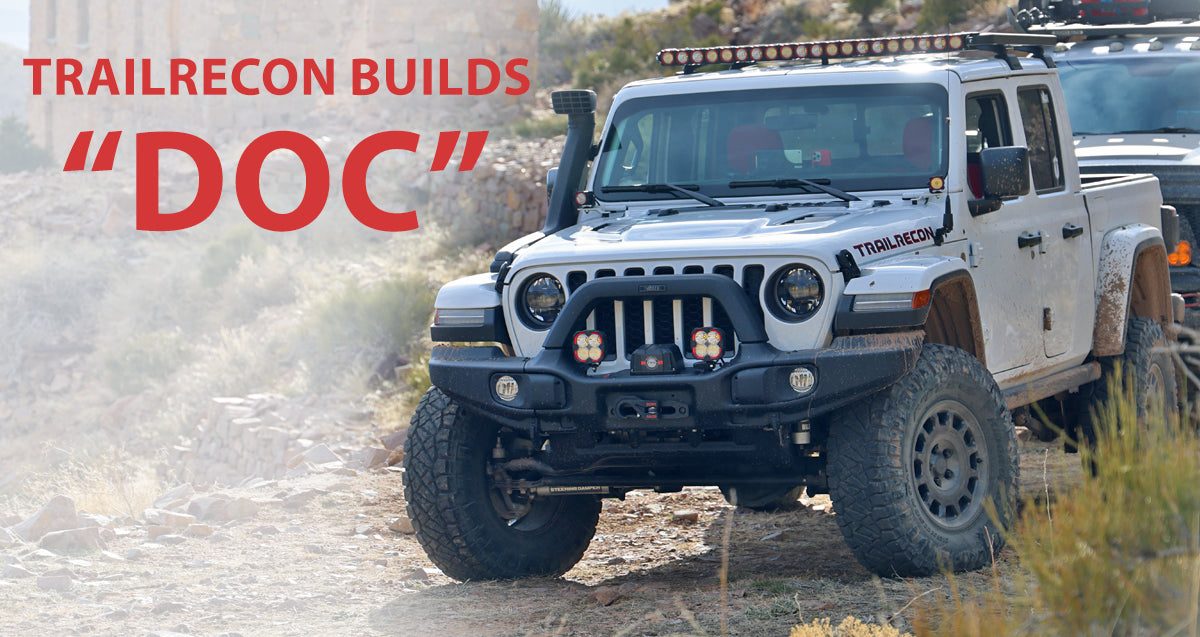
TrailRecon's Jeep Gladiator, called Doc, carries four separate KC systems on an eight-circuit sPOD BantamX, and the four sit at opposite ends of KC's own catalogue. A 50 inch Flex Era light bar and Flex Era 4 pods are the distance layer. Flex Era 1 pods, a series KC sells in flood, spot and spread and builds dedicated backup kits from, are the middle. Amber Cyclone V2s are the smallest thing KC makes: 5 watts, and 600 raw lumens each in the clear version, which is the only one KC publishes an output figure for. It sells amber as a replacement lens and gives no figure for it, so the amber pair on Doc makes somewhat less light than that.
The Cyclones are the instructive ones, because Kowitz files them in his own video description under the heading Underhood Lights, and KC lists their mount location as the hood. They are not there to light the trail. They are there to light an engine bay at arm's length, and they draw little enough to run on a stopped truck for as long as the job takes. The largest light on the truck is sold on a reach measured in hundreds of metres and the smallest on the width of an engine bay, and both are lighting equipment on the same vehicle.
That spread is the argument of this page in one parts list. What it is not is Kowitz's stated reasoning: nothing he has published in writing explains the split, and we have not reviewed the spoken content of his install videos, so the reading is ours. Our note on that build works through what the truck is organised around, and what its builder changed his mind about fifteen months later.
What we do not know
The one number this page most wants does not exist in public: an independent photometric measurement of any of these lights. Every candela, lumen and metre quoted here is the manufacturer's own, published by the company selling the light, and there is no equivalent of a standards body checking them for off-road lamps. That is exactly why the beam-distance arithmetic above does not reconcile, and we cannot say which of KC's two columns is the one to trust.
There is also no photometric standard for a work or scene light on a road vehicle at all. Driving lamps answer to SAE J581 and fog lamps to J583, and we could find no equivalent governing a scene light. That absence is the reason a work light has no aim specification and no cutoff, and it is why the only thing deciding where yours points is you.
Seen on
Also in the field guide
Sources
- Cyclone V2 LED, 2-Light Universal Under Hood Lighting System, 5W Flood Beam, KC HiLiTES, read 2026-08-27Carries both the light's specification table and the beam-pattern guide KC prints at the foot of its product pages, which is the source for every pattern definition quoted here. KC's site refuses automated retrieval behind a bot check, in a browser as well as to plain fetch, so this was read through the Internet Archive's capture of 16 October 2025. KC sells every light named on this page.
- FLEX ERA 4, 2-Light Master LED Light Pod Kit, KC HiLiTES, read 2026-08-27Read through the Internet Archive's capture of 25 December 2025, for the same reason. The specification table gives both lenses' figures for one light, which is what makes the lens comparison on this page possible.
- KC FLEX ERA 1 Series, highly adaptable LED pod lights, KC HiLiTES, read 2026-08-27Read through the Internet Archive's capture of 8 October 2025. Used for the series' available beam patterns and the existence of dedicated backup kits in spread only.
- ANSI/NEMA FL 1-2009, Flashlight Basic Performance Standard, National Electrical Manufacturers Association, read 2026-08-27The standard that put beam distance on the box. The copy NEMA publishes free is front matter only, so it establishes that the standard defines and tests beam distance, and that its scope is hand-held lights, but it does not give the threshold in the standard's own words.
- The FL 1 standard: what each icon means, Portable Lights American Trade Organization (PLATO), read 2026-08-27Where the 0.25 lux figure used on this page actually comes from: the trade body that maintains the standard, in plain language, via the Internet Archive because the live page is password-protected. PLATO is an association of the companies making the lights, not a regulator. Its scope is portable lighting, so a vehicle lamp quoting a beam distance is borrowing a convention nothing binds it to.
- 49 CFR 393.24, Requirements for head lamps, auxiliary driving lamps and front fog lamps, US Code of Federal Regulations, via GovRegs, read 2026-08-27Part 393 is the Federal Motor Carrier Safety Administration's rulebook for commercial motor vehicles, so this section binds a bus, truck or truck tractor in interstate commerce and not a private pickup. Quoted here because it is the clearest federal statement of what a driving lamp is for; a private vehicle answers to its state's code instead.
- TrailRecon's 2023 Jeep Gladiator JT Overland Build, "Doc", TrailRecon, read 2026-08-27The parts list for the worked example. It is published on TrailRecon's own storefront, which retails most of the brands it lists, so it is a catalogue as much as a build sheet.
- I Need Your HELP with the Jeep Gladiator by Brad Kowitz, TrailRecon on YouTube, read 2026-08-27Published 23 December 2023. Cited only for its description's own link labels, where Kowitz files the Cyclones under "Underhood Lights", which is the builder naming the job rather than us inferring it. The spoken content is unreviewed: YouTube serves transcript text only to a signed-in session.