
Out of the roof tent: a family of four builds a hard-side pod onto their Defender 130
Graeme and Luisa Bell and their two children lived out of a roof tent on a Land Rover Defender 130 for five years, camping about 330 nights a year. At the end of 2016 they cut everything behind the front doors off the truck and built a composite pod in its place, with a walk-through from the cab and a roof that lifts. The pod bought shelter. It also bought weight and body roll, and the decisions they made against those are the part worth copying.
Built by Graeme Bell (a2a Expedition)
Owned by Luisa Bell (a2a Expedition)
By Chad Sig · Published
Land Rover Defender 130 double cab, 2003, Td5 2.5 litre five-cylinder turbodiesel. Everything behind the front seats replaced by a composite-panel pod on a welded steel subframe, with a pop-up roof, a walk-through to the cab and a large rear door. Bearmach heavy-duty springs, custom Cibex shocks and Air Lift rear air bags.
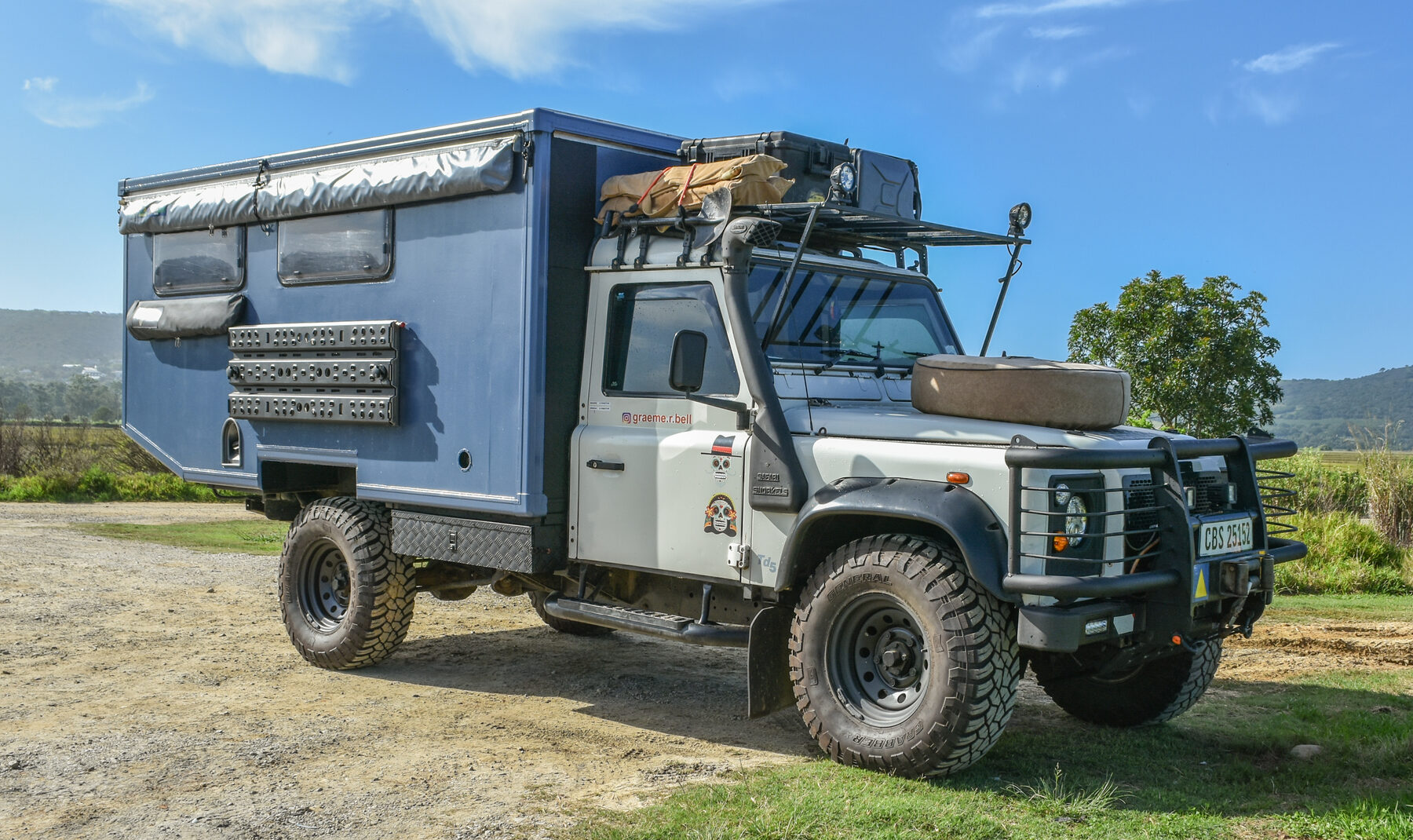
What it is designed for
Four people living aboard
A bed for each person, seats for the children inside a steel frame, and a kitchen and fridge used daily.
Shelter in any weather
The reason for the rebuild. A tent leaves a family outside in heat, cold and sandstorms; the pod does not.
Going where a Defender goes
A pod rather than a larger truck, sized to fit a high-cube shipping container and narrow village streets.
What it gets right
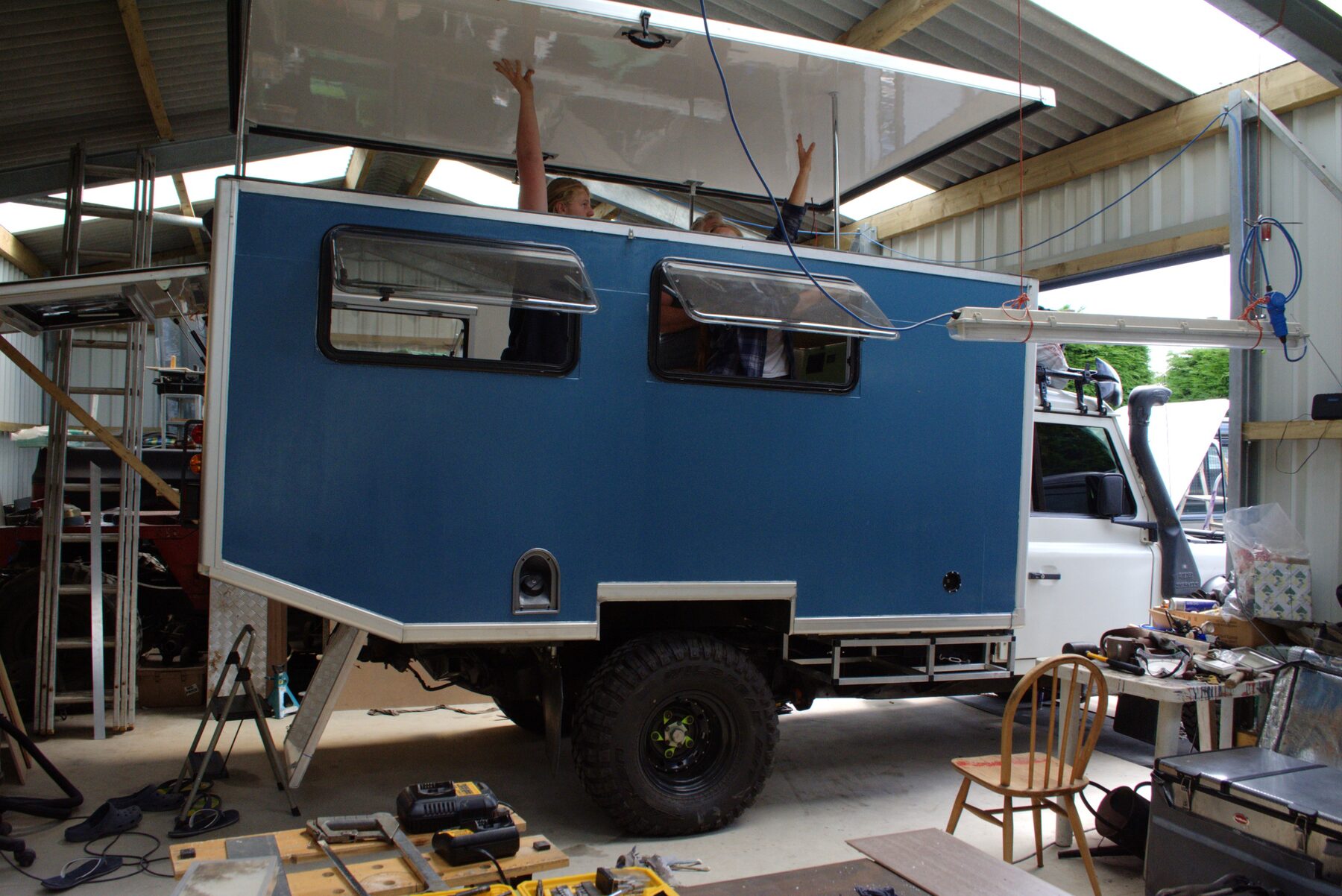
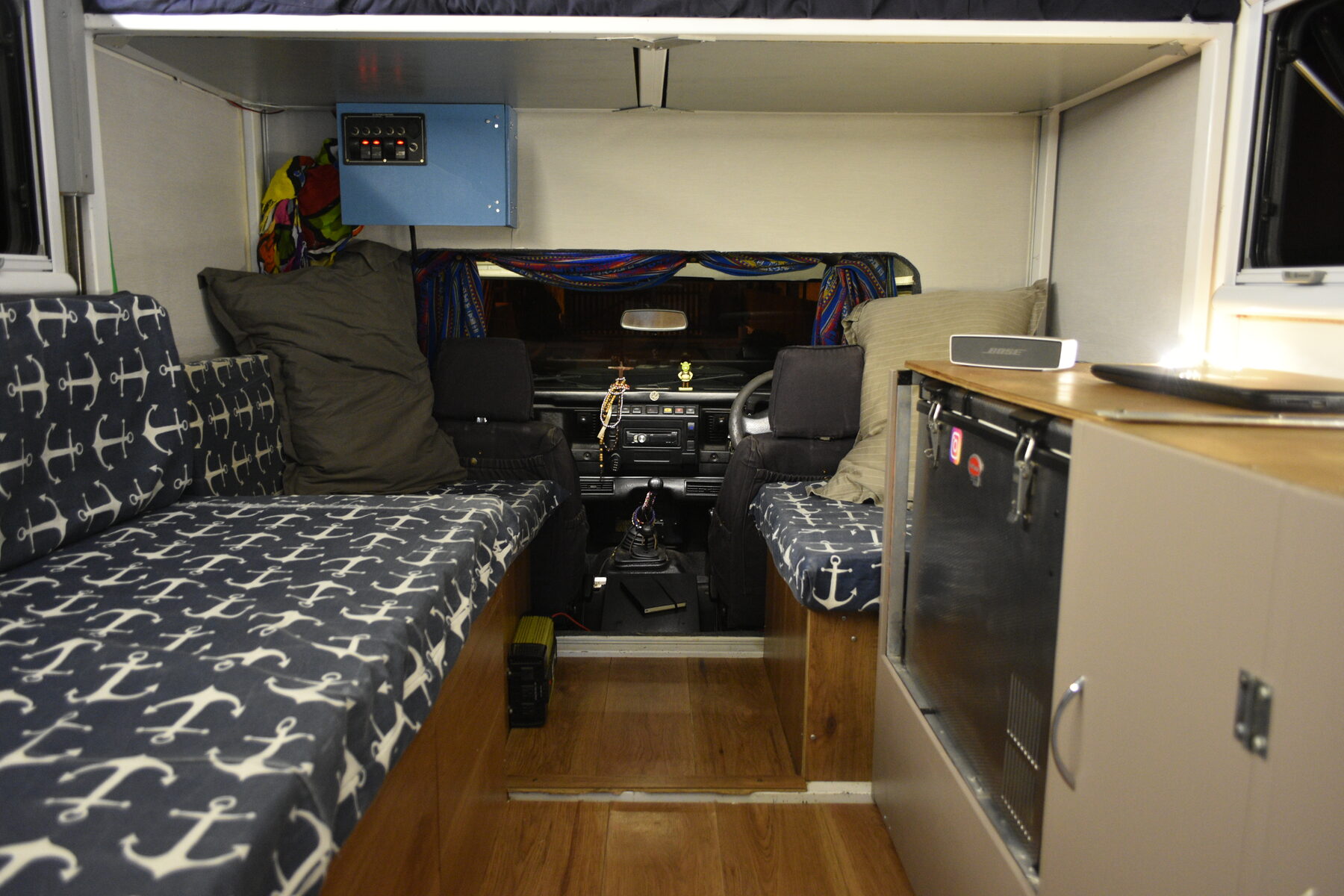
The Bells did not want a bigger vehicle; they wanted shelter without giving up what the Defender could reach. So they kept the truck and replaced only the part behind the front doors. Two choices did most of the work of keeping it a Defender. The pod opens into the cab, so the family travels together and can reach the driver's seat without going outside. And the heavy parts of the living space stay low: no cupboards above the windows, a subframe chosen to flex with the chassis, and a roof they deliberately kept shorter than they first planned.
In Graeme Bell (a2a Expedition)’s own account
- Why the tent went: they had lived in it for years and wanted shelter.
“Rooftop tents are great but we needed to make a live in situation sheltered from the elements that would not reduce our offroad abilities and be small enough to fit within a Hi-cube container.”
Source - How long they had lived in the tent before the rebuild.
“We had been living out of that tent permanently since we had shipped from South Africa to Uruguay in 2012, camping an average of 330 days of every year”
Source - Before the rebuild, in the tent years, they had already ruled out changing vehicle.
“A Sprinter may be more comfortable, a Westfalia may be more quirky, but neither are able to take us where our Landy has.”
Source - Storage kept below the windows, and the reason given is body roll.
“To increase the living space and reduce body roll we decided to have no storage cupboards above window height”
Source - The subframe was sized to flex, and a heavier section was rejected for weight as well as stiffness.
“We used 1”x 2” steel for the subframe, 2”x2” would be very heavy and too rigid, allowing no flex at all.”
Source - Why flex mattered: the walk-through joins a pod to a cab, and a chassis twists between them.
“A miscalculation could ultimately destroy the camper if the flexibility of the chassis under full articulation was not dissipated sufficiently through the subframe.”
Source - The roof was kept lower than planned, for wind.
“After arriving in Europe we planned to make the roof lift a extra meter but after seeing firstly how it was nearly too tall for us to touch and secondly how high-speed winds would most likely turn our roof into a oversize kite, we decided that the extra height wasn't that important.”
Source - The interior is light and removable: aluminium tube and clip connectors rather than welded or bolted cabinets.
“We used aluminium square tubing and Connect-its to create the shell of the cabinets and benches without welding or any nuts and bolts.”
Source - Their verdict after years in it.
“We often compare the Rooftop setup to the rebuild and in almost every situation we're happy that we did the rebuild, sometimes we wish we had done it sooner!”
Source
Dirtbeam’s reading
Not stated by the builder. This is what we take the build to show.
- Every choice listed above is a choice about height. Cupboards above the windows, a stiffer and heavier subframe, and a taller roof would each have added mass high up or far from the middle of the truck, and the Bells turned all three down. A pod on a Defender is already a tall load on a narrow track, so the margin goes on keeping the rest of it low.
- The walk-through is the decision that makes this a family build. Without it the children ride in a sealed box behind the cab, which is why most pod campers on a single-cab chassis carry two people. The cost is engineering: the cab and the pod move differently when the chassis twists, and the subframe and bulkhead have to take that up without cracking either.

What it gives up
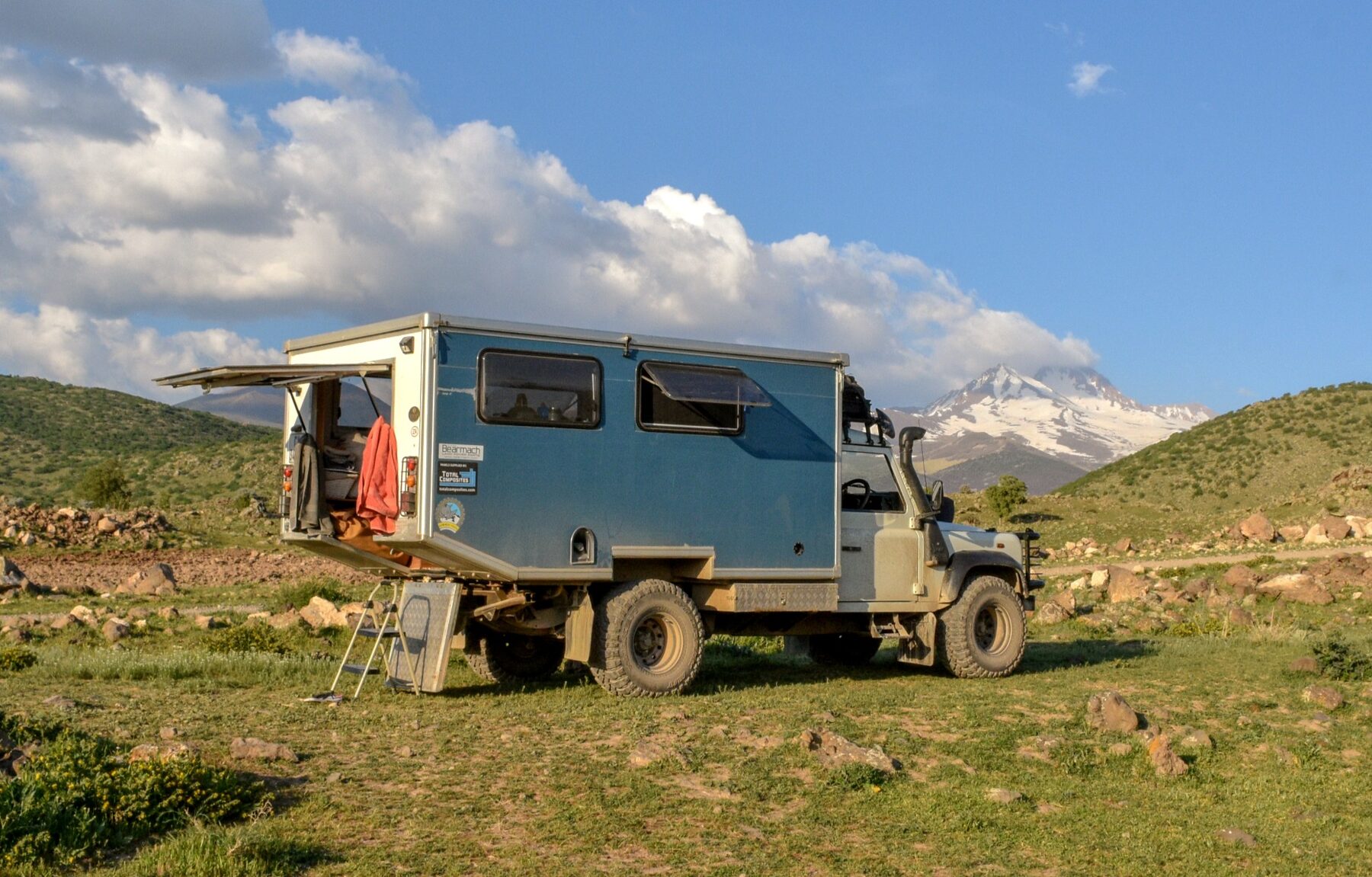
A pod is heavier than a tent and sits higher on the truck, and the Bells found the cost on the road. The truck rolled at low speed off-road and bounced on speed bumps until they added rear air bags. It weighs about three tonnes by their best guess, which they cannot pin down. And the build itself was rushed into a six-week window, which they name as the one thing they would change.
In Graeme Bell (a2a Expedition)’s own account
- The body roll, and the fix.
“We would experience body roll at low speeds while off-road. When we arrived in Europe we installed airbags in the rear suspension and that significantly reduced body roll while driving in all conditions”
Source - The same fix described in the essay, with the second symptom it cured.
“We did find the ride quite bouncy and installed a set of rear Air Lift air bags which canceled the low speed body roll and second bounce on speed bumps.”
Source - The suspension under it was replaced as well.
“Yes, we installed Heavy Duty springs from BearMach and custom shocks from Cibex”
Source - What it weighs, as far as they know.
“3 tons. We aren't entirely sure because every Weigh Station we've been to has given us vastly different results”
Measured: Weighed several times at weigh stations, with results they describe as inconsistent. No figure per axle. - The size of the box.
“The dimensions of the box are L: 3.3m W: 2m H: 1.6m”
Source - What they would do differently is time and tools, not the design.
“We ended up having to put the Defender in a shipping container without even having a test drive”
Source - The cost.
“Roughly 20,000 USD”
Measured: Their round figure, not itemised. The composite panels were supplied by Total Composites, so it excludes them. - One maintenance cost designed out: the subframe would have buried the fuel pump.
“The subframe wood and the floor were both measured and cut to provide easy access to the fuel pump as trying to replace the fuel pump in a stock 130 is already difficult enough whereas with the Subframe in place it would be Impossible to replace it.”
Source
Dirtbeam’s reading
Not stated by the builder. This is what we take the build to show.
- Body roll at low speed off-road is what a raised mass looks like on a soft suspension: the truck leans into each wheel drop and the tall box amplifies it. Air bags in the rear springs stiffen the rear against that lean and carry part of the load, which is why one part fixed both the roll and the second bounce. They do not change what the truck is rated to carry. Our GVWR page covers why no suspension part does.
- Weigh stations disagreeing is common and usually down to how the truck sits on the plates, what is aboard, and how full the tanks are. We have not found an official weight rating for this model year to set three tonnes against; the plate inside the driver's door is the number that counts.
- Two of the parts were supplied, as the Bells' own pages say: Total Composites provided the pod's panels, windows and adhesives in exchange for exposure, and SnoMaster USA supplied the fridge. Neither is obvious from photographs of the truck, so we note it here.
The kit
- Lighting
- LED spotlights added after the rebuild, named only as that in the build log. No lighting argument is made, so this note does not make one.
- Storage
- No cupboards above window height, by design. The left-hand bed is the main store for clothes and electronics, the kitchen drawers rest on steel angle so they lift out, and a 60 litre two-compartment fridge sits under the bench. 100 litres of house water feeds a basin. An extended roof rack carries the bulky things, including Entreq sand ladders that double as a side table, and an 11 kg LPG tank feeds the stove.
- Recovery
- Entreq sand ladders on the roof and Bearmach rock sliders. Nothing else is documented as recovery equipment on the pages we read.