
Are rock lights worth it, and are they legal?
By Chad Sig · Published
The short answer
Yes, if you camp out of the truck or work on it after dark; less so if you only want to crawl rocks at night. A rock light is a small lamp under the vehicle aimed at the ground, and its best job is lighting the ground around the truck at camp, and the suspension and the stuck wheel when something goes wrong, without shining in anyone's eyes. They draw little: a Baja Designs rock light is rated at 0.4 amps, so six of them on all night use about 19 amp-hours. Mount them along the length of the truck rather than only in the wheel wells, where the tire throws a shadow. As for the law, they are legal to fit and to use off the road, but on a public road most of them should be off. In California, the rule that allows an extra glowing lamp on a moving vehicle limits it to a diffused glow of no more than 0.05 candela per square inch, and anything visible from behind must be red, apart from a few listed lamps. A rock light is a far brighter point of white or amber.
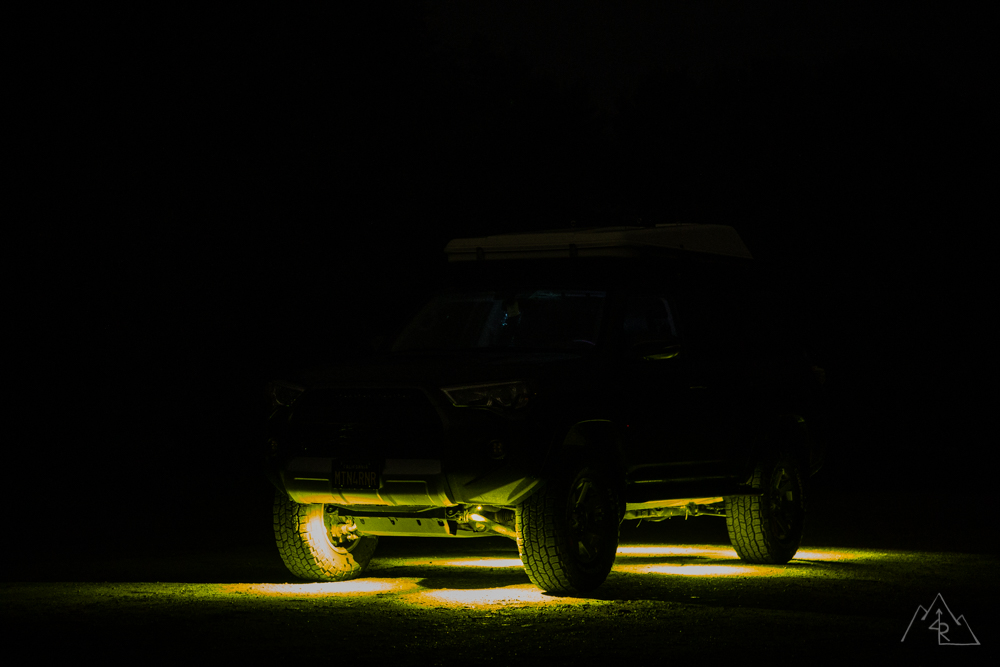
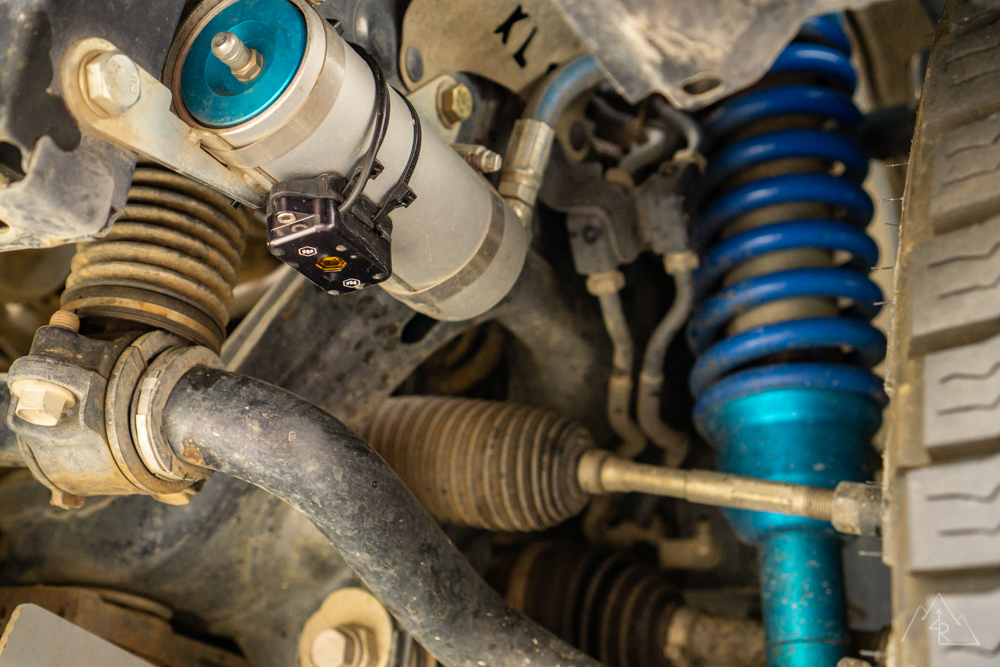
What are rock lights actually good for?
Three things, and crawling is the smallest of them. Max Sheehan, who fitted six to his 4Runner and wrote up why, lists the other two first. They let you "check around the vehicle after dark to see critical suspension and drivetrain components", and when things go wrong "help show where you need to dig, put chains on, or stack rocks." A headlamp lights one spot at a time and only where you are looking; a ring of light under the truck lights all four wheels at once and leaves your hands free.
The bigger use is camp. Expedition Overland, who run a working fleet, fit "a set of six" to every vehicle and describe the result as "a 360-degree illuminated path that eliminates the need for a headlamp." Sheehan's case for the same thing is about what the light does not do: "With the light down low being directed at the ground, there isn’t any “in your face” direct light to spoil your night vision or ruin the view of the stars." A roof light lights the camp and blinds everyone in it. A rock light lights the ground and nothing else.
"In my opinion, there is such a thing as too much light for a given task." Max Sheehan
Where should rock lights go?
Along the length of the truck, not only in the wheel wells. Baja Designs, which sells them, gives the usual pattern as "one rock light per vehicle corner or wheel well". The wheel well is good for one job: Expedition Overland call it "magic" because "it’s easy to inspect the suspension components". It is poorer for lighting the ground, because the tire sits between the light and the ground beside it. An Overland Bound member running his own lights on a 4Runner put it plainly: "With wheel well mounting the tire seems to cast a decent shadow on the ground and you don’t get good useful light on the ground." Expedition Overland add two more pairs, at the doors and at the back.
| Who | How many | Where | Why |
|---|---|---|---|
| Baja Designs' guidance | Four | One per corner, in the wheel well or on the bumpers | Light around each tire |
| Max Sheehan, 4Runner | Six, amber | Ahead of the front wheels, between the axles, behind the rear wheels | Camp light around the whole truck, out of the tire spray |
| Expedition Overland fleet | Six, white | Front wheel wells, between the doors, as far back as possible | Wheel checks, stepping out at night, a lit path round the truck |
Two rules hold whichever pattern you pick. Keep them out of the spray from the tires, as Sheehan did, or they spend their life under mud. And check full lock and full droop before you drill, because a wheel well is full of parts that move a long way. Sheehan's answer on the rock sliders, where a light is most likely to be hit, was a bracket held on with VHB tape, so that "if there is a rock impact, the tape will hopefully give before the light itself is damaged."
How much power do rock lights draw?
Very little per light, enough to matter over a night. Baja Designs rates its rock light at 0.400 A and 5.52 W. Rigid rates its A-Series at 0.3 A at 14 V and 6 W, two figures that do not agree with each other (0.3 A at 14 V is 4.2 W), so read any maker's numbers as approximate. Six lights at 0.4 A draw 2.4 A between them.
That is nothing while the engine runs, and about 19 amp-hours over an eight-hour night parked. A starter battery is not built to be drained like that night after night, which is why camp lighting and a second battery tend to arrive on the same truck. Our page on dual battery systems works through when you need one.
Do amber rock lights attract fewer bugs?
Fewer, not none. Sheehan chose amber "to reduce eye night vision loss and to hopefully attract less mosquitos in camp", and the hope has some support. In a 2026 study at German railway stations, amber LED street lights caught 45 to 51 percent fewer insects than cool white LEDs of similar output, and 51 to 77 percent less insect mass. Every lit lamp in the study, amber included, still caught significantly more than no light at all.
A 2025 forest study using narrowband LEDs found the same direction for red, which drew significantly fewer insects than ultraviolet, blue or green, though the effect differed between insect groups. It also found that catches rose with brightness for every colour, and its authors concluded that the answer is "longer wavelengths of low light intensity." For a rock light that means amber, and dim. Neither study tested a rock light at a campsite, and mosquitoes find people by more than light.
Are rock lights legal?
To fit, and to use off the road, yes. A state's lighting rules apply to vehicles on public roads, so rock lights lit at camp or on a trail are outside them. The question is driving on pavement with them on, and there the answer is usually no. We read California's code, which is the clearest we found; other states differ, and this is a reading of the statutes, not legal advice.
California allows any vehicle to carry a lamp that "emits a diffused nonglaring light of not more than 0.05 candela per square inch of area", the rule that covers glowing accent lighting, and says it "shall not display red to the front." That is a very dim glow. Rigid publishes a peak of 175 candela for its rock light; to stay inside 0.05 candela per square inch, that output would have to be spread over 3,500 square inches, about the size of a sheet of plywood. A rock light is a bright point, not a diffused glow.
Colour is the second problem, and it bites at the back. Under section 25950, light visible from in front of a vehicle must be white or yellow, and light visible from behind must be red, apart from a short list that includes turn signals, reverse lights and some marker lamps. A white or amber rock light behind the rear wheels shows light to the rear that is on no list. Sheehan has two there, Expedition Overland mounts theirs "as far back as possible", and both are right for camp. On the road, they stay off.
What we do not know
Nobody we found has measured a set of rock lights running a battery down overnight; the 19 amp-hour figure is arithmetic from the maker's rating. The IEC test conditions behind IP67 and IP68 sit in a paywalled standard we did not read. We read California's statute and no other state's, and found no enforcement guidance or court decision on rock lights in particular.
Seen on
Also in the field guide
Terms on this page
Sources
- Baja Designs 2.0 Rock Lights Install, Overview, and Review on 5th Gen 4Runner by Max Sheehan, Trail4Runner, read 2026-10-13The worked example. April 2019. The site carries affiliate links.
- Exterior Lighting for Your Overland Vehicle, XOverland (Expedition Overland), read 2026-10-13Bylined to the company, published 2021 and updated 2025. Expedition Overland is a sponsored show and names several lighting brands it uses.
- LED Rock Light, Universal, Baja Designs, read 2026-10-13The maker's specification: 0.400 A, 5.52 W, 400 lumens, and 'waterproof' with no IP number.
- Lighting Zone 6, Rock Light, Baja Designs, read 2026-10-13
- A-Series Rock Light 6-Pack Kit, Cool White, RIGID Industries, read 2026-10-13The maker's specification, which appears in the page's code rather than its visible text. 0.3 A at 14 V, 6 W, 600 raw lumens, 175 cd peak. The amps and watts do not agree with each other (0.3 A at 14 V is 4.2 W), and the page does not say whether figures are per light or per kit.
- Rock lights placement, Overland Bound forum, read 2026-10-13A forum thread. Cited for one member's account of wheel-well shadow, not as an authority.
- California Vehicle Code section 25400, diffused nonglaring lights, California Legislative Information, read 2026-10-13
- California Vehicle Code section 25950, color of lamps and reflectors, California Legislative Information, read 2026-10-13As amended with effect from 1 January 2026.
- Intensity and colour of artificial light at night affect insect attraction in a taxon-dependent manner by Charvalakis, Stavenga, Visser, Spoelstra and Hut, Insect Conservation and Diversity, 2025, read 2026-10-13Peer-reviewed, open access. Narrowband LED traps in Dutch forest; amber was not among the colours tested.
- Optimised light sources reduce nocturnal insect attraction at railway stations by Carmen Ludreschl, Christoph Scherber and colleagues, Biological Conservation 321 (2026) 111964, read 2026-10-13Peer-reviewed, open access under CC BY. Read in full from the publisher's PDF. Street lights on station platforms over two seasons, compared at broadly equal output.