
Light where your feet are: Max Sheehan's six amber rock lights
Most rock-light installs are sold on crawling. Max Sheehan wrote his up as camp lighting first: six amber lights under a 4Runner, pointed at the ground, so there is light where people walk and none in their eyes. He put down why each choice was made, from the colour to a bracket stuck on with tape so it would let go before the light broke.
Built by Max Sheehan (Trail4Runner)
Photographs by Trail4Runner
By Chad Sig · Published
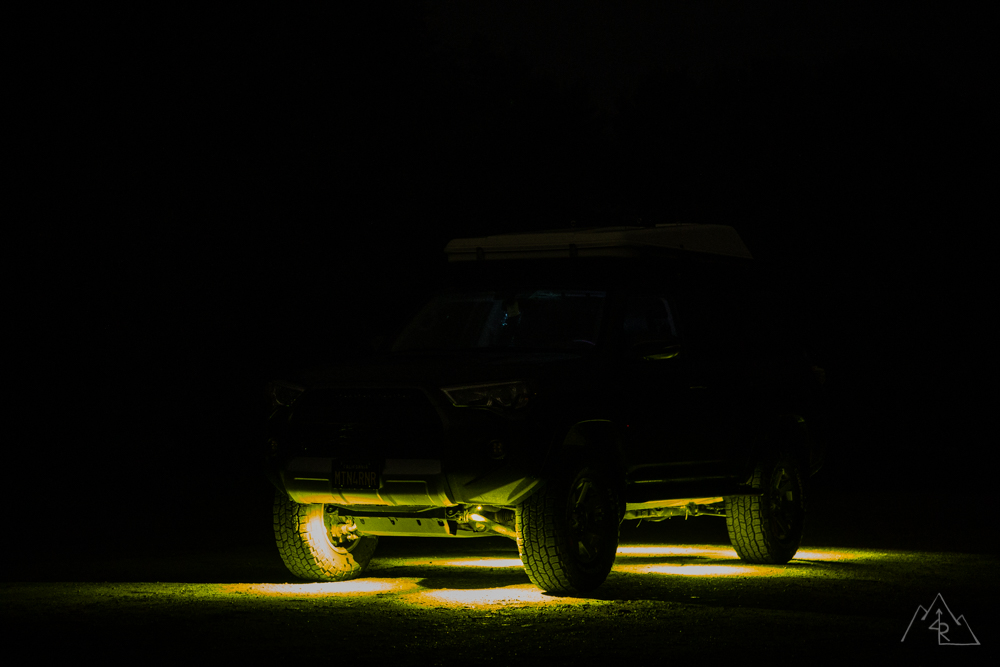
Fifth-generation Toyota 4Runner, expedition style: King remote-reservoir front shocks mounted on the frame, 4x4 Labs boat-side rock sliders, a roof rack with a hard-shell box. Six Baja Designs 2.0 rock lights in amber on a Switch Pros panel.
What it is designed for
Camp after dark
Ground light around the whole truck, low enough that nobody is looking into it, and dim enough to sit beside.
Checking and fixing the truck
Light on the suspension, the drivetrain and the ground under a stuck wheel, where a headlamp only lights one spot at a time.
Surviving the trail
Mounts placed out of tire spray, a slider bracket meant to give way, and wiring split by side so one failure does not take out both.
What it gets right
Sheehan starts from what the light is for, and it is not reach. Six small lights aimed at the ground make a ring of light around the truck at a level that leaves the night intact, which is a different job from the roof light, and he says so. Then each mounting choice answers a specific way rock lights fail: mud on the lens, a rock to the housing, a wire chafed through.
In Max Sheehan (Trail4Runner)’s own account
- The idea the whole install rests on.
“In my opinion, there is such a thing as too much light for a given task.”
Source - Why low and down works at camp.
“With the light down low being directed at the ground, there isn’t any “in your face” direct light to spoil your night vision or ruin the view of the stars.”
Source - Why amber. He is careful to call the insect part a hope.
“I opt’d for the amber version of the 2.0 Rock Lights to reduce eye night vision loss and to hopefully attract less mosquitos in camp.”
Source - The second job: looking the truck over at night.
“When properly placed, rock lights can be used to check around the vehicle after dark to see critical suspension and drivetrain components.”
Source - And the third, when it goes wrong.
“When things eventually get sideways and stuck, rock lights can be beneficial to help show where you need to dig, put chains on, or stack rocks.”
Source - The pattern: six, spread along the whole length of the truck rather than one in each wheel well.
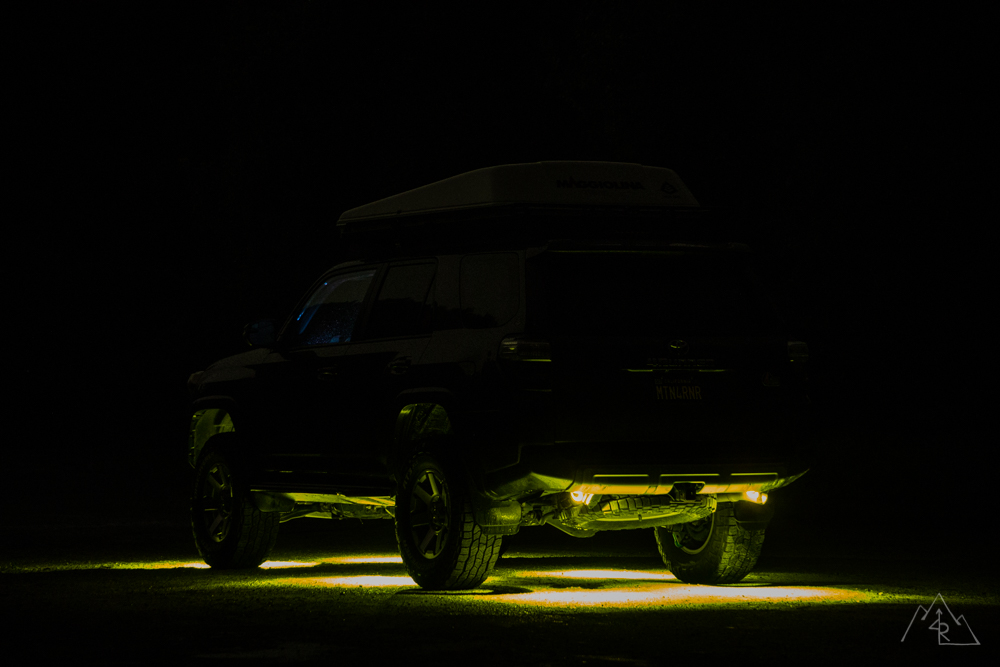
“I ordered 6 lights for my 4Runner, 2 forward of the front wheels, 2 between front and rear wheels, and 2 behind the rear wheels.”
Source - How he chose the spots: under the truck, out of the spray.
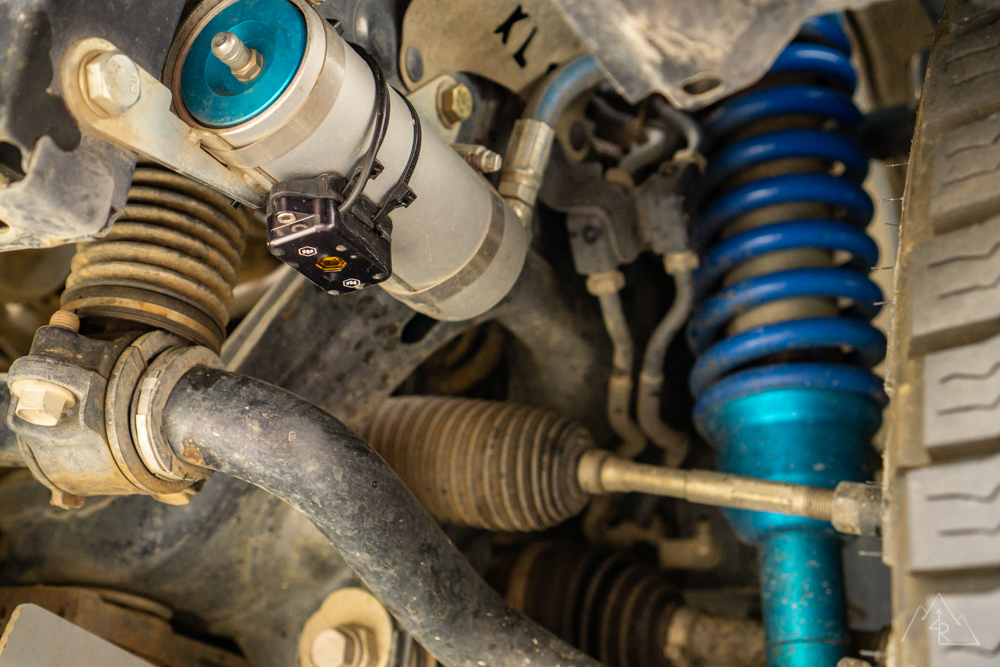
“I was able to find where I wanted to mount them by crawling under the chassis and looking for mounting spots that would allow for easy attachment, while staying out of the spray pattern of the tires to keep them clean and clear in muddy conditions.”
Source - A mount designed to fail first.
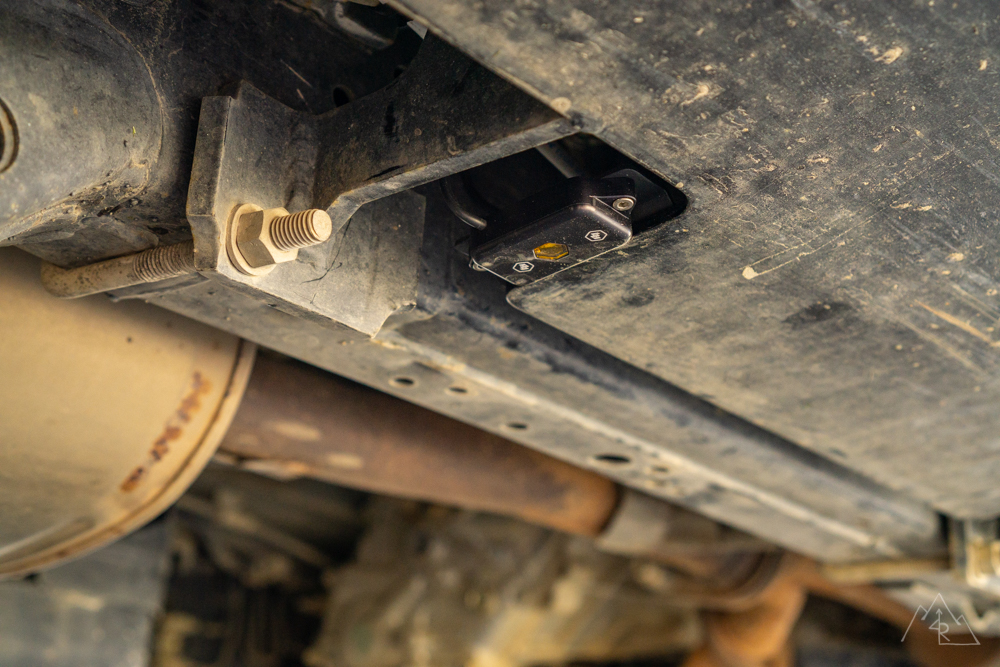
“The bracket would then be adhered to the back side of the slider plating using VHB tape. This way, if there is a rock impact, the tape will hopefully give before the light itself is damaged.”
Source - Wiring split by side.
“I chose to run a wire down each frame rail to connect the lights on both sides of the 4Runner to allow for future flexibility and to keep the two sides isolated in case of a wire failure.”
Source
Dirtbeam’s reading
Not stated by the builder. This is what we take the build to show.
- Three lights a side, none in the wheel wells, is the answer to a problem he does not name. A light inside the arch throws the tire's shadow across the very ground you want to see; an Overland Bound member running the same pattern on another 4Runner says so in as many words. Sheehan's photographs show the light pooled between and beyond the wheels, which is what his placement buys.
- Splitting the wiring by side turns the six lights into two independent sets of three. A wire torn out on one slider leaves the other side lit, which matters most in exactly the situation he describes, stuck and digging in the dark.
What it gives up
Six lights is more than the maker's guidance of one per corner, and every one of them lives where the trail hits hardest. He accepts that with sacrificial mounts rather than avoiding it. The figures he gives for draw are the maker's, and his write-up was made before he had camped with them.
In Max Sheehan (Trail4Runner)’s own account
- The draw is a rating he passes on, not something he measured.
“And with the super low draw of 0.40amps per light, they can remain on for a long time without running the risk of killing your battery!”
Measured: The maker's rating. No battery test reported. Six at 0.4 A is 2.4 A, which is our arithmetic. - The maker's spec table lists the same light at 0.400 A and 5.520 W, which does not quite agree with the 4 W per light he works from.Measured: The maker's ratings, not a measurement.
- The maker's guidance is one per corner, four in all, and in the wheel well. He fits six, none of them in a wheel well.
“Typically one rock light per vehicle corner or wheel well to achieve the best results.”
Source - A risk the wiring has to be routed around.
“Note: be sure that all wires are routed away from any heat sources (exhaust). Wires can melt with high heat which would cause a short and possibly a fire!”
Source - And the review was written before the camp test.
“I will be able to test in them while camping very soon to see how they mesh with the rest of the lighting that I already have installed on the 4Runner, but so far they look very promising!”
Source
Dirtbeam’s reading
Not stated by the builder. This is what we take the build to show.
- Left on all night, which is what he describes, six lights at 0.4 A use about 19 amp-hours in eight hours. That is a fair share of a starter battery, and the reason camp-light use and a second battery tend to arrive together. The page does not say what his truck runs.
- The two lights behind the rear wheels throw amber light visible from behind the truck. At camp that does not matter. On a public road it is the placement most likely to break a lighting code, which is why they stay off when the truck is moving on pavement. Our page on whether rock lights are worth it works through that.
The kit
- Lighting
- Six Baja Designs 2.0 rock lights in amber, 400 lumens and 0.4 A each by the maker's figures: two ahead of the front wheels on adjustable tube mounts clamped to the King shock reservoirs, two in cutouts in the rock sliders on brackets held with VHB tape, and two behind the rear wheels. Wired with 18 gauge marine duplex down each frame rail to a Switch Pros panel that runs all his accessory lighting. A roof-rack light handles the brighter work.
- Storage
- Not covered in the post this note draws on. The photographs show a hard-shell box on the roof rack.
- Recovery
- 4x4 Labs rock sliders. The lights are part of the recovery kit by his own account: they show where to dig, chain up or stack rocks when the truck is stuck.