What gauge wire do off-road lights need?
The short answer
It depends on two numbers: the current the lights draw and the length of the wire. For a pair of LED pods drawing about 5 amps on a run of up to 12 feet, 14 gauge copper wire is enough. A 30 inch light bar drawing 12 amps on a 12 foot run wants 10 gauge to keep the voltage drop under 3 percent, the figure the boat-wiring standard uses for circuits that have to work properly. A thicker wire, which is a lower gauge number, is never wrong; a thinner one costs light at the lamp and, past its limit, overheats. Fuse the wire within a few inches of the battery, at 125 percent of the load or more and never above what the wire can carry, and use a relay whenever the lights draw more than the switch is rated for.
What decides the wire gauge?
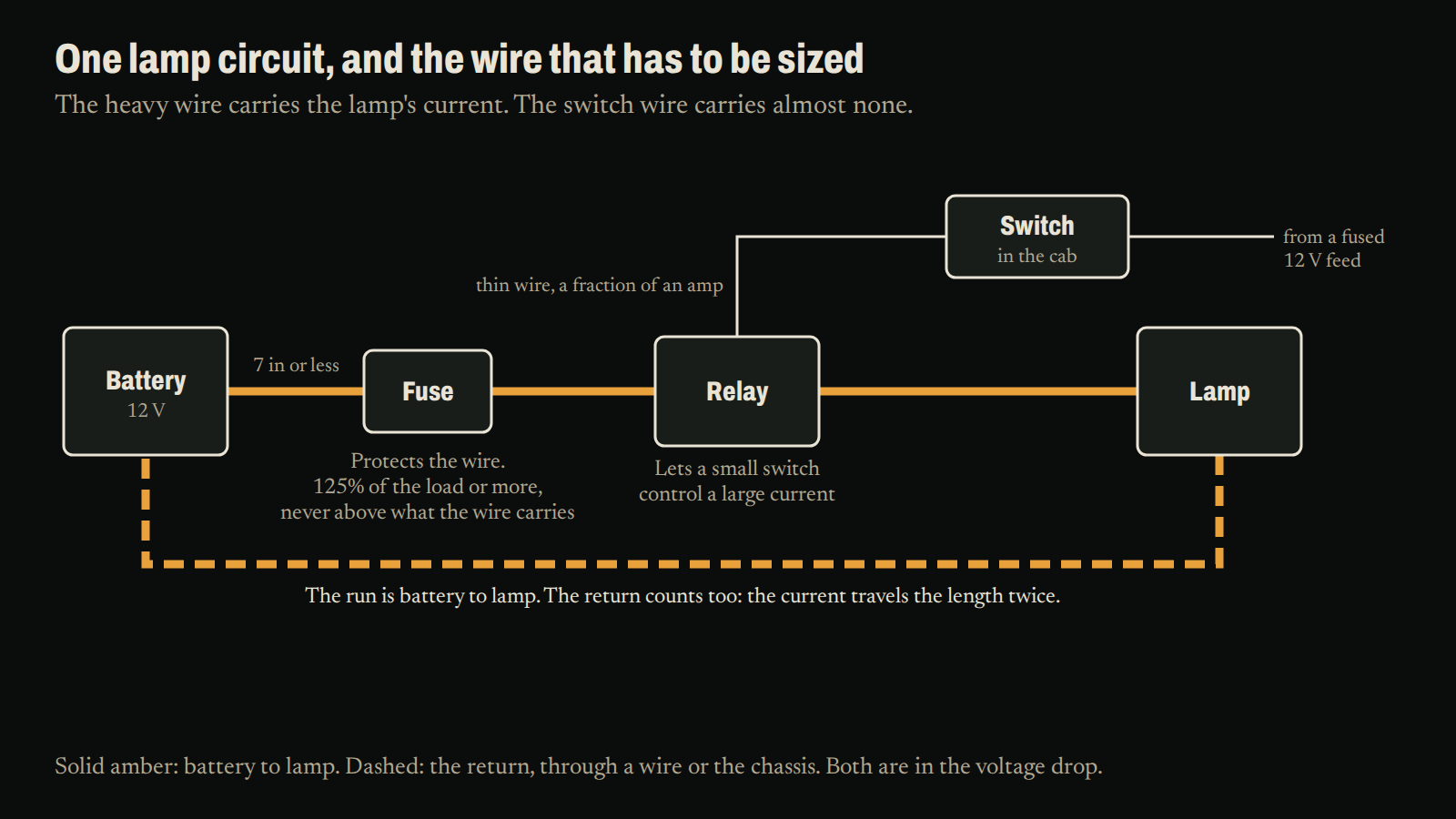
Two tests, and the wire has to pass both. The first is ampacity, the most current a wire can carry continuously before its insulation overheats. The second is voltage drop. Every foot of wire has resistance, so some of the battery's 12 volts is lost as heat along the way and never reaches the lamp. The loss grows with current and with length, and it counts the whole loop: out to the lamp and back to the battery.
On a short run the first test decides, and on a long one the second does. A wire that could safely carry 20 amps for two feet will starve a lamp at the end of fifteen. That is why a chart that lists only amps per gauge gets vehicle wiring wrong.
Wire gauge calculator
Enter what the lights draw in amps, from the maker's specification, and the length of the wire from the battery to the lamp along the route it will take. It starts with a 30 inch light bar that draws 12 amps on a 12 foot run.
10 AWG copper wire with a 15 amp fuse.
| Wire | Drop | Carries | Verdict |
|---|---|---|---|
| 18 AWG | 2.01 V (16.8%) | 17 A | Too much drop |
| 16 AWG | 1.33 V (11.0%) | 21 A | Too much drop |
| 14 AWG | 0.84 V (7.0%) | 30 A | Too much drop |
| 12 AWG | 0.53 V (4.4%) | 38 A | Too much drop |
| 10 AWG | 0.33 V (2.8%) | 51 A | Use this |
| 8 AWG | 0.21 V (1.7%) | 68 A | Heavier than needed |
| 6 AWG | 0.13 V (1.1%) | 102 A | Heavier than needed |
| 4 AWG | 0.08 V (0.7%) | 136 A | Heavier than needed |
| 2 AWG | 0.05 V (0.4%) | 178 A | Heavier than needed |
12 volt wire gauge chart
The same sums as a chart. Find the current across the top and read down to the first gauge whose run is at least as long as yours.
| Wire | Carries, open air | Carries, engine bay | 5 A | 10 A | 15 A | 20 A | 30 A |
|---|---|---|---|---|---|---|---|
| 18 AWG | 20 A | 17 A | 5 ft | 2 ft | - | - | - |
| 16 AWG | 25 A | 21 A | 7 ft | 3 ft | 2 ft | - | - |
| 14 AWG | 35 A | 30 A | 12 ft | 6 ft | 4 ft | 3 ft | - |
| 12 AWG | 45 A | 38 A | 19 ft | 9 ft | 6 ft | 4 ft | - |
| 10 AWG | 60 A | 51 A | 31 ft | 15 ft | 10 ft | 7 ft | 5 ft |
| 8 AWG | 80 A | 68 A | 49 ft | 24 ft | 16 ft | 12 ft | 8 ft |
| 6 AWG | 120 A | 102 A | 82 ft | 41 ft | 27 ft | 20 ft | 13 ft |
The carrying figures are for a single wire with insulation rated to 105 Celsius. Heat takes some of it away: the standard cuts the figure to 85 percent in an engine space, which is where most lamp wiring starts. It sets no further limit for wires bundled together below 50 volts, though a wire buried in a hot loom has less margin than one in open air.
How much voltage drop is acceptable?
Three percent is the careful figure and 10 percent is the lenient one. Blue Sea Systems, following the boat standard, allows 3 percent for what it calls critical circuits, navigation lights among them, and 10 percent for general lighting and appliances. On 12 volts those are 0.36 and 1.2 volts. Nobody classifies off-road driving lights, so the choice is yours, and it should turn on what kind of lamp is at the end of the wire.
A halogen lamp is very sensitive to voltage. The lamp maker Ushio gives the relation as light output rising with the 3.19th power of the voltage, so a 3 percent drop costs about 9 percent of the light and a 10 percent drop costs nearly 30. For halogen, hold to 3 percent.
Most LED off-road lamps contain a driver that works across a range of voltages. Rigid states 9 to 15 volts for one of its bars and Baja Designs 12 to 32 for a pod. Inside that range a lamp may hold its output as the voltage sags, though we found no maker that publishes output against voltage. That is probably why makers' own harnesses are thinner than a 3 percent rule would choose. The cost of sizing for 3 percent anyway is a few dollars of copper.
What size fuse do you need?
One that protects the wire. A fuse is there to stop the wire becoming the heating element when something shorts, and the lamp's own safety is secondary. Blue Sea's instruction is direct: "Always select a fuse size to protect the wire according to its rating." That gives a range. The lowest sensible fuse is 125 percent of what the lights draw, so that it does not blow in normal use, and the highest is what the wire can carry. Pick a standard size in between.
For a 12 amp light bar, 125 percent is 15 amps, so a 15 amp fuse on wire that carries at least 15. If a lamp maker specifies a larger fuse than your wire can carry, the answer from the same source is to change the wire: "If this fuse value is too high to protect the wire, use a bigger wire in the circuit."
Put it close to the battery. Any wire between the battery and the fuse is unprotected, so the boat standard asks for the fuse within 7 inches of the battery terminal, or further only if that length of wire runs inside a sheath.
Do you need a relay?
When the lights draw more than the switch is rated for, yes. Rigid puts it in its installation sheet: "if switch rating is less than the amperage required to power your lighting then a relay must be added in line to prevent failure of the switch." A relay is a switch worked by a small current. The harness maker Painless describes it as letting you "use a low-power signal to control a high-power circuit without risking damage to your control switch or wiring."
It also shortens the heavy wire. With a relay near the battery, the thick wire runs from battery to relay to lamp, and only a thin wire carrying a fraction of an amp has to go through the firewall to the dashboard. Without one, the full lamp current makes the trip into the cab and back out, and all of that length counts toward the voltage drop.
A switch panel with a controller under the hood is the same idea with the relays and fuses built in, one per circuit.
What do the lamp makers supply?
Less than the chart would, where they say at all. Of the makers we read, only Diode Dynamics states the gauge of its harness.
| Maker | What it states |
|---|---|
| Diode Dynamics, heavy duty harness | 14 AWG wire, 30 A fuse, 60 A relay, for up to 25 A of lamps |
| Diode Dynamics, light duty harness | 18 AWG wire, 15 A fuse, for up to 6 A of lamps |
| Rigid, Radiance Plus bars | Fuse by bar length: 10 A for a 10 inch bar, 20 A for 30 inch, 30 A for 50 inch. Harness has a relay |
| Baja Designs | Harness with relay and fuse, "heavy duty wire gauge"; no gauge or fuse value stated |
Those harnesses pass the first test. A 14 gauge wire carries 30 amps in an engine bay, which matches Diode's 30 amp fuse, and 18 gauge carries 17, above its 15 amp fuse. They do not hold 3 percent: 16 amps over a 10 foot run of 14 gauge loses about 0.9 volts, close to 8 percent. Use the maker's harness with the maker's lamp. Reach for the chart when you are extending a harness, building your own, or putting a different load on the wire.
Their specifications are where the current figure comes from. Baja Designs lists its 30 inch S8 bar at 12 amps and its 10 inch at 4.2, and a Squadron Sport pod at 2.2 amps each. Diode Dynamics lists its pods at 1.1 to 3 amps, its 12 inch bar at 4.2 and its 50 inch at 18.5.
What does a home-built harness look like?
Blaise Iacofano built one for eight rock lights on his Tacoma and wrote up each choice for Trail Tacoma. The lights came with thin leads and he went one size up for the harness: "The R4T rock lights use 20 gauge wire, I’ll be using 18 gauge wire. This will ensure that every light receives the necessary power without issue." He fused the whole string at 5 amps, with the caution that "You may need a bigger fuse than 5 amps if you use more than eight lights on one switch."
His harness is an H: a run down each side of the truck with the lights spliced in, a wire across the engine bay joining them, and one lead to the switch panel. He measured by laying the spool along the frame where the wire would go, which is the length the calculator wants. Each light joins through a waterproof two-pin connector so that one can be replaced without cutting the harness, and he tested after every connection. The fuse and relay are in his switch panel: "Not having to wire in a fuse, switch, or relay, cut a lot of work out and simplified the harness assembly."
By the chart, 18 gauge carries far more than a 5 amp fuse passes, so the wire is protected. Whether it holds 3 percent over the length of a truck depends on what the eight lights draw, which he does not give. Rock lights are small loads, and his are LEDs, so a larger drop would cost him little.
Workmanship decides whether any of this lasts. Expedition Overland, which runs lights on a fleet of trucks, says of its own early builds that most of its lighting failures "occurred due to poor wiring." Sizing the wire is the easy part. Sealed connectors, wire tied clear of heat and moving parts, and a fuse where it should be are what keep the lights working in the third year.
What we do not know
The figures are from a boat standard, read from a wire maker's printing of it. We have not read the standard itself, and we found no open vehicle standard to set beside it. Vehicle wire comes with several insulation ratings, and a wire with insulation rated below 105 Celsius carries less than the chart says. Everything here is for copper. Copper-clad aluminium wire, often marked CCA, has more resistance and should not be sized from these tables.
Ancor's printed tables are not a clean product of its formula. Worked on SAE wire sizes, our sums match the printed 12 volt tables from 5 to 40 amps and 10 to 50 feet of round trip in all but three cells, where the printed table is one size heavier: 30 and 40 amps over a 10 foot round trip, and 25 amps over 30. In those three the calculator's wire still carries its fuse, and it will show a little more drop than Ancor would allow.
No lamp maker we read publishes how its output changes with voltage, so we cannot say what a 5 or 7 percent drop costs an LED lamp, only that the makers' own harnesses accept it. Baja Designs and Rigid state no harness gauge in anything we could read, and KC's pages would not open at all. The 3 and 10 percent figures are a convention from boats. Nobody has tested them on a light bar.
Seen on
Also in the field guide
Terms on this page
Sources
- Wire and Technical Data catalog, 2021, appendix: wire and cable specifications, Ancor Marine Grade, read 2026-11-26A wire maker's printing of the boat-wiring table from ABYC E-11, with the voltage drop formula. The source for every ampacity figure and for the sums on this page. It is a marine standard; we found no vehicle standard with an equivalent table open to read, and have not read ABYC E-11 itself.
- Choosing the Correct Wire Size for a DC Circuit, part 1, Blue Sea Systems, read 2026-11-26The 3 and 10 percent voltage drop rule and how length is counted. Part 2, on fuses, is at http://bluesea.com/viewresource/1441; the fuse location figures are from the maker's instruction sheet at https://web.archive.org/web/2024/https://assets.bluesea.com/files/resources/instructions/6330.pdf.
- Copper Wire Tables, NBS Handbook 100, National Bureau of Standards, read 2026-11-26The resistance of copper wire by gauge, used to check the constant in Ancor's formula.
- Radiance light bar installation instructions, Rigid Industries, read 2026-11-26The maker's sheet, read from a retailer's copy. The fuse chart by bar length is from the Radiance Plus SR sheet at https://www.revzilla.com/assets/0004/3659/Radiance_Plus_SR.pdf. Neither states a wire gauge in text we could read.
- Heavy duty and light duty dual output off-road wiring harnesses, Diode Dynamics, read 2026-11-26The one lamp maker we found that states the gauge of its harness. Light duty harness at https://www.diodedynamics.com/light-duty-dual-output-offroad-wiring-harness.html.
- S8 light bar and Squadron Sport, specifications, Baja Designs, read 2026-11-26Current draw and operating voltage. Squadron Sport at https://www.bajadesigns.com/products/squadron-sport/. Baja Designs states no wire gauge or fuse value for its harnesses.
- Halogen lamp technical specifications, Ushio, read 2026-11-26A lamp maker's relation between supply voltage and light output. For general halogen lamps, not a particular headlamp bulb.
- What Is A Relay?, Painless Performance, read 2026-11-26
- R4T Rock Lights Install and Review by Blaise Iacofano, Trail Tacoma, read 2026-11-26A harness built by its owner, with his reasons. The page carries affiliate links and does not state what the lights draw.