
Should you carry water and fuel in jerry cans or a built-in tank?
By Chad Sig · Published
The short answer
Use cans when the trip is short, when the vehicle has other jobs, or when the supply is a reserve you rarely touch. Build in a tank when you draw on it every day for months, because a tank costs one fabrication job and then saves the lifting, pouring and stowing every day after. The weight does not change: water is a kilogram a litre and diesel about 0.82 to 0.85, so 100 litres is 80 to 100 kg whatever it is in. Put it low and between the axles, never on the roof. A tank under the floor freezes in a cold winter, so if you travel in snow, keep the water inside the heated space or keep the cans.
What decides it?
How often you use it, and for how long. Water for drinking, cooking and washing is drawn on several times a day, so every can is lifted, carried, poured and stowed again, over and over. Reserve fuel is drawn on a few times a year, if that. A tank earns its cost by removing handling, so it pays back fastest on the supply you touch most.
Coen Wubbels and Karin-Marijke Vis, who lived in a 1984 Land Cruiser BJ45 for more than twenty years, put the rule in one sentence: "For a 1- or-2-year journey, we'd stick to containers for budget reasons." Once the trip had no end, the tank, filters and sink were worth it. It took them twelve years to build one, and they say they should have planned it before leaving.
| Cans | Built-in tank | |
|---|---|---|
| Cost | Low, and you can start today | A fabrication job, plus pump, filters and plumbing |
| Daily handling | Lift, pour and stow every time | Open a tap |
| Where the weight goes | Wherever there is room, often the roof | Fixed, ideally low between the axles |
| Moving to another vehicle | Take them with you | Stays with the truck |
| Cold weather | Bring them inside | Freezes if outside the heated space |
| Checking what is left | Lift it | Needs a gauge, or a second tank to switch to |
How much does it weigh, and where should it go?
Water weighs a kilogram a litre, which the USGS gives as 1.000 grams per cubic centimetre at 4 °C and barely less when warm. Diesel is lighter, 0.820 to 0.845 kg a litre under the European EN 590 standard, and petrol lighter again at 0.720 to 0.775 under EN 228. Container weight comes on top.
| Volume | Water | Diesel | Petrol |
|---|---|---|---|
| 20 L (one jerrycan) | 20 kg | 16.4 to 16.9 kg | 14.4 to 15.5 kg |
| 40 L (two cans) | 40 kg | 32.8 to 33.8 kg | 28.8 to 31 kg |
| 100 L | 100 kg | 82 to 84.5 kg | 72 to 77.5 kg |
Low and between the axles is the best place for it, and the roof is the worst. On the roof it raises the centre of gravity, adds to the roof's own load limit, and loads rack mounts that were never designed for it. The BJ45's owners found that out the slow way: "Roof bars, but also window bars broke and were welded on numerous occasions", until the reserve diesel moved to a tank under the truck. Behind the rear axle it lightens the front and sags the rear. Kristen Bor of Bearfoot Theory found her second van sagging with 25 gallons of water and a heavy battery bank in the rear garage.
However you carry it, it counts against payload. A full 100 litre water tank and two full 20 litre jerrycans of diesel come to about 135 kg before the containers, which is a passenger's worth of weight on many trucks.
What does a water tank actually cost?
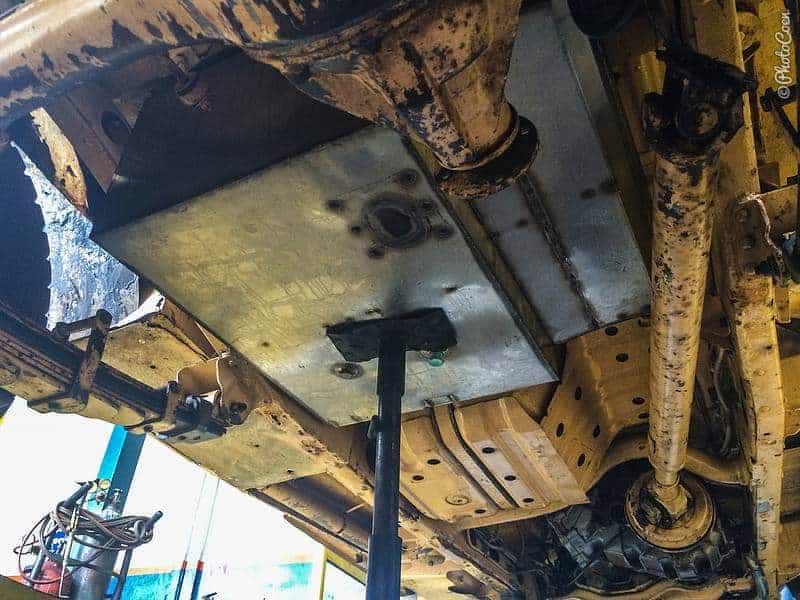
Less in materials than people expect and more in everything else. The BJ45's tank started as two food-grade stainless tanks bought from a scrapyard in Venezuela for the equivalent of $20. Turning them into one 100 litre tank and its brackets took a shop crew "about five days of cutting and welding", and the space for it only existed because the old exhaust, which ran diagonally under the floor, had broken and been replaced with a short side exit.
Then the tank needs a system. Theirs has a coarse sediment filter where the hose enters the body, a pump, a pressure tank, a sediment filter and a UV filter on a separate drinking tap, a sink, and a hand shower. It all had to fit the rear corner so it would not cost packing space, and the compromise that made it fit means "hoses would bend 45 degrees every time we would need to access the water system's core." The pump keeps running into a leak, so they added a switch to cut its power. They fill the tank through a funnel made from a cut-up bottle, and there is no level gauge.
What goes wrong with a tank in winter?
It freezes, along with the hose and filters that feed it, if any of them sit outside the heated space. The BJ45's owners had travelled mostly in the tropics and never planned for it. In winters in Japan, Russia and Central Asia they "run the tank dry, close off the system and go back to carrying 2×20 liter jerrycans inside the vehicle."
Bearfoot Theory's vans learned the same lesson from the other side. On the first van, "my exterior 15-gallon tank is unusable in winter, limiting me to the 10-gallon tank inside." On the second, the whole plumbing system went inside the van so nothing could freeze, and the third keeps its tank in a cabinet inside the heated space. If you travel in snow, an inside tank or a couple of cans you can bring indoors will outlast an underbody tank.
Fuel: a bigger tank, cans, or both?
Start from range, not litres. Coen Wubbels's advice to a reader planning a fuel system: "I think you need to think about range instead of liters. What distance feels good to you?" Work out how far you need to go between fuel stops on the route, multiply by consumption loaded and off-road, which is higher than on the highway, and add a margin.
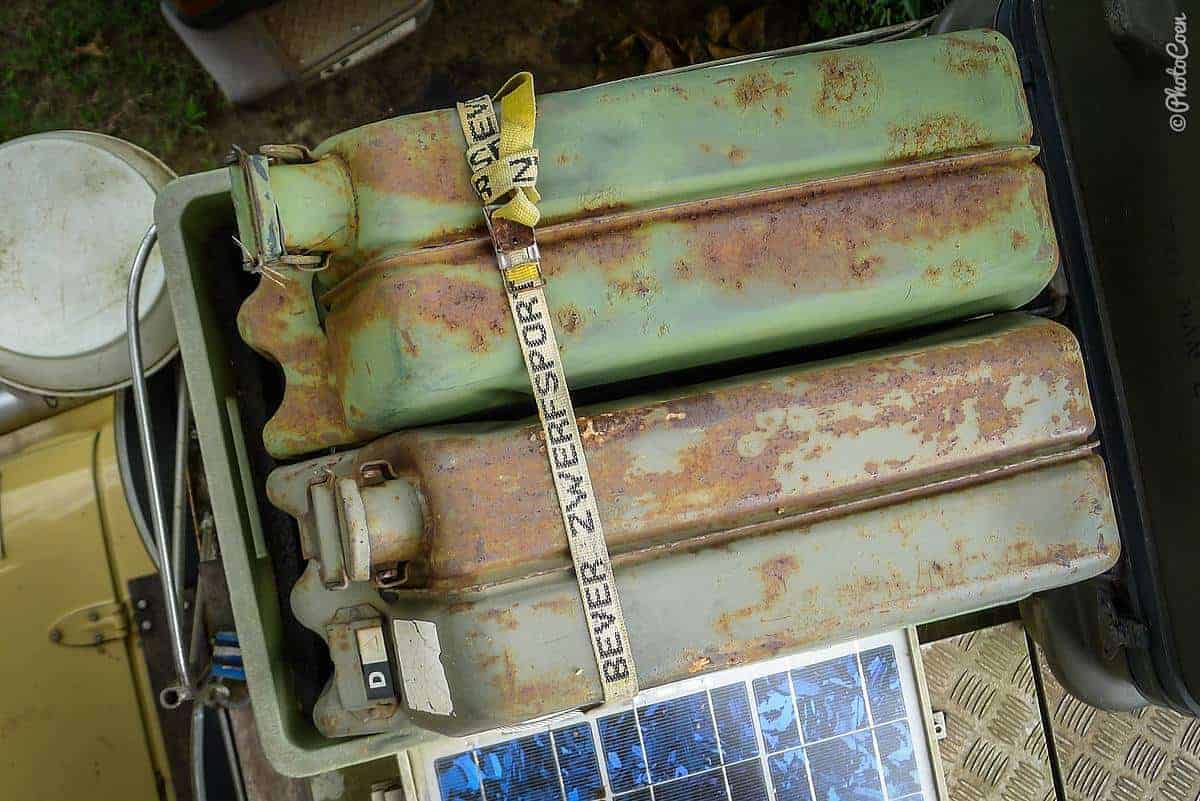
Then ask how often you would use the extra. The BJ45's 85 litre main tank gave 600 to 750 km, and in two decades the reserve was needed a handful of times: the Persian Gulf coast of Iran, Patagonia, south-west Bolivia and the Bartang valley in Tajikistan. For a reserve used that rarely, cans are cheap and do no harm sitting empty, but full ones on the roof broke that truck's rack. A second tank underneath, fitted in Bolivia in 2010, took the weight down, and two cans stayed on the roof for the rare day they were needed.
Cans also do something a tank cannot: carry fuel from a station to a vehicle that ran dry, or to a stove. Keep at least one. Carry it outside the cabin, and check the rules where you travel. In the UK, for example, the Health and Safety Executive caps petrol in spare containers at 30 litres in no more than two suitable containers, and its definition of premises includes motor vehicles.
What makes a good water can?
One small opening that closes tightly and a narrow neck, so water pours out without a hand or a cup going in. That is the CDC's description of a safe household water container, and it suits a vehicle too. Use a container made for drinking water, or one bought new and never used for anything else. The CDC says never to store water in one that has held fuel, solvents or other chemicals.
Clean and sanitise it regularly. The CDC's method is to wash it, then shake it with 5 mL of unscented household bleach (5 to 9 percent sodium hypochlorite) per litre of water so the solution touches every inside surface, wait at least 30 seconds, pour it out and let it air-dry. The same applies to a tank, which is harder to reach inside, and is one more reason to plan the access before you build it.
Good cans can be hard to find away from home. The BJ45's owners could not find a second heavy-duty water can outside Europe and made do with a red plastic fuel can of the kind used on boats. Buying the cans you need before you leave is cheaper than improvising later.
How do the builds on this site carry theirs?
| Build | Water | Fuel reserve | What it shows |
|---|---|---|---|
| Landcruising Adventure, 1984 BJ45 | Cans for 12 years, then a 100 L tank under the floor | 70 L tank underneath, two cans on the roof | Moving both off the roof, and back to cans in winter |
| a2a Expedition, 2003 Defender 130 | 100 L of house water feeding a basin | Not stated | A family of four living aboard full time |
| Bearfoot Theory, Sprinter vans | Exterior tank, then all plumbing inside | Not stated | Freezing, and rear sag from water in the garage |
Every one of them ended up with the water low and inside or between the axles. The cans that survived are the ones used rarely: reserve fuel on the BJ45's roof, and the winter water cans that come out when the tank is drained.
Seen on
- Twelve years on cans, then a tank welded from scrap: Landcruising Adventure's BJ45Coen Wubbels and Karin-Marijke Vis left the Netherlands in 2003 in a 1984 Land Cruiser BJ45 for a two-year trip that lasted more than twenty. They carried reserve diesel in jerrycans on the roof until the roof bars broke, and drinking water in cans for twelve years until a broken exhaust freed the space for a tank. Both moved under the floor, for reasons they wrote down, and the cans never quite went away.
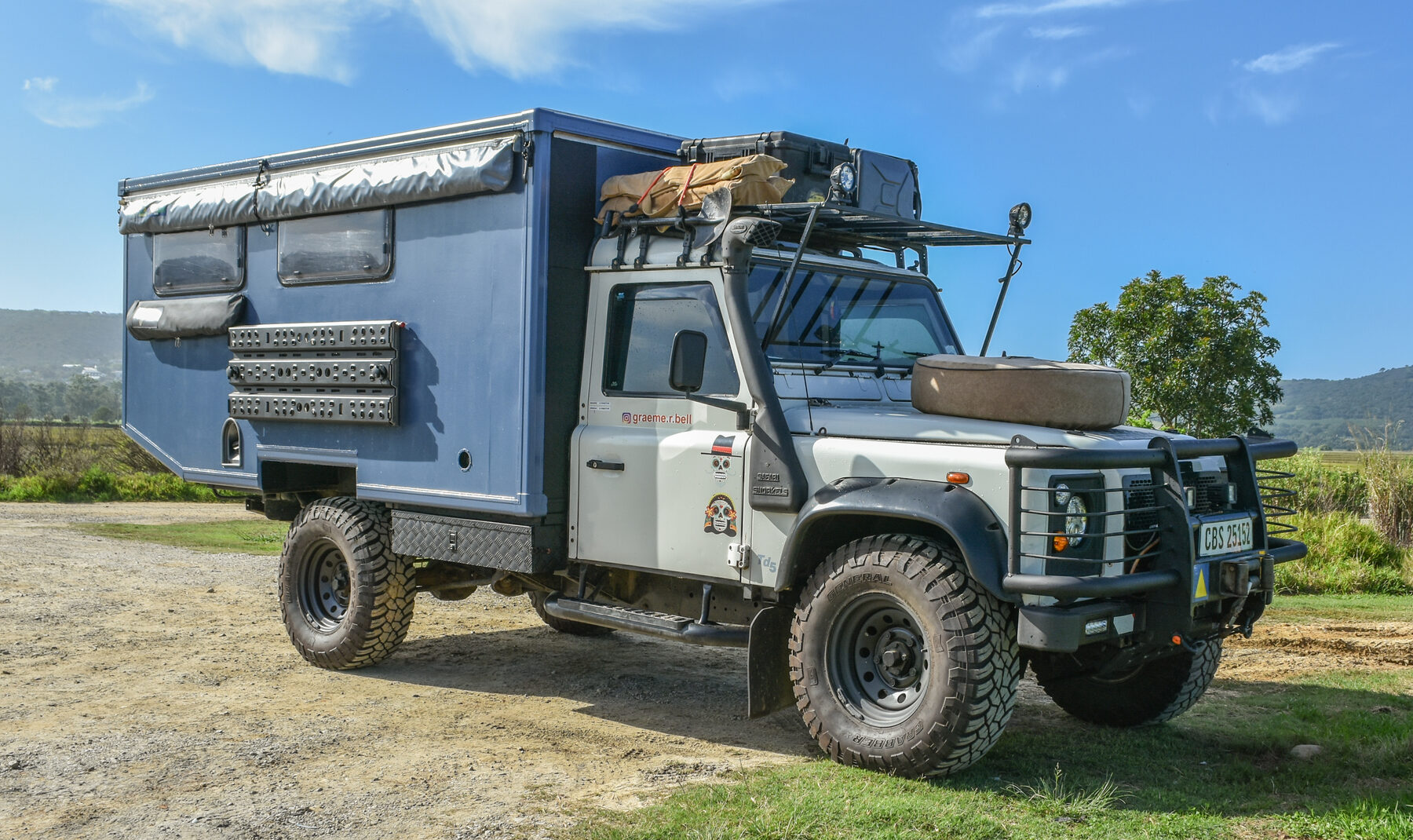
- Out of the roof tent: a family of four builds a hard-side pod onto their Defender 130Graeme and Luisa Bell and their two children lived out of a roof tent on a Land Rover Defender 130 for five years, camping about 330 nights a year. At the end of 2016 they cut everything behind the front doors off the truck and built a composite pod in its place, with a walk-through from the cab and a roof that lifts. The pod bought shelter. It also bought weight and body roll, and the decisions they made against those are the part worth copying.
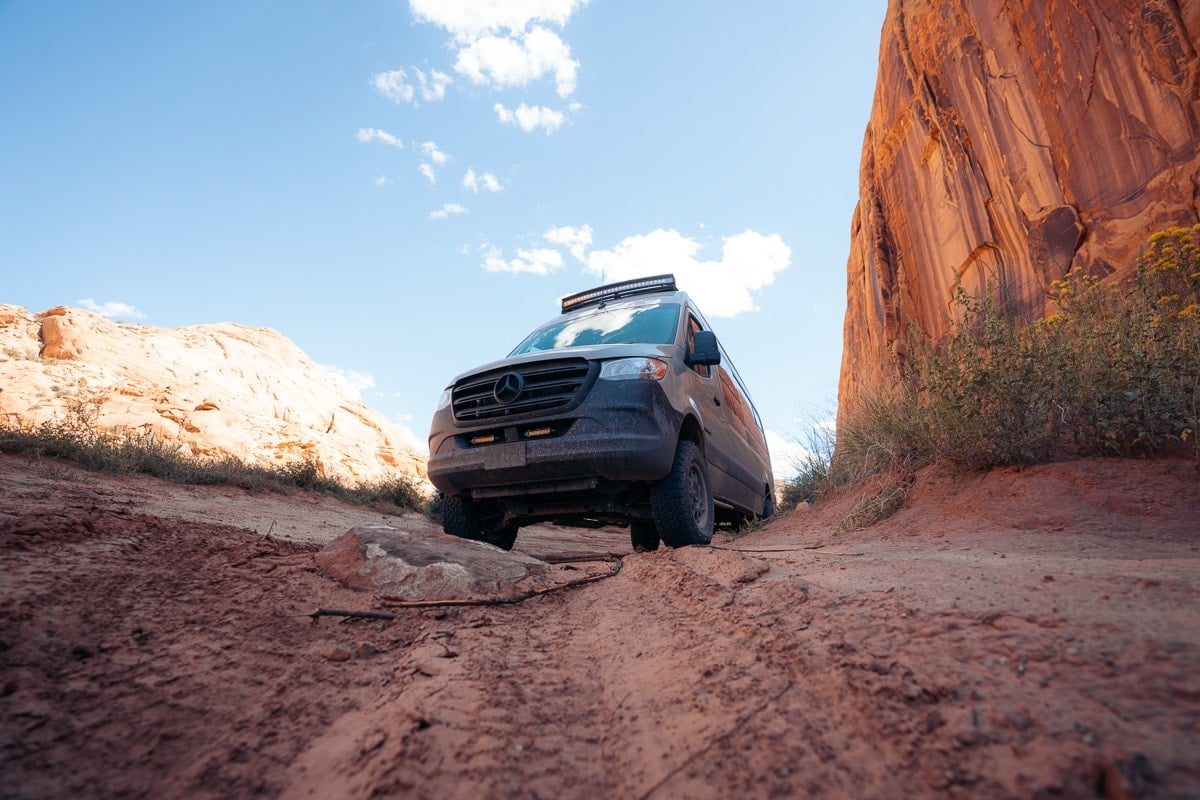
- Three 4x4 Sprinters: the drivetrain was the easy partKristen Bor bought a factory 4x4 Sprinter three times in eight years. The four-wheel drive took her one sentence: snow and rough dirt roads, so it was non-negotiable. The tires, the wheels, the springs, where the water goes and how the family would fit took three vans to get right. Read together, her build pages show where the work in a capable van actually is.

Also in the field guide
Terms on this page
Sources
- The Overhaul in the Guianas (part 2): From Water Canisters to a Water Tank & Sink, Landcruising Adventure, read 2026-10-12Twelve years on cans, then a 100 litre tank under a BJ45. Includes the freezing note in the comments.
- The Land Cruiser's Ins & Outs: The BJ45's Build Up and Equipment by Karin-Marijke Vis, Landcruising Adventure, read 2026-10-12Their rule for cans or a tank, the roof damage from full jerrycans, and Coen Wubbels's comment on sizing fuel by range.
- The Rebuild by Graeme Bell, a2a Expedition, read 2026-10-12
- Van Payload and Weight Considerations by Kristen Bor, Bearfoot Theory, read 2026-09-24
- 4x4 Mercedes Sprinter Van Conversion Tour by Kristen Bor, Bearfoot Theory, read 2026-09-24
- 170 Sprinter Camper Van Tour by Kristen Bor, Bearfoot Theory, read 2026-09-24
- Water Density, USGS Water Science School, read 2026-10-121.000 g/cm³ at 4 °C, so a litre of water weighs a kilogram at any temperature a vehicle sees.
- Automotive Fuels: EU (EN 590 diesel), DieselNet, read 2026-10-12A reproduction of the standard's limits; EN 590 itself is paywalled. Density at 15 °C, 820 to 845 kg/m³ for temperate grades.
- Unleaded petrol to BS EN 228, specification sheet, ATF, read 2026-09-28A supplier's reproduction of the EN 228 limits. Density at 15 °C, 720 to 775 kg/m³.
- Safe Water Storage, CDC, read 2026-10-12Written for household storage, not vehicles. Used for what a good water container looks like and how to sanitise one.
- If you store petrol at home, or at a club/association or similar premises, Health and Safety Executive (UK), read 2026-10-12UK only, and petrol only. Its definition of premises includes motor vehicles.