
How much weight can your roof carry?
By Chad Sig · Published
The short answer
Your roof has two separate limits and the smaller one is the one that matters. A static rating covers what the roof can hold while the vehicle is parked, and a dynamic rating covers what it can carry while moving, which is lower because the load is swinging a long way above the roll centre. The dynamic figure lives in the owner's manual and is often between 100 and 200 lb on a wagon or a van, which a rack and a hard-shell tent can spend on their own before anything is packed. The rack's own rating is a different number again and does not override the vehicle's. And roof weight is the most expensive place to put mass twice over: it raises the centre of gravity, and Oak Ridge National Laboratory measured a rooftop cargo box costing an SUV nine percent of its fuel economy at 60 mph, where the same load on a hitch tray cost it 0.2 mpg.
Why does a roof have two different weight limits?
Because holding something still and carrying it down a road are different problems. FarOutRide, who looked both figures up for their Transit, separate them cleanly: a static rating comes from the body builder's manual and exists to ensure roof structural integrity, the maximum load when parked, with people on it. A dynamic rating comes from the owner's manual and exists to ensure adequate stability and control while driving, because of the high centre of gravity.
So the static number is about whether the roof caves in, and the dynamic number is about whether the vehicle stays upright and steerable. The second is always the smaller, and it is the one a rooftop tent has to answer to while you are moving. A tent that is comfortably inside the static rating with three people asleep in it can be outside the dynamic rating at 60 mph with nobody in it at all.
What does putting weight on the roof actually cost?
Fuel, and more of it than almost anyone expects. Oak Ridge National Laboratory tested this properly in 2014, running the vehicles through SAE J2263 coastdown procedures on a closed track before measuring on a dynamometer, which is the difference between a measurement and a hunch.
A 2009 Ford Explorer with a rooftop cargo box went from 24.9 mpg at 60 mph to 22.9, a drop of nine percent. A 2009 Toyota Corolla with the same box went from 42.5 mpg to 33, a drop of twenty-two percent. The number that makes those useful is the control: with a hitch-mounted cargo tray instead, the Corolla's mileage at 60 mph was unaffected, and the Explorer's fell from 24.9 to 24.7.
The same cargo costs an SUV nine percent of its fuel economy on the roof and two tenths of a mile per gallon on a hitch. The difference is not the weight. It is the air.
That is the case for the back of the vehicle in one experiment. A roof box sits in clean fast air ahead of the vehicle's own wake and has to push it aside; a hitch tray sits in the dirty slow air behind and barely adds to the frontal area. If what you are carrying does not have to be on the roof, the roof is the most expensive place to put it.
Why is roof weight worse than the same weight inside?
Because of where it sits relative to the point the vehicle rolls around. Mass high up has a longer lever on the roll axis than the same mass at floor level, so it does more to the vehicle's willingness to lean, and it does that in the two situations you least want it: a fast avoidance swerve and a side slope.
FarOutRide put the rule plainly before their own build followed it: keep the vertical centre of gravity as low as possible, and weight added higher, a roof rack, overhead storage, ceiling material, has much more impact than weight added at floor level, a battery bank or a water tank. It is the same physics that makes the dynamic rating smaller than the static one, stated from the builder's side rather than the manufacturer's.
Worked example: 150 lb of tent on a 1999 Land Cruiser
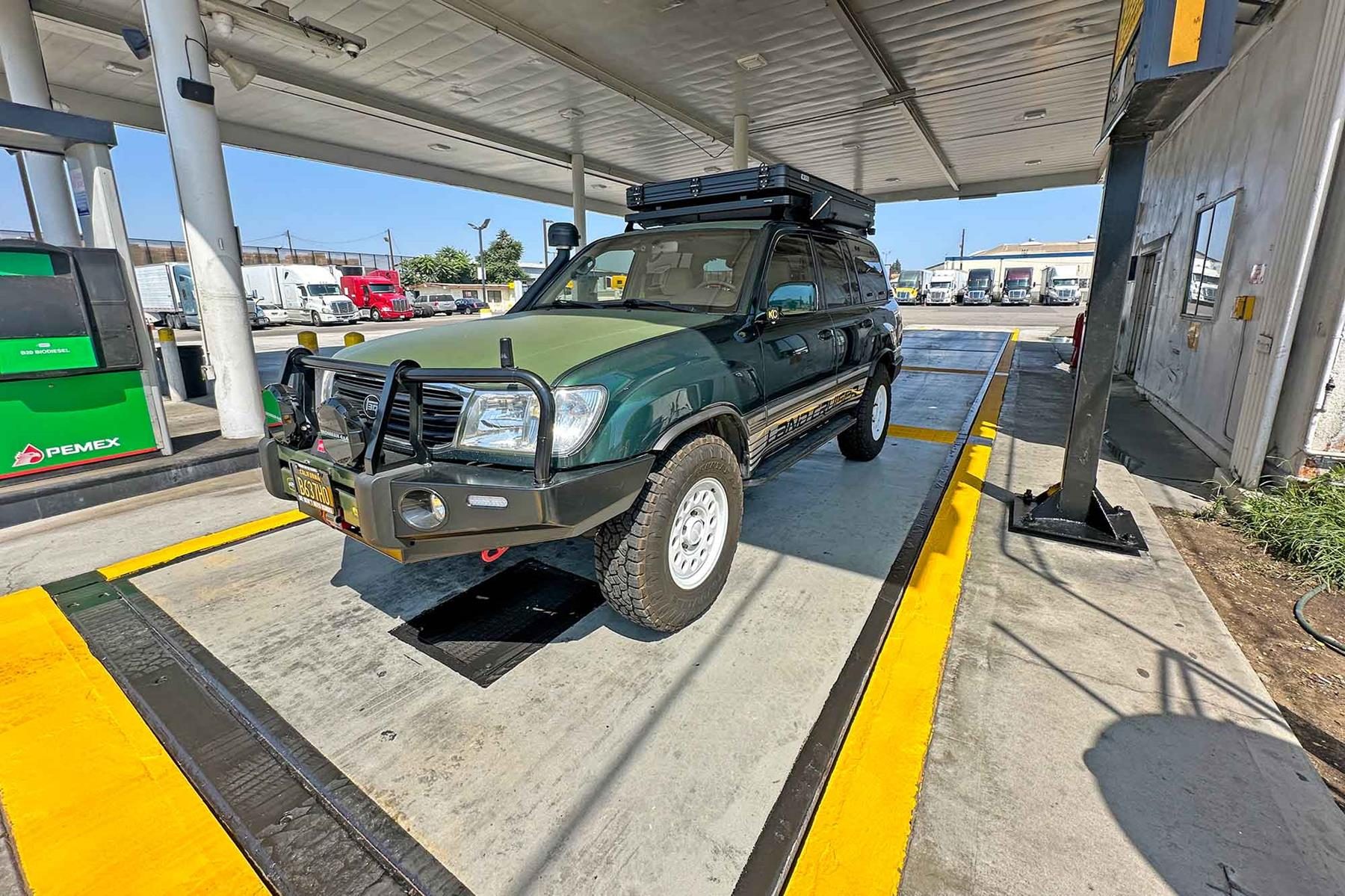
OVR's project Land Cruiser 100 is a useful case because the magazine published what happened rather than only what was fitted. An Overland Vehicle Systems hard-shell tent went on the roof, described by them as clocking in at over 150 pounds plus mounts, alongside more electrical gear and a pair of 300Ah lithium batteries.
Then they drove onto a CAT Scale. Stripped to what they call a standard loadout, with three quarters of a tank and one person aboard, the truck read 7,000 lb even. Toyota lists that vehicle's gross vehicle weight rating at 6,860 lb. Their own arithmetic from that reading puts the truck about 275 lb over the rating with two people and a full tank, before any gear, water or food for a week goes in.
What makes it a Dirtbeam example rather than a cautionary tale is the response. They did not fit a stiffer spring and call it solved. They took weight back out: most of the second row of seats, a 53L fridge swapped for a 35L, and the drawer system emptied of what never got used. Our note on that build follows the whole sequence, including the spring choice made ten months before the scale confirmed the problem.
How do you find your own roof limit?
The owner's manual, for the dynamic figure, and it is worth reading the exact wording rather than a forum's memory of it. Manufacturers state roof limits inconsistently, sometimes only for their own accessory rails, sometimes in a body builder's document a private owner never sees, and the figure moves between model years and roof heights on the same nameplate.
Then weigh the rack and the tent, because those are the two numbers a spec sheet will give you and most people never add up. A rack of 60 to 90 lb and a hard-shell tent of 130 to 160 lb is a realistic pair, and on a 150 lb dynamic limit that pair is already over before anything is stowed on it.
What we do not know
We could not verify a published roof load figure for the Land Cruiser 100 from Toyota. The figure circulating in owner forums is a quotation of a 2006 manual, which is neither this truck's model year nor a document we have read, so no roof rating for that vehicle appears on this page. That absence is worth noticing: the one number a rooftop tent buyer most needs is often the hardest to find for an older vehicle.
The ORNL figures are also two specific vehicles from 2009 with one specific cargo box, not a law of nature. The direction of the result is solid and the method is unusually good, but the size of the penalty on your vehicle with your box is not something those numbers can tell you. And nobody, as far as we can find, has published a measured centre-of-gravity change or a drag figure for a hard-shell roof top tent, which is the measurement this subject most needs and does not have.
Seen on
Also in the field guide
Terms on this page
Sources
- ORNL study pegs fuel economy costs of common practices by John Thomas, Shean Huff and Brian West, Oak Ridge National Laboratory, US Department of Energy, read 2026-08-27Published 9 April 2014. The vehicles were run through SAE J2263 coastdown procedures on a closed track before dynamometer testing, which is why these figures are worth more than the usual anecdote. A national laboratory with nothing to sell, which is rare in this subject.
- Roof rack for a Ford Transit by Antoine Gagne and Isabelle Richard, FarOutRide, read 2026-08-27The clearest statement we found of the difference between a static and a dynamic roof rating, and of which document each one comes from. The site sells conversion plans and runs affiliate links.
- Revisiting the scales: why you should weigh your overland vehicle after modifications by Jerry Tsai, OVR: Outdoor Vehicle Recreation, read 2026-08-27Published 24 July 2025; the scale ticket in it is dated 20 July. A magazine publishing its own project vehicle over its weight rating, in a title that sells advertising to the brands fitted to that vehicle.
- Stop guessing your rig's weight: weighing your off-road vehicle with CAT Scale by Jerry Tsai, OVR: Outdoor Vehicle Recreation, read 2026-08-27The first weigh-in, and the procedure it used.