
Where should the weight go on an adventure motorcycle?
By Chad Sig · Published
The short answer
Carry as little as the trip allows, then put the heaviest things low, close to the middle of the bike, and over or in front of the rear axle. Weight high up makes the bike harder to hold up and to pick up; weight far from the middle makes it slower to steer; weight behind the rear axle can upset steering and braking and cause a wobble, which is why KTM caps its 690 Enduro R at 130 km/h with baggage and tells owners to fix it as close as possible to the centre of the vehicle. Fuel is usually the heaviest load you add: petrol weighs about three quarters of a kilo a litre, so extra tanks belong low and forward, not in one tall tank on top. Luggage goes in soft panniers that sit close to the bike, with dense things at the bottom and front of each bag, and very little on the tail, whose rack is often rated for only a few kilos. The limit on the rule is practical: bags hung too low swing, rub, and catch your boots when you need to put a foot down.
Why does it matter where the weight sits, and not only how much?
Total weight comes first. Every kilogram has to be pushed through sand, held up at walking pace and lifted after a drop, and nothing about where it sits changes that. Placement changes how the weight behaves once it is on the bike, and it does that in three separate ways that are worth keeping apart.
Height. The higher the combined center of gravity of bike, rider and load, the further the bike wants to fall once it starts to lean, and the more effort it takes to hold it upright at a standstill or crawling through rocks. It is also the difference between a bike you can pick up alone and one you cannot.
Distance from the middle. Mass far from the center makes the bike slower to lean, pitch and turn, because the bike has to swing that mass around with it on every change of direction. The same kilo in a tank bag and on the end of a tail rack weighs the same on the scale and feels very different in a rut.
Distance behind the rear axle. A load behind the axle acts on a lever: it presses the rear down and lifts weight off the front tire, which is the one doing the steering. The Motorcycle Safety Foundation's rider manual says to place the load over, or in front of, the rear axle, and that mounting it behind "can affect how the motorcycle turns and brakes. It can also cause a wobble." The same manual's advice when a wobble starts: "Center the weight lower and farther forward on the motorcycle."
Where is the middle you are aiming at?
Not the middle of the seat. The target is the center of gravity of the bike with its rider and load aboard, and Chris Scott, author of the Adventure Motorcycling Handbook, puts it "in the region of the injectors": on most singles and twins, a little below the top of the tank and just ahead of the rider's knees. His rule for everything heavy is to carry it "low, forward and close" to that point.
That tells you the order of good places. Low beside the engine is best, which is where rally bikes carry fuel and where a bash-plate tool box sits. A tank bag is forward but high, so it suits light things. Panniers are low but behind the rider and wide, so they suit the middle weights, packed dense end forward. The tail, behind and above the axle, is the worst place on the bike and gets the lightest things or nothing.
Where should extra fuel go?
Low, and split either side of the bike, not in one tall tank on top. Fuel is dense: the European petrol standard puts it between 0.72 and 0.775 kg a litre, so 20 extra litres is roughly 15 kg, and it is usually the heaviest single thing a long-range rider adds. It also changes as you ride, so a layout that balances full may not balance half empty.
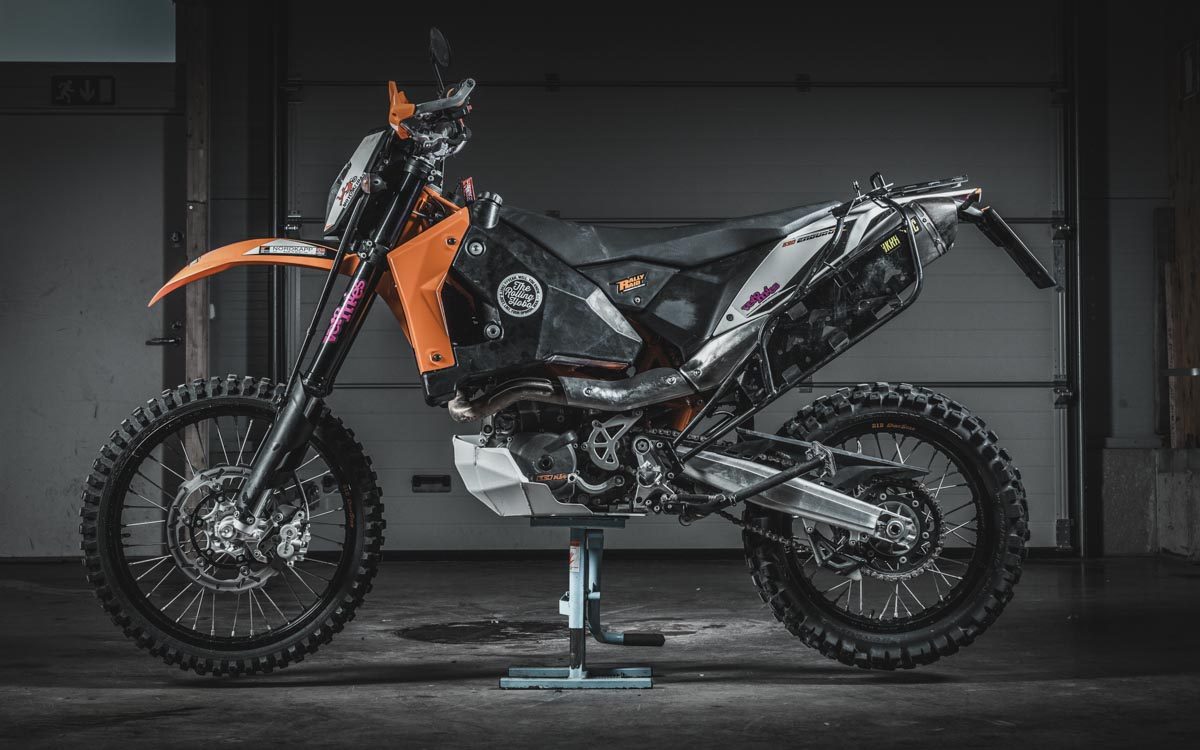
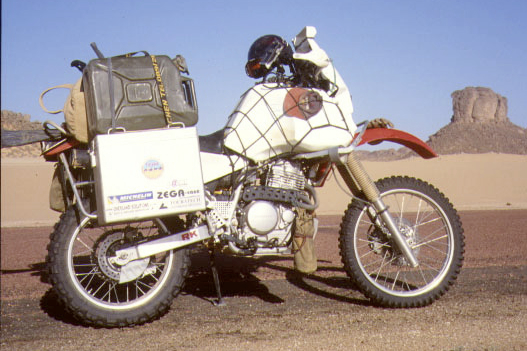
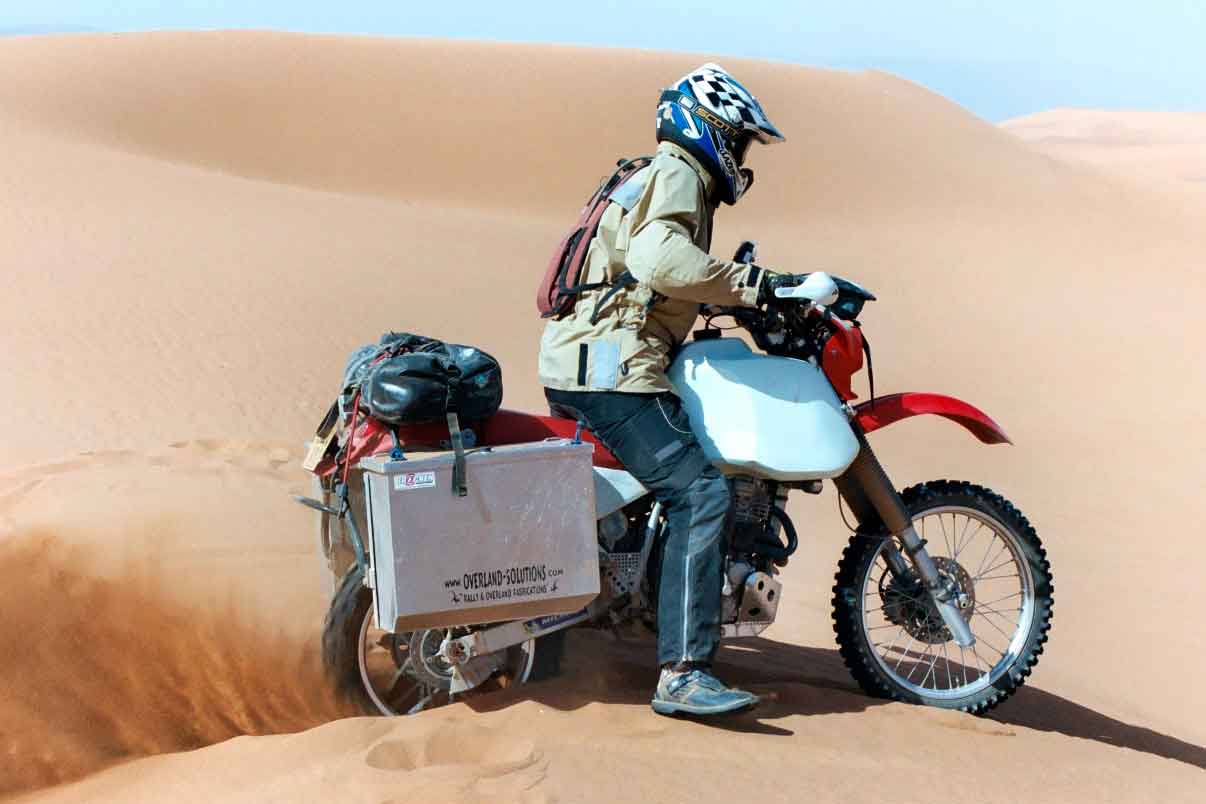
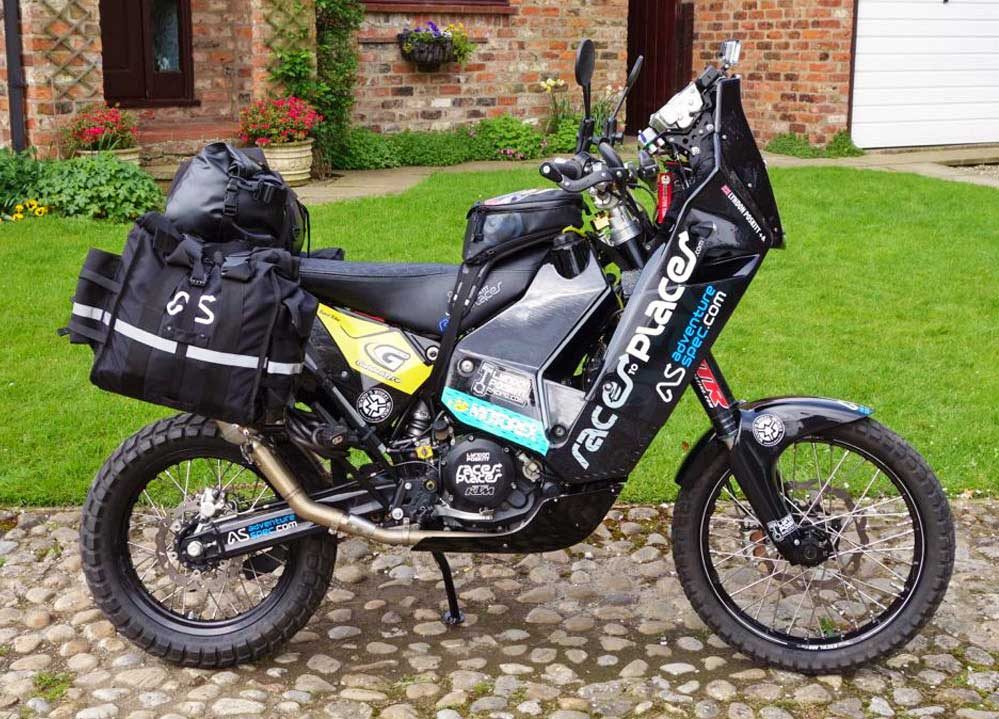
The three builds on this page split along exactly this line. In 2003 Chris Scott's Desert Riders XR650Ls carried 37 litres, about 27 to 29 kg, in one big tank that sat above the carburettor so fuel fed by gravity. His verdict afterwards: "Too high and top-heavy with that giant tank", and "A lower tank with a fuel pump would lower CoG and improve handling." Lyndon Poskitt's 690 Rally carries 32 litres in a factory layout, two tanks beside the engine and one under the seat, which he says "help to keep the weight central and low down." Jussi Hyttinen, The Rolling Hobo, added most of his fuel to his 690 Enduro R in tanks at the front of the bike.
| Build | Fuel carried | Weight of fuel | Where it sits |
|---|---|---|---|
| Desert Riders XR650L, 2003 | 37 L | 27 to 29 kg | One tank, high, above the carburettor |
| Poskitt KTM 690 Rally | 32 L | 23 to 25 kg | Two tanks beside the engine, one under the seat |
| Rolling Hobo KTM 690 Enduro R | 12 L stock, plus added tanks | 9 kg stock | Stock tank under the seat; added fuel mostly forward |
The pump is what made the difference between 2003 and now. A tank mounted below the carburettor needs a pump or a siphon to feed it; a fuel-injected bike already has a pump, so low tanks are easier to plumb on a modern bike. Scott's own advice today: fuel pumps are cheap to run and easy to replace, "so better to suck low than have the mass of the added high."
How much can a rack carry?
Far less than most people load onto one, and the number that matters is usually the structure the rack bolts to, not the rack. On KTM's 690 Enduro the rear subframe is the plastic fuel tank, so the rack is carried by a fuel tank and is rated to match. Honda's current XR650L manual gives a maximum luggage weight of 3 kg, including the luggage itself and any accessories.
| Bike or part | Rated load | Source |
|---|---|---|
| Rally Raid tail pack rack on its 690 aux tank | 2.5 kg | Rally Raid, which advises side racks for luggage instead |
| Touratech aluminium top rack, KTM 690 Enduro | 5 kg | Touratech |
| Honda XR650L, maximum luggage weight | 3 kg | Honda, 2023 owner's manual |
| KTM 690 Enduro R, rear axle | 200 kg including rider | KTM, 2014 owner's manual |
Side racks that run down to the footpeg bracket or the frame put their load into steel instead of into the tail. That is why Rally Raid tells 690 owners not to extend its tail rack for luggage and to fit its soft-luggage side racks, and why Poskitt fitted the rear tank from KTM's 450 Rally: it is a structural part with proper attachment points for a luggage rack. On the Desert Riders XR650Ls, which ran alloy boxes on a heavy rack, Scott found the rear subframe cracked on one bike "and possibly" a second.
Soft or hard luggage?
For rough ground, soft. A pair of Adventure Spec Magadan soft panniers weighs 1.57 kg a side for 32 litres each; one 38 litre Touratech Zega Pro aluminium case weighs about 5.2 kg empty, before the heavier rack it needs. Soft bags sit closer to the bike, can be sewn up in camp, and do less damage to a leg or a subframe in a fall. Hard cases lock, keep water out, and make a table at camp, which is why road-going tourers still choose them.
The Desert Riders trip is the worked example. Scott wrote that the Sahara "took it out of our alloy panniers (never again!)", and his later guides favour soft bags. Both 690s on this page run Adventure Spec Magadans.
Where does low and centered stop working?
Where the bags start to move or get in the way of your feet. Scott's rule carries the exception inside it: low, forward and close, "while allowing for those instinctive corrective dabs when losing control, as well as paddling in soft terrain."
Jussi Hyttinen's 690 shows what happens without that allowance. In 2013 he chose Rally Raid's racks because the bags sit lower and further forward, writing "I don't want to have my luggage far back and high up." By 2018 he had done the opposite: hung low, the left bag touched the side stand, the luggage "could swing a little", and in technical terrain "I kept getting my foot caught between an obstacle and a pannier." So he "raised the panniers higher up and further back", and kept the straps over the seat loose so the weight rests on the frame-mounted racks.
Low and centered is the rule. A bag that swings, or a boot that cannot reach the ground, is where it stops.
How do you pack so the heavy things end up in the right place?
Weigh what you carry once, then pack by density. Tools, spares and water go lowest and most forward: in a tool box on the bash plate if the bike has one, otherwise at the bottom front of each pannier. Clothes and the sleeping bag go on top and toward the back. Keep the two sides within a kilo or so of each other, because an uneven load makes the bike drift to one side. Keep the tank bag for light things you need often. Leave the tail rack for a light roll or nothing, and never stack a fuel can on top of a pannier.
Then check it where it counts. Paddle the loaded bike across a car park and put a foot down on each side; if a bag touches your boot or the side stand, it is too low or too far forward. Push the bike upright from its side stand. If that is hard on tarmac, it will be harder in sand.
Seen on
- Too high and top-heavy: Chris Scott's Desert Riders XR650L, and what he would changeIn 2003 Chris Scott and two friends rode three Honda XR650Ls across the central Sahara to the Lost Tree in Niger and back. To get the range, each bike carried a 37-litre tank mounted high above the carburettor, and a steel rack with alloy boxes and jerricans on top. After the trip Scott put "too high and top-heavy" first on his list of dislikes, named the fix, and later wrote the loading rule it taught him. Few builders publish their own correction, and his is a clear lesson in where the weight should go on a motorcycle.
- Basil: KTM put the fuel low, Poskitt hung the luggage on itMost riders who want range on a single-cylinder bike start with a stock machine and bolt tanks on. Lyndon Poskitt started from a Dakar rally bike whose 32 litres were already split between two tanks beside the engine and one under the seat, and made it tour. The fuel layout is KTM's engineering. His own change was to the rear tank, which on this bike is also the subframe, so the part holding half the fuel ended up holding the luggage.
- Higher, further back, and strapped loose: The Rolling Hobo's KTM 690 Enduro RIn 2013 Jussi Hyttinen fitted his KTM 690 Enduro R with side racks chosen for the reason every packing guide gives: they hold the bags low and forward. Five years and tens of thousands of kilometres later he had moved the same bags higher and further back, because hung low they swung, rubbed the side stand and trapped his boot. The rule is right. This build shows where it stops.
Also in the field guide
Terms on this page
Sources
- Owner's Manual 2014: 690 Enduro R, KTM, read 2026-09-28USA edition, section 7.3 on loading and the technical data. Hosted by a KTM dealer, ktmshop.se. Same chassis generation as the 2013 Rolling Hobo bike.
- Motorcycle Operator Manual, Motorcycle Safety Foundation, read 2026-09-282009 edition, the manual many US state licensing handbooks reproduce. Carrying Loads, and Wobble.
- Honda XR650L 2023 Owner's Manual, specifications, Honda, via ManualsLib, read 2026-09-28A current-model manual. The 2002-era manual for the Desert Riders bikes was not found, so its figures are not applied to those bikes.
- Building an overlanding rack by Chris Scott, Adventure Motorcycling, read 2026-09-28The live site refuses automated readers; read from the Wayback Machine snapshot of 2026-02-12.
- Long-range fuel for adventure motorcycling by Chris Scott, Adventure Motorcycling, read 2026-09-28Read from the Wayback Machine snapshot of 2026-02-14.
- Honda XR650L: after Desert Riders by Chris Scott, Adventure Motorcycling, read 2026-09-28Read from the Wayback Machine snapshot of 2026-02-10.
- Desert Riders: XRL650s in the Sahara by Chris Scott, Adventure Motorcycling, read 2026-09-28Read from the Wayback Machine.
- The Factory Rally-Adventure Bike by Lyndon Poskitt, Lyndon Poskitt Racing, read 2026-09-28The live site refuses automated readers; read from the Wayback Machine snapshot of 2024-08-26.
- Adventurizing the KTM 690 Enduro R by Jussi Hyttinen, The Rolling Hobo, read 2026-09-28
- KTM 690 Enduro R luggage racks: Rally Raid vs. Touratech by Jussi Hyttinen, The Rolling Hobo, read 2026-09-28
- 690 Rear Fuel Tank, Rally Raid Products, read 2026-09-28Maker's product page. Source of the 2.5 kg tail rack rating and the advice against loading it with luggage.
- Luggage rack, aluminium, for KTM 690 Enduro / Enduro R, Touratech, read 2026-09-28Maker's product page. Rated for loads up to 5 kg.
- Zega Pro aluminium pannier, 38 litres, Touratech, read 2026-09-28
- Magadan Panniers Mk3, Adventure Spec, read 2026-09-28
- Unleaded petrol to BS EN 228, specification sheet, ATF, read 2026-09-28Density at 15 °C, 720 to 775 kg/m³, which is the range the standard sets.