
Twelve years on cans, then a tank welded from scrap: Landcruising Adventure's BJ45
Coen Wubbels and Karin-Marijke Vis left the Netherlands in 2003 in a 1984 Land Cruiser BJ45 for a two-year trip that lasted more than twenty. They carried reserve diesel in jerrycans on the roof until the roof bars broke, and drinking water in cans for twelve years until a broken exhaust freed the space for a tank. Both moved under the floor, for reasons they wrote down, and the cans never quite went away.
By Chad Sig · Published
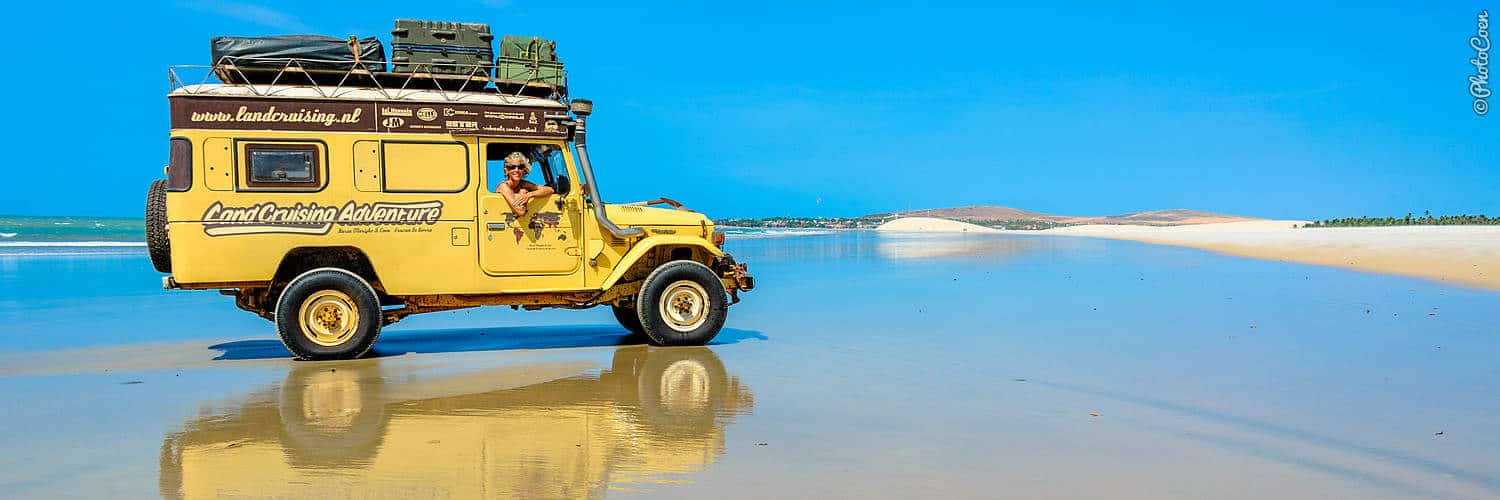
Toyota Land Cruiser BJ45, the long-wheelbase 40 Series, 1984, with the 3B 3.5 litre naturally aspirated diesel and 24 volt electrics. An 85 litre main fuel tank, a 70 litre auxiliary tank fitted underneath in Bolivia in 2010, and a 100 litre stainless water tank under the floor from 2015.
What it is designed for
Living aboard for years
Water used every day for drinking, cooking and washing, which is what eventually justified a plumbed tank.
Range on the main tank
An 85 litre tank for 600 to 750 km, and a reserve that is almost never needed.
Keeping it simple to fix
Their first tip on water systems is that the simpler it is, the fewer headaches.
Who built it
Coen Wubbels and Karin-Marijke Vis set out from the Netherlands in 2003 in this BJ45, meaning to be gone for two years. They wrote and photographed the trip as Landcruising Adventure for more than two decades, Karin-Marijke mostly writing and Coen mostly taking the pictures and doing the mechanical work, including everything in this note. Coen died in 2026. The photographs here are his.
What it gets right
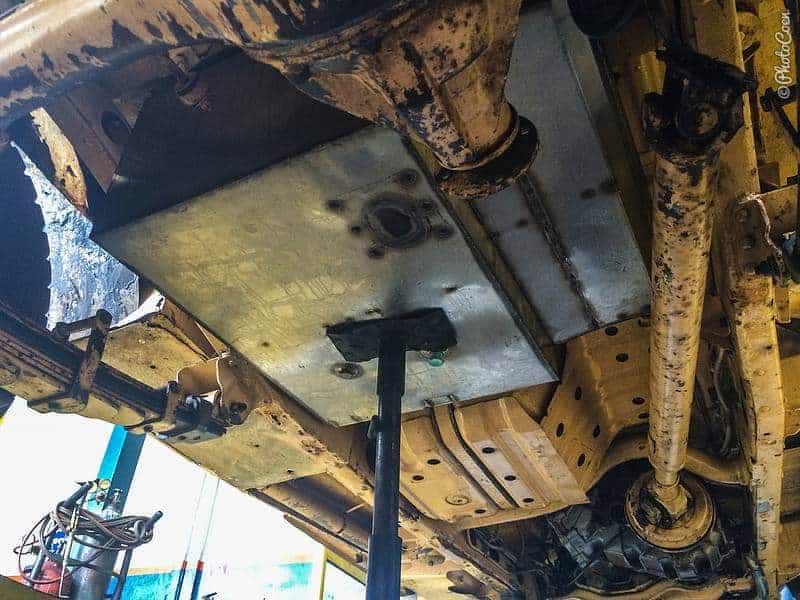
This truck answers the cans-or-tank question twice, years apart, and both answers move weight off the roof and down between the axles. The fuel moved first, because full jerrycans on the roof kept breaking the rack. The water moved later and more by luck than plan: a broken exhaust took them to a shop that could weld stainless, a shorter exhaust freed the space under the floor, and two scrap tanks became one 100 litre tank. Their rule for water is the most useful thing on the page: for a trip of a year or two, carry containers; for a life on the road, the tank pays for itself.
In Coen Wubbels (Landcruising Adventure)’s own account
- The rule, as they put it.
“For a 1- or-2-year journey, we'd stick to containers for budget reasons. Now that we have been – and will remain – on the road for so long, the investment of a watertank, filters, sink, etc are worth it.”
Source - The tank had been on the list for years.
“For years a better water system simmered in the back of our heads but we never took the time to make it happen. A good water system is one of those things to think through before departure and to install when building your vehicle. Oh well, we took 12 years to get to that point…”
Source - Good water cans were hard to replace outside Europe, so one of theirs was a boat fuel can.
“we found it hard – and in some countries impossible – to find top-quality water canisters (outside Europe). As a result our second canister is one of those red, plastic, high-quality fuel carriers that are used on boats.”
Source - The space came from the exhaust.
“This system would free sufficient space under the Toyota to install a 100-liter water tank (the original exhaust passed diagonally under the car, taking up a lot of space).”
Source - They went looking for food-grade stainless and found it in a scrapyard.
“He answered that for the equivalent of $20 we could take both tanks. I tried not to blink and had to restrain myself from running to the car to get money and shout for joy.”
Source - The labour is the real cost, done by a shop crew between their paid jobs.
“We took about five days of cutting and welding to fabricate the tank as well as the metal brackets to hold it in place.”
Measured: A stated time, not a price. The page does not say what the shop charged. - Fuel: why the jerrycans came off the roof.
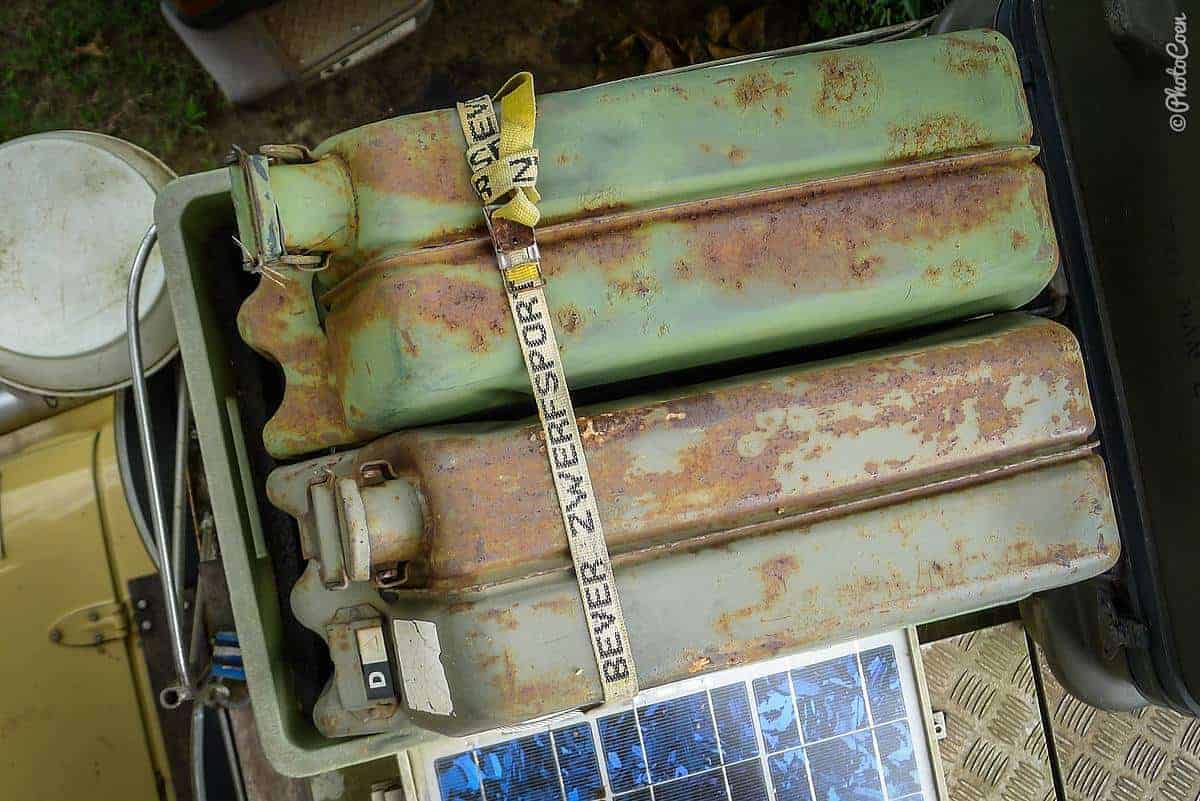
“The disadvantage is, when filled, their weight on the roof. Roof bars, but also window bars broke and were welded on numerous occasions.”
Source - How often the reserve fuel was needed: a handful of times in twenty years.
“With our regular, 85-liter tank we can drive some 600-750 kilometers. The only time we needed our spare diesel jerry cans was along the coast of the Persian Gulf (Iran).”
Source - Coen's advice to a reader planning tank size: start from distance.
“I think you need to think about range instead of liters. What distance feels good to you? 1000 Kilometers or range sounds good to me, but for you it might not be enough. If you agree on a range, then you can calculate your tank capacity.”
Source
Dirtbeam’s reading
Not stated by the builder. This is what we take the build to show.
- The two moves use the same test differently. Water is drawn on every day, so a plumbed tank saves handling every day as well as moving weight down. Reserve fuel is drawn on a handful of times, so its tank was bought for the roof's sake, not for convenience. That split is our reading; they state the water rule and the roof damage, not the comparison.
- 100 litres of water is about 100 kg, and their roof sits about 2.7 metres up with its extension and rack. Under the floor between the axles is the lowest place on the truck that weight can go. They do not make the centre-of-gravity argument; the photographs and the weights make it for them.
- The $20 is a scrapyard price for material, not the price of a tank. The real costs were a shop able to weld stainless, five days of its crew's time, and a space that only existed because the exhaust had broken.
What it gives up
A tank built into the space that happened to be free is shaped by that space. Theirs costs them awkward access to the plumbing, an improvised way to fill it, no level gauge, and the whole system in winter, when they drain it and go back to cans. The fuel cans stayed on the roof as a rarely used reserve, which is a choice to keep a little weight up high for the few places that need it.
In Coen Wubbels (Landcruising Adventure)’s own account
- Everything had to fit the rear corner, and access paid for it.
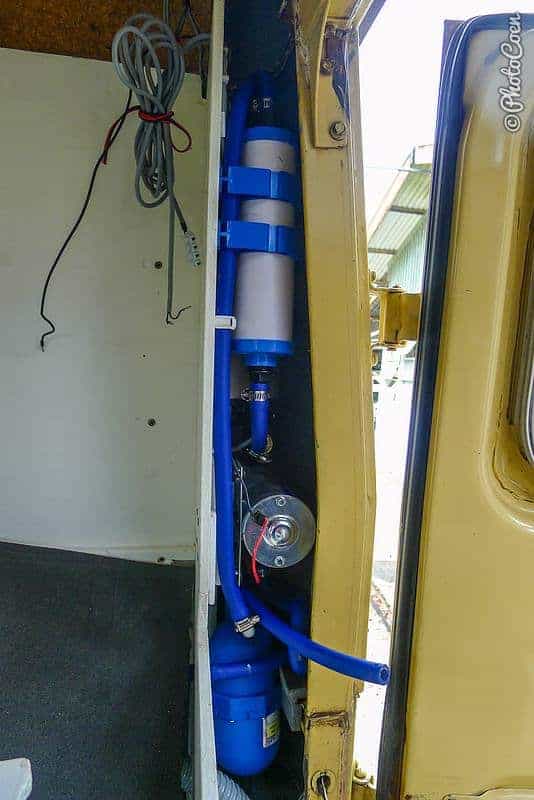
“Everything had to be installed into the rear back-end corner so we wouldn't lose valuable packing space.”
Source - The compromise that made it fit.
“It was not the best solution as it meant that hoses would bend 45 degrees every time we would need to access the water system’s core, but at least it now all fit.”
Source - A pump that keeps pumping into a leak, and the switch that stops it.
“This means that when there is a leak, the pump will continue pumping water. To prevent this from happening, I installed a switch to cut the power to the pump.”
Source - Filling it: a cut-up bottle and a hose.
“We now have a cut-up, plastic bottle to which I attached a piece of hose in order to create some sort of funnel system in which we can pour water using our 20-liter wash bag.”
Source - Freezing, which they had not planned for, and what they do about it.
“Freezing is an issue. We never thought about that because we traveled in the tropics. So in winters in Japan / Russia/Central Asia, we run the tank dry, close off the system and go back to carrying 2×20 liter jerrycans inside the vehicle.”
Source - The reserve fuel stays, unused day to day.
“We have a 70 liter aux tank, but this one is never used on a daily basis, as are the two jerry cans on the roof.”
Source
Dirtbeam’s reading
Not stated by the builder. This is what we take the build to show.
- The freezing note is the strongest argument for cans in the whole record. A tank under the floor is outside the heated space, and so is the hose that feeds it, so in a cold winter the tank is dead weight and the cans come back. A tank inside the living space avoids that, which is the lesson Bearfoot Theory's vans arrived at from the other direction.
- Fitting a tank on the road meant designing around what was already there. A tank planned at the build, as they say themselves, could have had its fill, its gauge and its service access designed in rather than improvised afterwards.
The kit
- Lighting
- Not part of this note. The pages we read do not make a lighting argument.
- Storage
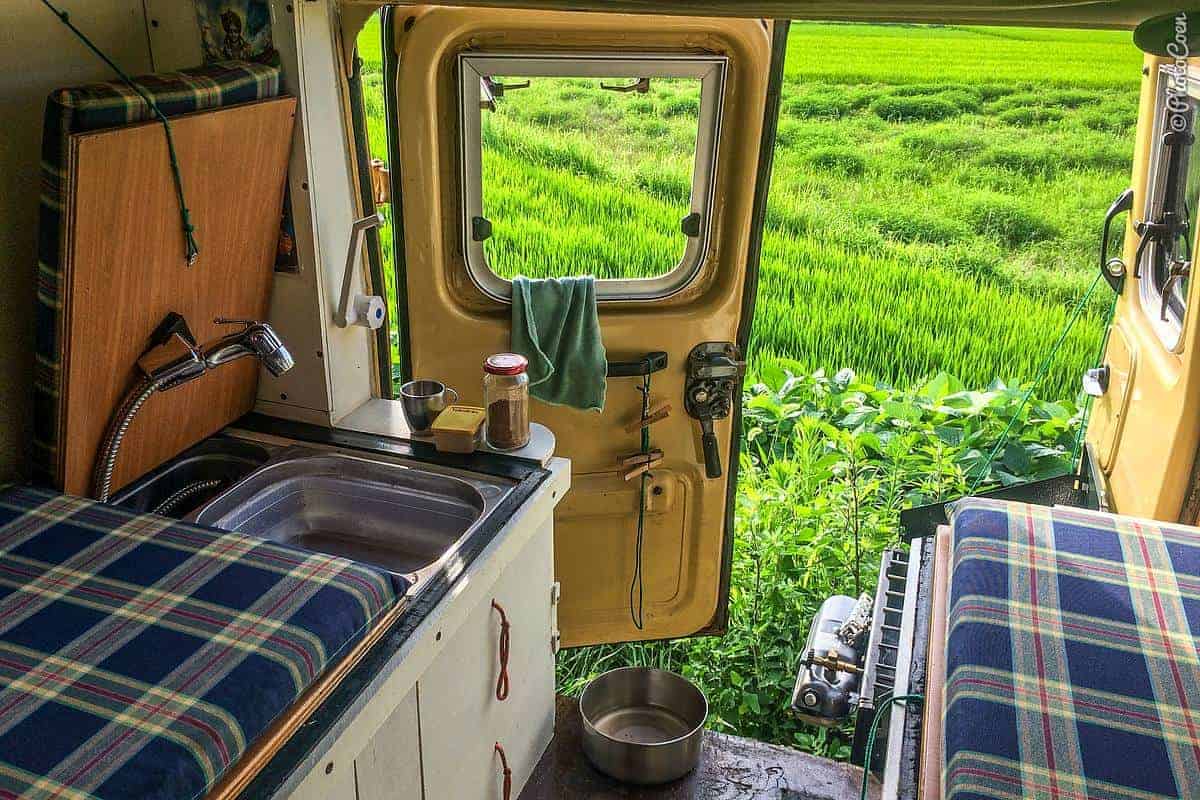
- Bunks behind the front seats double as seats and storage. For twelve years the middle section held a 20 litre water can, a shower bag, chairs, a table and the toolbox; from 2015 that space came free when the water went under the floor. A sink with a hand shower sits by the rear door, fed by a pump, with a sediment filter and a UV filter on a separate drinking-water tap. Fuel: 85 litres main, 70 litres auxiliary underneath, and two jerrycans on the roof.
- Recovery
- Not part of this note. Their recovery gear has its own page on their site.