
What is GVWR, and how do you know if you are over it?
By Chad Sig · Published
The short answer
GVWR, gross vehicle weight rating, is the maximum your vehicle is permitted to weigh fully loaded: not what it can carry, but what it may total, including the vehicle itself, its fuel, everyone aboard and everything you put in. Federal law defines it as the value specified by the manufacturer as the loaded weight of a single vehicle, which makes it a declaration rather than a measurement, and it is printed on the certification label in your driver's door opening. It never changes for the life of the vehicle. What you can carry is payload, and payload is a subtraction: GVWR minus what your specific vehicle actually weighs empty. That second figure is not on any brochure, because every option adds weight, so the only way to know your own payload is to drive onto a scale. A bigger rating is also not a bigger payload: FarOutRide ordered a van with 500 lb more GVWR than their last one, took all-wheel drive and a turbocharged engine in the same order, and ended up with 30 fewer pounds to pack.
What does GVWR actually mean?
It is a ceiling on the whole vehicle, not a measure of its strength. The federal definition is deliberately plain: gross vehicle weight rating means the value specified by the manufacturer as the loaded weight of a single vehicle. Read that twice, because the load-bearing word is specified. Nobody derives your GVWR from testing your particular truck. The manufacturer sets it, having designed the brakes, the axles, the tires and the frame around it, and then prints it.
Which means the number is a design envelope with a legal wrapper, and the things inside the envelope are the reason it exists. Stopping distance is certified with the vehicle loaded to that figure and no further. The axles, the wheel bearings and the tires are chosen against it. Past it, nothing has been promised about how the vehicle behaves, and no test has been run.
Where is your GVWR written?
On the certification label in the driver's door opening. 49 CFR 567.4 requires it to carry the gross vehicle weight rating and then an axle rating for each axle, front to rear, and on a vehicle rated 10,000 lb or less a second label, the tire and loading placard, states how much combined weight of occupants and cargo the vehicle should never exceed. Our page on flatbed truck campers reads both labels closely, including the fixed wording the standard puts on the placard.
The part worth repeating here is which number to use. A brochure's maximum payload belongs to the lightest configuration in the range, usually a two-wheel-drive, short, basic version nobody converting a van would buy. The placard is calculated for the vehicle you are standing next to, options already subtracted, and it is the only figure that describes yours.
Why does a bigger GVWR not mean a bigger payload?
Because payload is a subtraction, and the thing being subtracted moves too. Payload is GVWR minus curb weight, so a heavier rating only helps if the vehicle underneath it did not get heavier by as much. Options are the usual culprit, and they are bought in the same conversation as the rating.
FarOutRide have done this twice and published both halves, which is what makes the comparison possible. Their first Transit was rated 9,000 lb against a 5,500 lb curb weight from the spec sheet, which is 3,500 lb of payload. Ordering the second they took their own advice and bought the 9,500 lb package, 500 lb more rating, and in the same order took all-wheel drive, the 3.5 EcoBoost and the extended-range tank. That van weighed a measured 6,030 lb empty. Its payload is 3,470 lb.
Five hundred pounds of extra rating came back as thirty fewer pounds to pack. The two figures sit one table apart on the same website.
Nobody on that site draws the line between those two numbers, and it is not a criticism of the build: it is the clearest demonstration available that rating and capacity are different quantities that move independently. The 500 lb was spent at the order desk, on drivetrain, before a single screw went in. Buying rating is still the right move, and it is their own advice, because the alternative is having less. It is just not the same as buying capacity.
How do you find out what your vehicle actually weighs?
You drive it onto a scale, loaded the way you actually travel. There is no substitute and no arithmetic that gets you there, because the published curb weight belongs to a configuration rather than to your vehicle, and because the things that vary most are the things spec sheets never list.
Water is the clearest case. It weighs about 8.34 lb per US gallon, so a 33 gallon tank and a 24 gallon tank together are roughly 475 lb when full and nothing when empty, and that swing appears in no parts list because it arrives from a hose. Fuel does the same at about 6.3 lb per gallon. Weigh the vehicle empty of those and you have measured a vehicle you never drive.
The public truck scales are the practical answer, and CAT Scale, whose network most owners will use, publishes how to sit on one: the vehicle must be completely on the scale, with the steer axle on the first platform and the drive or rear axle on the second. That gives a total and a split between the axles, which is the pair of numbers you need. It does not give you a corner-by-corner weight, so it cannot see side to side imbalance.
Can you be under your GVWR and still overloaded?
Yes. Every axle carries its own rating, defined in the same regulation the same way, and a vehicle can sit under its total rating with the rear axle over its own, because a total says nothing about where the mass sits. The flatbed camper page works through how that trap is built; what this page can add is what it looks like when it catches somebody careful.
The most useful exchange on their weight page is in the comments. A reader writes that fully loaded with gear his rear axle exceeded its rating by about 200 lb, and asks how theirs came out. Antoine's answer is that they could only do a total weight, so he is not sure about the rear axle, and that he is curious now and will try to find a scale. Two careful engineers, a published weight page, an instruction to measure both axles, and the axle number is the one nobody has. That is not a lapse peculiar to them. It is what happens when the easy measurement and the important one are different measurements.
Do bigger springs or air bags raise your GVWR?
No, and the clearest statement of it comes from a builder on the page where he installs the kit: an air suspension kit, or any other aftermarket suspension kit for that matter, does not increase the GVWR of your vehicle, and in other words it does not add payload capacity. That is written on a page carrying affiliate links to the product, which is the kind of sentence worth trusting.
What they do buy is real and worth having: the air bags increase the rear suspension stiffness, which restores the sag, reduces sway and improves the overall handling of the van. That is a fix for how an already-legal load rides, not permission to carry more. And the kit itself weighs about 80 lb, so it spends payload to do its job.
Our page on flatbed truck campers works through the regulations underneath this, including the one federal path to a re-rating and why it closes before a private owner can use it, along with the Australian scheme that keeps one open.
What about the roof?
The roof has its own budget, and GVWR arithmetic never touches it. It is also much smaller than people expect: on FarOutRide's reading of Ford's manual for the extended van the limit while driving is 200 lb, and a 70 lb rack plus about 60 lb of solar is 130 lb of it before anything is stowed. Our page on what a roof can carry works through the two separate ratings and what the weight up there costs in fuel.
Where should the weight go?
Low, and the builders state the rule before they follow it: the holy grail of safety, performance and handling for any vehicle design is to keep the vertical centre of gravity as low as possible. They put the comparison in the same breath, with examples on each side. Weight added higher, a roof rack, overhead storage, ceiling material, has much more impact than weight added at floor level, a battery bank or a water tank.
They also split centre of gravity into three axes and give each its own consequence, which is more careful than most writing on the subject. Front to back drives the axle weights, steering and traction. Side to side drives the load on the left and right tires and roll in a turn. Up and down drives brake dive and roll. Only the first of those is visible on a truck scale, and only the third is the one most people have heard of.
What we do not know
No axle-by-axle weight exists for the worked example on this page, by the builder's own account, so the one number that would test the rear axle argument on a real van is missing. Nor is the second van finished: its published conversion breakdown totals 1,125 lb with the water system, the cabinets, the walls and the storage still blank, and the total row on its table reads Wait for it.
The first van's own arithmetic has a gap we cannot close either. Its three published rows, 5,500 lb of curb weight, 1,800 lb of conversion and 1,700 lb of everything else, sum to exactly 9,000, which is the rating, while the total underneath reads 8,950. All three components are round hundreds and the total is not, so the components are probably rounded. Either way the margin at the end of a careful conversion by two engineers was smaller than the rounding in the numbers that produced it, which is the most useful thing that page demonstrates by accident.
Seen on
Also in the field guide
Terms on this page
Sources
- Weight ratings explained, and our van conversion weight breakdown by Antoine Gagne and Isabelle Richard, FarOutRide, read 2026-08-27The worked example on this page, and the rare case of a builder publishing a payload budget before the build and a measured curb weight after it. The site sells conversion plans and runs affiliate links throughout, disclosed on its about page. The decisions cited here have nothing to sell, and one of them argues against a category of product the site links to.
- Ford Transit order guide for a camper van conversion by Antoine Gagne and Isabelle Richard, FarOutRide, read 2026-08-27Source of van 1's published budget and of their advice to buy the highest payload package available. Monetised as above.
- Air Lift air suspension install on a Ford Transit by Antoine Gagne and Isabelle Richard, FarOutRide, read 2026-08-27The page states plainly that an air suspension kit does not add payload capacity, on a page that links to the kit it installed. Advice against the adviser's own affiliate interest.
- Roof rack for a Ford Transit by Antoine Gagne and Isabelle Richard, FarOutRide, read 2026-08-27Source for the distinction between a static and a dynamic roof load rating, and for which document each comes from. Their reading of Ford's figures, not Ford's own page, which we could not retrieve.
- 49 CFR 571.3, Definitions, US Code of Federal Regulations, via Cornell Legal Information Institute, read 2026-08-27The federal definitions of gross vehicle weight rating and gross axle weight rating. Both are written as a value specified by the manufacturer, which is the whole point this page makes about what a rating is.
- 49 CFR 567.4, Requirements for manufacturers of motor vehicles, US Code of Federal Regulations, via GovRegs, read 2026-08-27What the certification label must carry and in what order, including an axle rating for each axle front to rear.
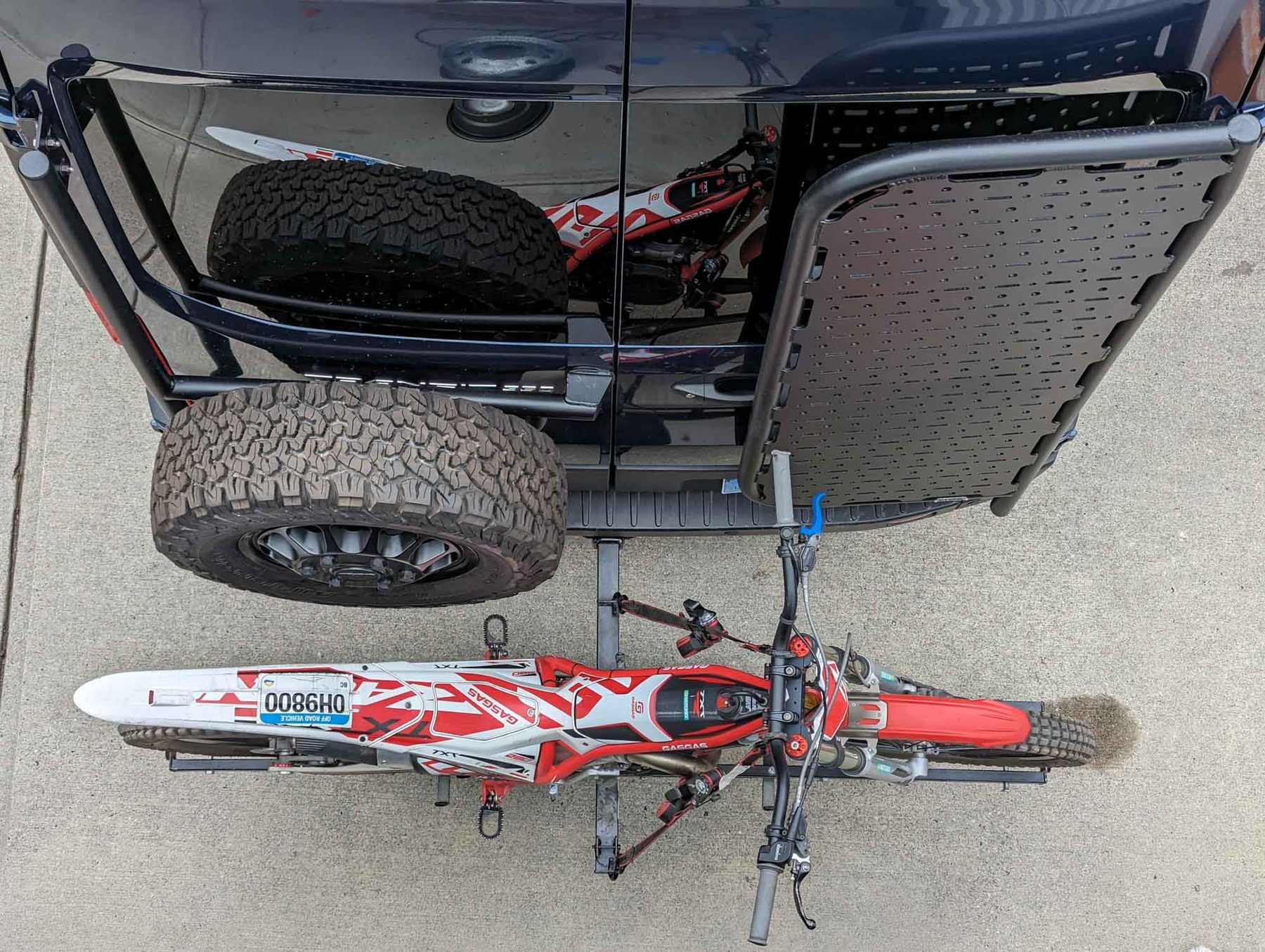
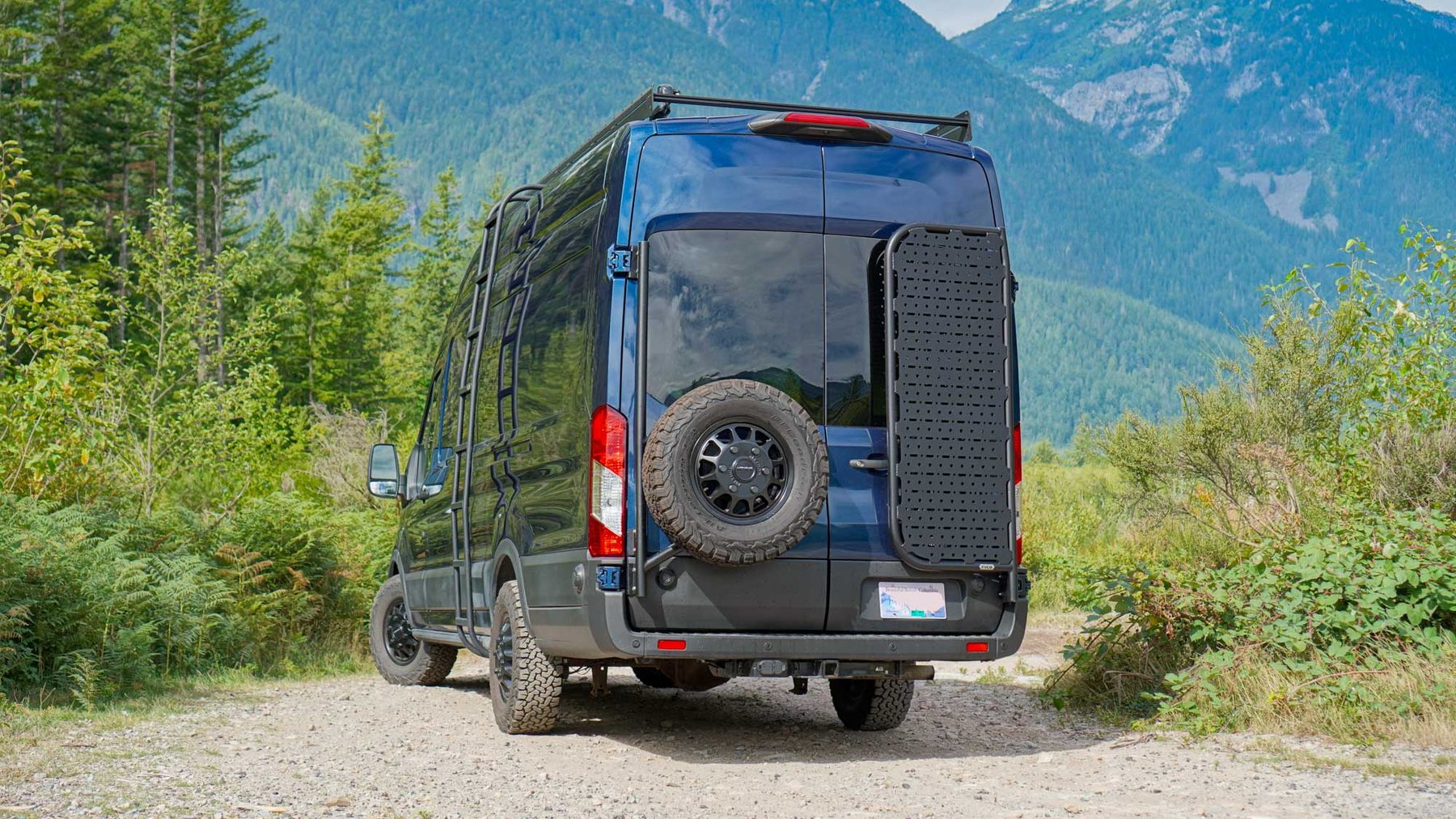
- Rear tire carrier for a Ford Transit by Antoine Gagne and Isabelle Richard, FarOutRide, read 2026-08-27Source of the photograph on this page, and of the spare-tire swap it shows.
- How to weigh, CAT Scale, read 2026-08-27The operator of the public scale network most owners will actually use, on how to position a vehicle across the platforms. CAT Scale sells weighings.