
Three 4x4 Sprinters: the drivetrain was the easy part
Kristen Bor bought a factory 4x4 Sprinter three times in eight years. The four-wheel drive took her one sentence: snow and rough dirt roads, so it was non-negotiable. The tires, the wheels, the springs, where the water goes and how the family would fit took three vans to get right. Read together, her build pages show where the work in a capable van actually is.
By Chad Sig · Published
Mercedes-Benz Sprinter 2500 cargo van, factory 4x4, 170in wheelbase, high roof, converted by Outside Van. BFGoodrich KO2 265/70R17 tires on Black Rhino Stadium wheels, Agile Offroad RIP suspension kit.
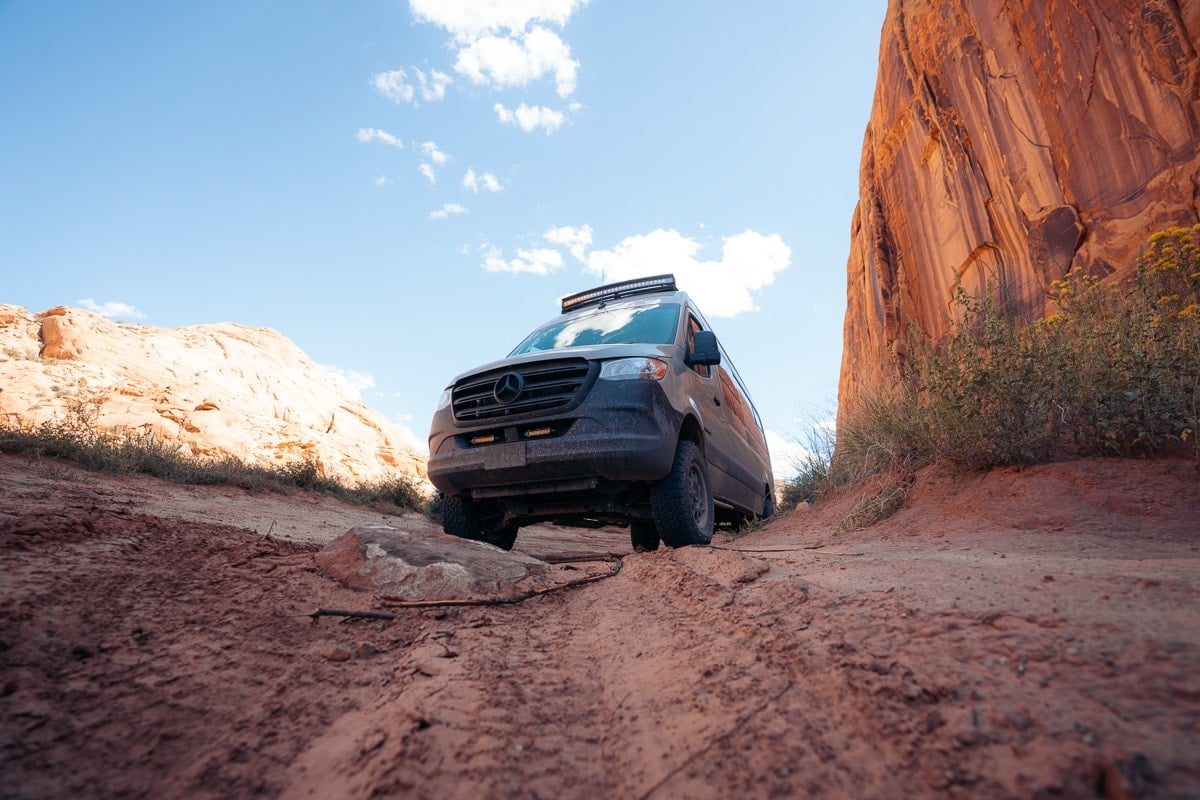
What it is designed for
Getting there, then living there
Dirt roads, mountain passes and ski-area parking lots, in a van that is also the house. Most of the design decisions are about the second half of that sentence.
Winter
Water and plumbing inside the heated envelope, a lesson paid for on van 1. The drivetrain choice sits in the same frame: snow is the one place a van's driven wheels most plainly matter.
A heavy rear end that stays level
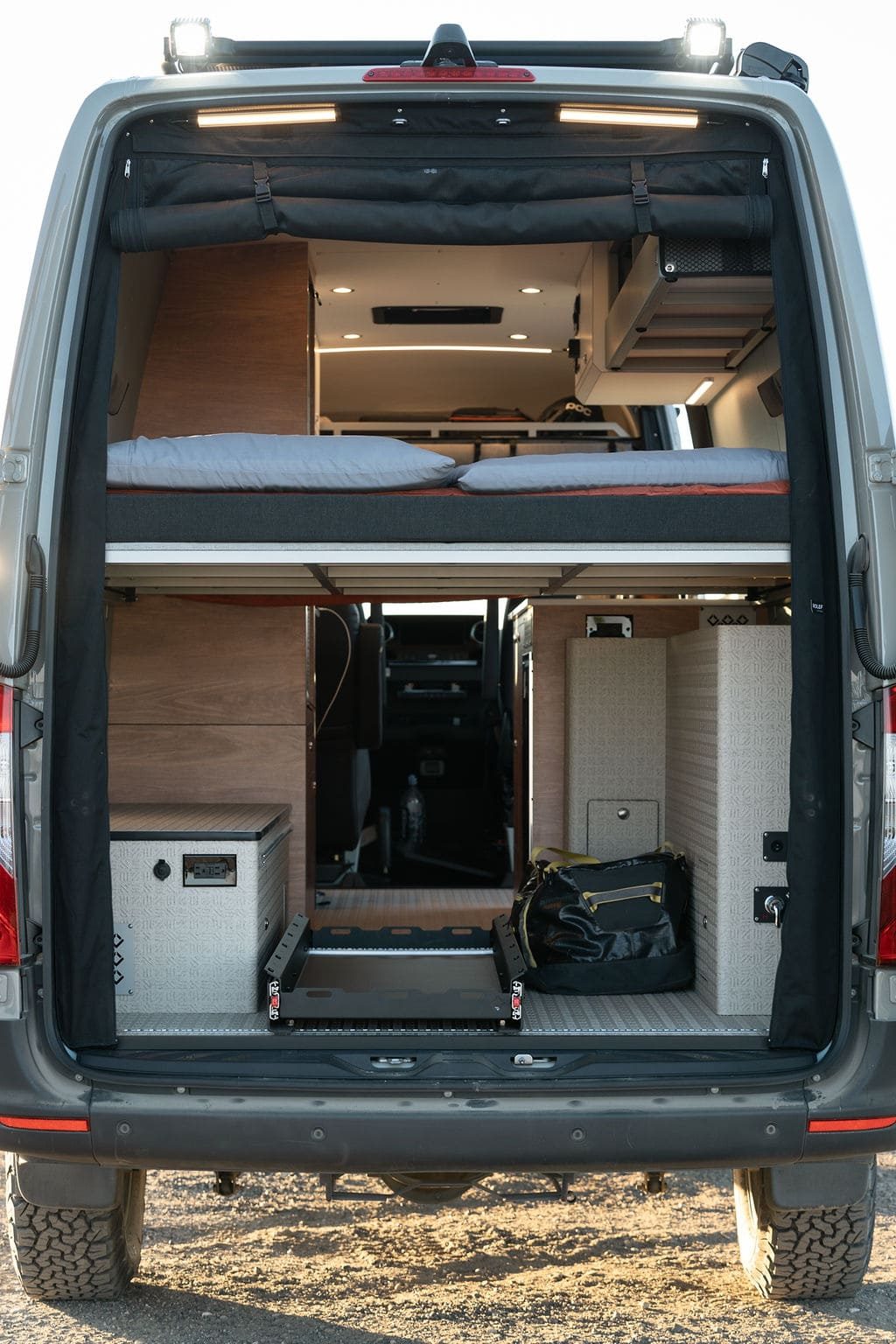
Water and batteries live in the garage over the rear axle, so the rear springs were tuned to rear-axle weight from the day the van was built.
A family that had not arrived yet
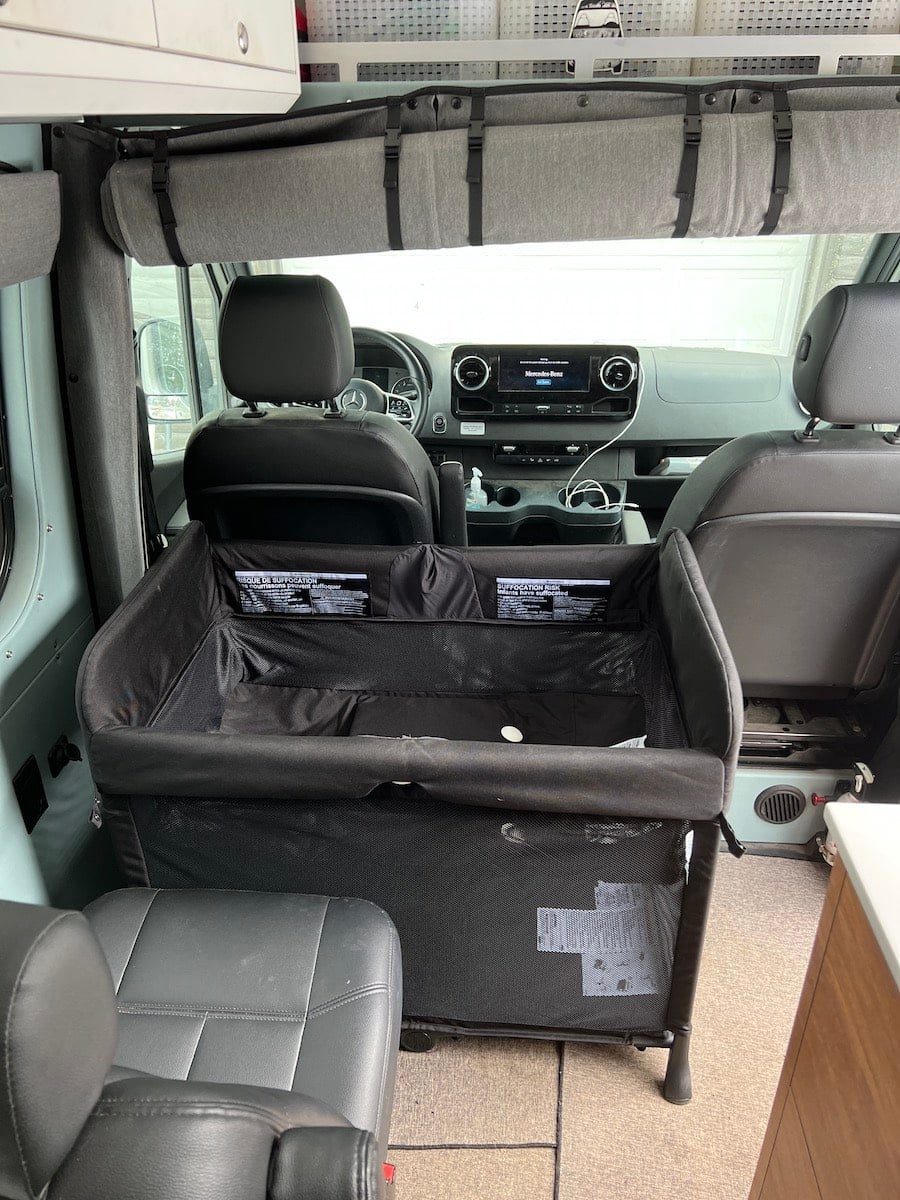
A third seat bought against a planned child. The bed that child would need was not bought, and she says so.
What it gets right
What makes this build worth reading is not any single choice but the run of three. Kristen Bor has published a tour of every van, and each one carries forward the lesson of the one before. The 4x4 is the constant, settled early and for a stated reason. The things that changed are the things that decide whether a heavy van actually gets through and stays livable: the tires, the wheels, the suspension, where the weight sits, and the floor plan.
In Kristen Bor (Bearfoot Theory)’s own account
- Why a 4x4 at all, in her words, written while she owned her second van.
“We spend a lot of time in the snow and on rough dirt roads, so this was a non-negotiable for me.”
Source - And her verdict on it after living with one.
“I have been very impressed with the performance of my 4 wheel drive Sprinter and would choose to get the 4x4 upgrade if I were to get another one.”
Source - Why the same drivetrain a third time: the previous van's record.
“We took our previous van to some pretty crazy places. We drove over rocky 13,000 foot passes in Colorado, chased powder, camped off hundreds of dirt roads, and more.”
Source - The decision, stated as not needing to be a decision.
“So I didn't hesitate to choose the same exact chassis for this van conversion.”
Source - What she names as essential, in the sentence where she says how she uses the van.
“We do a lot of off-roading in our Sprinter Van, so having an excellent all-terrain tire and upgraded suspension was essential.”
Source - Wheels chosen on load rating rather than looks.
“I chose these specific wheels because they have a heavy duty load rating at 2,450 lbs/wheel.”
Source - What a converted van on stock suspension feels like, from someone who lived in one.
“In bumps, windy conditions, or even pulling out of a driveway, a converted Sprinter Van with stock suspension has an unnerving amount of sway.”
Source - Why the second van sagged: the heavy things were in the garage.
“In my second Sprinter van, I had 25 gallons of water and a very heavy battery bank in my garage and found that the back of my van was sagging due to all of that heavy weight weight.”
Source - And the third van's answer, specified against the axle rather than the vehicle.
“In the rear, the factory leaf spring system was replaced with a progressive six leaf spring system, and the system in tuned based on your rear axle weight.”
Source - Van 1's mistake, which set the plumbing rule for every van after it.
“I spend a lot of time in wintery climates and my exterior 15-gallon tank is unusable in winter, limiting me to the 10-gallon tank inside.”
Source - Van 2's fix.
“I wanted my entire plumbing system contained inside the van, so I didn't have to worry about anything freezing in the winter.”
Source - The fixed bed, which is a full-timer's decision.
“This provides us with a stable and cozy place to sleep every night without the hassle of setting up or breaking down a bed.”
Source
Dirtbeam’s reading
Not stated by the builder. This is what we take the build to show.
- The proportions are the lesson. The four-wheel drive is one checkbox, decided for a clear reason and kept for three vans. The pages of explanation go to tires, wheels, springs, shocks, water tanks and the floor plan. That matches where a heavy van's capability comes from: a Sprinter's factory 4x4 drives the front axle and lifts the body a few inches, and what then gets a 9,000 lb box through a rut is tire grip, suspension that keeps the tires on the ground under load, and clearance.
- Choosing wheels on load rating is the detail that tells you she was thinking about weight, and it is a check most people skip. The test is per axle, not per vehicle: each wheel has to carry half of its axle's rating, the GAWR on the door label, and on a garage van the rear axle carries well over half the load. Adding up four wheel ratings and comparing the total with the vehicle's GVWR, which is the tempting shortcut, says nothing useful. Her pages give the wheel rating but not her van's rear axle rating, so we cannot say how much margin she bought, only that she asked the right question.
- The suspension story is a weight story. Van 2 sagged because the water and the batteries sat over and behind the rear axle. Van 3 put the water tank and the electrical back in the garage, and specified a rear spring tuned to rear-axle weight on day one. She fixed the symptom and kept the layout, which is a reasonable trade: a garage van needs its garage, and the fix is cheaper than a new floor plan.
- The revision chain on water is the cleanest in the record. An exterior tank that froze on van 1, all plumbing inside on van 2, and a tank in a garage cabinet inside the heated space on van 3. Three pages, three vans, one lesson applied twice.
What it gives up
The limits of these vans are mostly about living space, and they are what she eventually left the vans over. The one capability limit on record is a single line about her second van, and she tells it as the exception.
In Kristen Bor (Bearfoot Theory)’s own account
- Her second van, the 4x4 with the Van Compass suspension, and the one time it met a road it could not climb. She tells it as the exception to years of remote roads, not the rule.
“The van performed beautifully, and I rarely felt limited by it...other than the time we had to back down Ophir Pass after getting stuck in a big shale rut. Whoops!”
Source - The scale of the experience behind that line.
“I owned three different Sprinter vans over eight years, spent more than 2,000 nights living on the road.”
Measured: Self-reported. Her about page gives 1,526 nights in vans; the larger figure appears to include the truck that followed. - The galley decision and its cost, stated together by her.
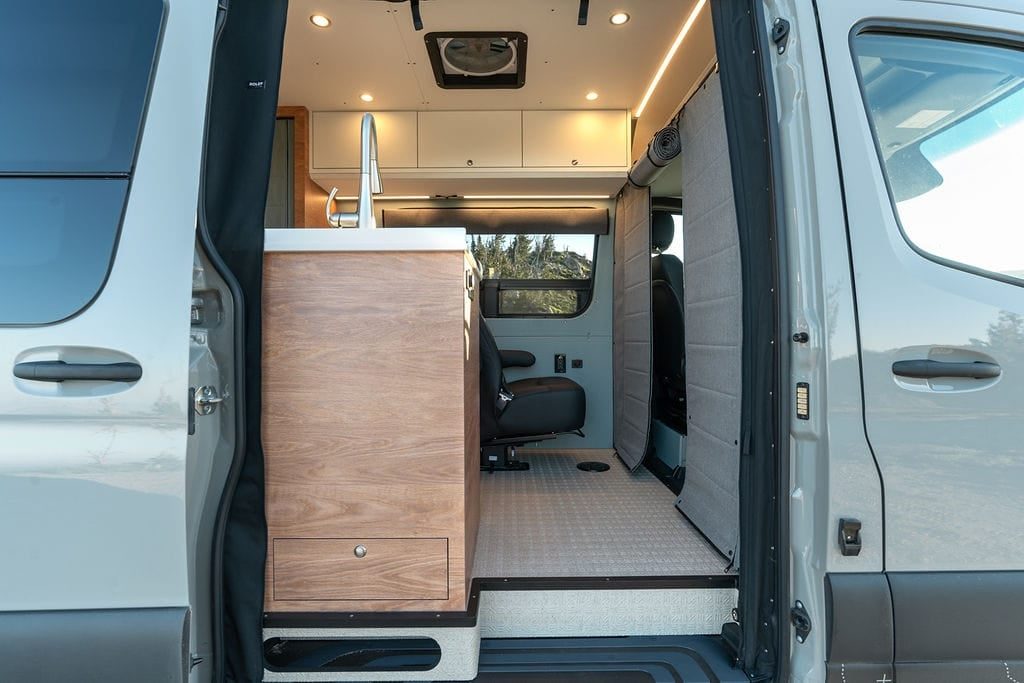
“I chose to have the custom galley come out into the slider door to maximize the use of space in the van. I loved being able to look out the slider door while doing dishes, but this definitely contributed to the cramped feeling inside the living area.”
Source - The storage-versus-space regret, from her least-favourite list.
“All of those cabinets were amazing for storage, but they came at a cost.”
Source - The third seat, bought against a future child.
“As my partner and I were planning to start a family, I needed a layout that included a captain's chair behind the drivers seat.”
Source - And the half of that plan she did not build.
“I wasn't certain if I would get pregnant, so I hesitated to design the space around an additional bed for a child.”
Source - Why the vans ended: space, not capability.
“after attempting full-time travel with my newborn and two dogs, it quickly became clear that we needed more space to make this lifestyle feel sustainable”
Source
Dirtbeam’s reading
Not stated by the builder. This is what we take the build to show.
- Ophir Pass does not say four-wheel drive failed, and she does not say what stopped the van: traction, clearance or the shape of the rut. What it does show is that a factory 4x4 van has a ceiling. The pre-2023 Sprinter system splits power 35 percent front and 65 rear through a centre differential, with open differentials on both axles and the brakes doing a locker's job by slowing a spinning wheel. Nothing locks mechanically. On a long, tall van in a deep rut, that is a real limit, and it is a reasonable place to picture where a van ends and a truck begins.
- She writes that the rear spring pack increases the payload capability. The springs may well carry more before they sag; the rating on the door label does not change, because payload is the vehicle's GVWR minus what it weighs, and no aftermarket part moves the GVWR. It is the most common misreading in van building, and our GVWR page covers it.
- The 4x4 is also part of the weight budget. On a current Sprinter the AWD version weighs about 360 lb more than the same van in rear-wheel drive, with the same GVWR, which is about 360 lb less for water, batteries and a family. Her vans are the older 4x4 system and its penalty was not published, but the direction is the same.
- Her exit continues her own regret list rather than contradicting it. The van 3 page says there was not enough open space and no bed for a child. The truck review says the family needed more space. Capability is not mentioned in either. The drivetrain question, which gets most of the attention when people price a van, was not the one that ended the vans.
The kit
- Lighting
- Not documented in the pages we read, and not the subject here. We make no claims about it.
- Storage
- A garage van. The rear under the fixed bed holds the water tank in one cabinet and the electrical system in the other, with a gear slider on the floor between them, which puts the heaviest fixed items over the rear axle. The galley stands in the sliding-door opening, which gained counter space and a view and cost living room. Cabinets throughout, which she later judged to be more storage than the space could afford.
- Recovery
- Not documented as equipment in what we read. The recovery that is documented is backing down Ophir Pass in her second van, which is the one every van driver should practise: the way you came in is usually the way out.