The truck built around the worst day
Almost every overland build is organised around getting somewhere. Brad Kowitz spent 26 years as a Navy corpsman and built a Gladiator organised around what happens after you arrive at a bad scene. Fifteen months later he published a video saying he had it backwards.
Built by Brad Kowitz (TrailRecon)
By Chad Sig · Published
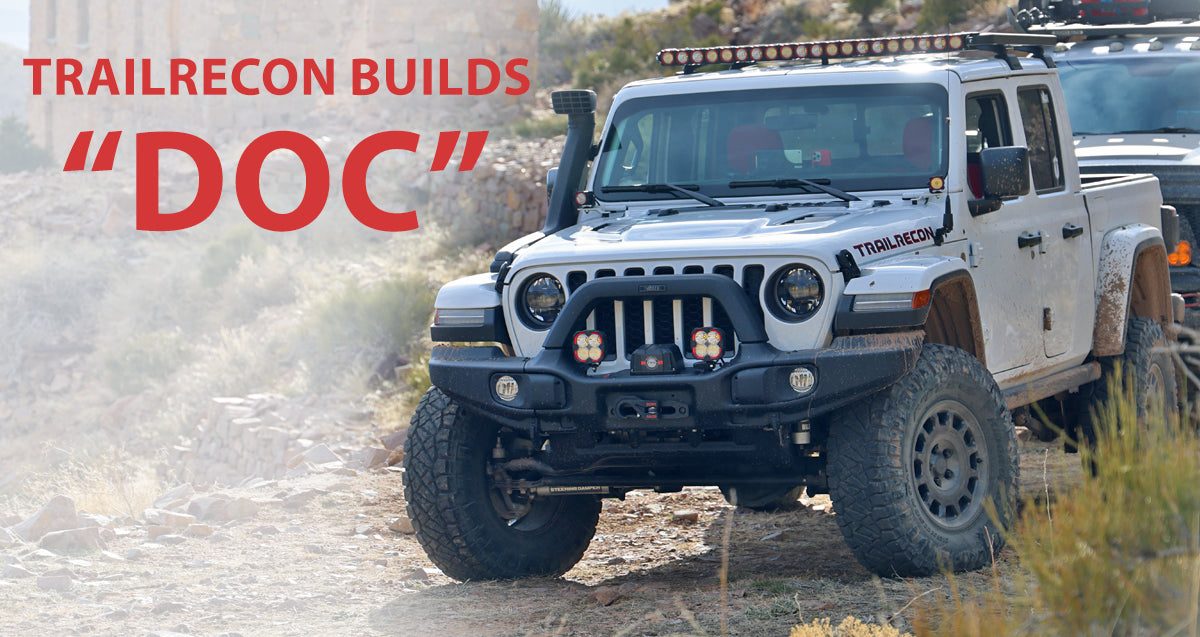
2023 Jeep Gladiator Rubicon (JT), AEV 3in DualSport RT lift, AEV EX Highline front bumper, 37x12.50 Nitto Trail Grapplers on AEV Salta XR wheels, regeared
What it is designed for
Closing the distance to the casualty
The stated model is the Battalion Aid Station, which is defined by proximity rather than by capability. Everything downstream follows from treating the truck as a treatment point that has to arrive, not a vehicle that carries a first aid kit.
Reached from outside, standing on the ground
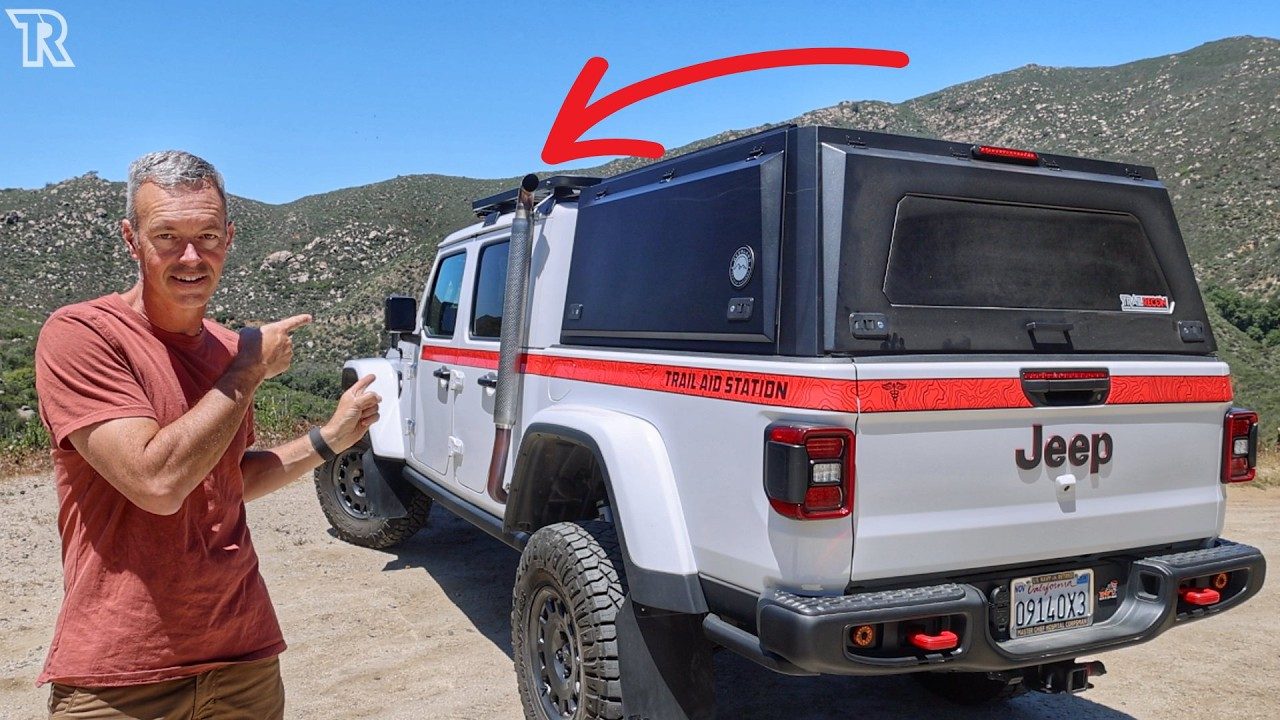
A truck cap with side access doors over the bed, rather than a drawer stack under a bed-mounted tent, so gear comes out at standing height and by somebody who did not pack it.
Light split by job, not bought by output
Four separate KC systems on an eight-circuit switch panel, from a 50 inch bar down to 5 watt under-hood pods. The panel is the design decision made visible.
Drivability first, then the tires it ruled out
He refused 37s in public on drivability grounds, then regeared and runs 37s now. The tire is the same either way; what changed is that the cost got paid first.
What it gets right
The interesting thing about Doc, which is what Marines call the Navy corpsman attached to their unit, is not the parts list, which is a catalogue on the seller's own storefront. It is that the truck has a stated job that is not driving, and the job is specific enough to argue with. A Battalion Aid Station exists to be near the wounded, so the build's real question is what a vehicle needs in order to be useful in the ten minutes after it stops.
In Brad Kowitz (TrailRecon)’s own account
- The mission is stated as medical capability, not a themed trail rig. The wording is careful about which half is the point.
“an off-road vehicle that not only tackles rugged terrain but is also equipped to bring the latest innovations in medical aid to the front lines of adventure”
Source - The design model is named, and it is a doctrine about distance rather than about equipment.
“treat combat casualties efficiently to reduce mortality and stabilize injuries for evacuation, operating as close to the frontline as tactically feasible”
Source - The authority behind the framing is biographical, and the build page states it plainly.
“who served 26 years in the U.S. Navy as a Hospital Corpsman with extensive experience alongside the U.S. Marines, including a combat tour in Iraq”
Source - Kowitz states the truck's priority himself, and puts the expedition use and the first-aid message in the same sentence. The typos are his description's own.
“The focus for this truck is to be a practical expedition vehicle with a focus of brining awareness to the importance of first aid off the grid.”
Source - The build exists partly to be looked at, which is a constraint on it rather than a footnote: a truck carrying a cause has to stay presentable.
“raises awareness for Operation Homefront's mission to support active duty personnel, veterans, and their families”
Source - The smallest lights on the truck are filed by their job in his own link labels, under the heading Underhood Lights, alongside the sPOD panel and a pair of Flex Era 1 pods in December 2023.
“Underhood Lights”
Source - The truck carries its own name in vinyl along the bed: Trail Aid Station, with a medical caduceus, and he uses the name in his descriptions too.
“the Trail Aid Station”
Source
Dirtbeam’s reading
Not stated by the builder. This is what we take the build to show.
- The lighting split is the clearest expression of the mission, and it is our reading rather than his. Four systems is not four times the light; it is four different jobs. The 50 inch bar and the Flex Era 4 pods are distance instruments for a truck that is moving. The Flex Era 1 pods sit in the middle, in a series KC builds flood, spot, spread and dedicated reversing kits from. The Cyclones are 5 watts and 600 lumens, which is not trail lighting by any reading, and he mounts them under the hood. A build chasing brightness buys one big light. A build expecting to work on something stopped, at night, without blinding the people doing the work, buys several small ones and separate switches for them.
- The eight-circuit panel is doing the real work, because the patterns are wanted at opposite times. Everything that helps you arrive is wrong once you have arrived, and vice versa, so a truck with both needs a way to run each without the other. Most people reach this arrangement by accident after buying lights one at a time; this one starts from it.
- The storage follows the same reach-it-from-outside logic. A cap with side doors over the bed, with the platform and the tent above it, keeps the bed a covered gear bay you open from the flank while standing on the ground. A drawer system under a bed-mounted tent puts the same gear behind a tailgate and under a structure. If the person fetching the trauma kit is not the person who packed it, the difference is not cosmetic.
- The tire sequence is a tradeoff paid for in the right order. In February 2024 he argued in public against 37s because drivability mattered more for long distances with medical equipment aboard. By May he had regeared, and the parts list now reads 37x12.50. Our reading is that the tires became acceptable once he regeared, which restores the effective gearing a taller tire changes, and so bought back what they cost, which is the opposite of the usual order and the reason it is worth pointing at.
What it gives up
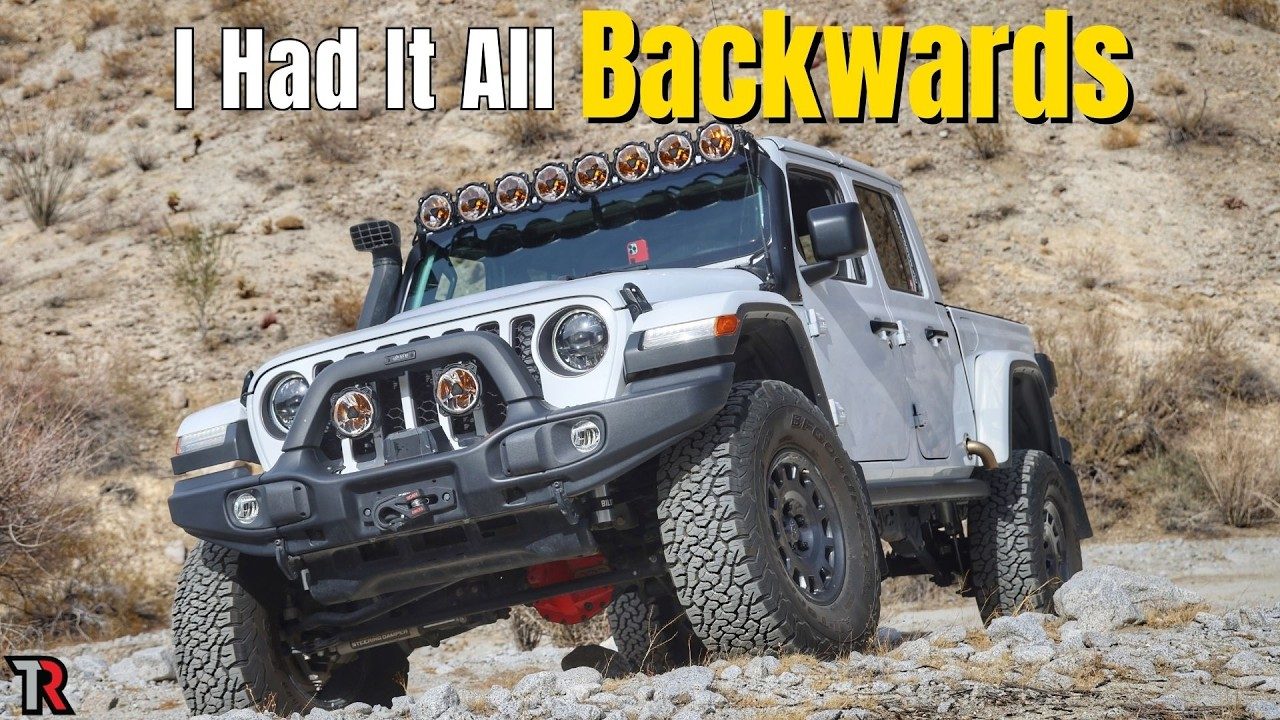
The sharpest cost on this build is one Kowitz published himself, in a video titled I Was Wrong About My Jeep Gladiator Build. A truck organised around a mission met 7,300 miles of real expedition and the mission lost. That is a more useful thing to read than any parts list.
In Brad Kowitz (TrailRecon)’s own account
- He names what the build was for, in the past tense, and the tense is the tell.
“When I first built this rig, my goal was clear: create the Trail Aid Station to raise awareness for first aid and honor my military medical brothers and sisters.”
Source - Then he names what he wants instead, and the word showpiece is his. A truck built partly to be looked at, for a cause, turned out to be carrying that as a cost.
“I realized I need a Gladiator that's not just a showpiece but the ultimate overlanding adventure rig.”
Source - The trip that changed it is dated and specific: a month, and over 7,300 miles to the Arctic Circle, with a workshop inspection before it left.
“Before I leave on my month long trip to the Arctic Circle, I asked my good friend Jerry at Shift Autowerx to give my Jeep Gladiator a good inspection before it hits the road and dirt for over 7300 miles.”
Source - The drivability argument he made against 37s was explicit about why, and it is the constraint the later regear had to satisfy.
“because this will be used on long expedition and transporting lots of medical equipment, maintaining drivability is a key factor”
Source
Dirtbeam’s reading
Not stated by the builder. This is what we take the build to show.
- A Gladiator is the wrong shape for the mission and the right shape for the message. The platform's short bed and long wheelbase are a compromise on both cargo and breakover, and a truck meant to carry medical equipment into remote country would be better served by almost any full-size pickup. What the Gladiator gives instead is recognisability, which matters to a build whose second job is public advocacy. That is a real tradeoff, and no source on the build states it.
- Building around a rare event is expensive in ways that show up daily. Equipment for the worst day is carried on every other day, and the weight, the height and the complexity are paid continuously against a benefit that may never be claimed. This is the same arithmetic behind every recovery kit, and the Arctic trip appears to be where it stopped balancing.
- The sponsorship runs deep enough to change how the parts list should be read. Three of the build videos carry YouTube's paid-promotion label, and the build page is a storefront selling most of the brands on it. None of that makes the choices wrong, and Kowitz installs and then publicly criticises his own decisions, which is not what a pure advertisement does. It does mean the list is evidence of what he was given and sells as well as what he chose.
- Every performance number attached to this truck is a manufacturer rating. Nothing here has been independently measured, including the lights this note reads the most into, and there is no weight, payload or scale figure published for the finished vehicle.
The kit
- Lighting
- Four separate KC HiLiTES systems on an eight-circuit sPOD BantamX, as the build page lists it. A 50 inch Flex Era light bar overhead and Flex Era 4 pods for distance; Flex Era 1 pods in the middle of the range; amber Cyclone V2s, 5 watts and 600 lumens each, fitted under the hood. KC publishes a single Flex Era 4 at 7,912 lumens and 180,000 candela on its spot lens, so the two ends of KC's own range on this truck are separated by more than a factor of ten in output and by their entire purpose.
- Storage
- An Overland Vehicle Systems Expedition truck cap over the bed with side access doors, a Rhino-Rack Pioneer platform above it, and an OVS XD Lhotse clamshell hard-shell roof top tent on top of that. A Dometic CFX3 36L fridge, a Rugged Ridge metal jerry can, and the TrailRecon trauma kit the whole build is an argument for. The stack is tall for a truck whose case is speed of access, and the tent on top is the part that argues with the rest of it: everything else here is reached from the ground, and the sleeping platform is the one thing that is not.
- Recovery
- An OVS Scar 12S winch with synthetic rope behind the AEV EX Highline bumper, a Factor 55 extreme-duty kinetic energy rope, ARB front and rear differential covers, Artec aluminium skid plates, an ARB twin compressor, and an AEV high-flare snorkel with a custom deep-water fording exhaust added in 2024. Nothing on that list is specific to the medical mission. It is a well-specified expedition recovery kit, which is its own answer to what the Battalion Aid Station framing actually changed about the truck: the lighting and the storage, and not much else.