
Are truck bed drawers worth it?
The short answer
They are worth it if you live out of the truck and have payload to spare, and a poor trade if the truck is already near its limit or carries tall or bulky loads. A bought drawer system weighs about 150 to 230 pounds installed and stands about 12 inches high, so it uses up part of a small truck's capacity before anything goes in it. On a four-wheel-drive Toyota Tacoma Double Cab, which Toyota rates for 950 to 1,000 pounds of people and cargo, a 177 pound system, a 200 pound cap and two adults leave about 320 pounds for everything else. A plywood system can be built lighter: Mike Henderson's weighs 114 pounds by his own figure, and cost him about $320 in materials. A drawer's load rating does not raise the truck's. Count the drawers as cargo, and start from the number on the door label.
How much do truck bed drawers weigh?
Between about 150 and 230 pounds for the bought systems, before anything is in them.
| System | Fits | Weight | Height | Price |
|---|---|---|---|---|
| DECKED midsize, short bed | 5 ft beds | 177 lb | 12.3 in | From about $1,700 |
| DECKED midsize, standard bed | 6 ft beds | 204 lb | 12.3 in | |
| DECKED full-size | 5.5 to 8 ft beds | 208 to 233 lb | 12 in | |
| Front Runner, Medium | Universal | 149.5 lb | 11.6 in | $2,499 |
| Front Runner, Large | Universal | 172 lb | 11.8 in | $2,999 |
| Mike Henderson's plywood deck and drawers | 5 ft Tacoma bed | 114 lb | Not stated | $318 in materials, 2021 |
Check which weight you are reading. DECKED lists its midsize short-bed system at 177 pounds installed and 235 as shipped, and the larger figure is the one that gets repeated. Weights also change between generations: the same maker's catalog gave 205 pounds for that system in 2018.
What do drawers take out of payload?
Their whole weight, and on a midsize truck that is a large share. Payload is the number on the door label for everything the truck carries: people, gear and anything bolted on after it left the factory. Toyota's owner's manual for the Tacoma of Henderson's year lists a four-wheel-drive Double Cab with the short bed at 950 or 1,000 pounds, depending on the exact model.
| With a 177 lb bought system | With a 114 lb plywood one | |
|---|---|---|
| Rated for people and cargo | 1,000 lb | 1,000 lb |
| Less the drawers | 823 lb | 886 lb |
| Less two adults | 523 lb | 586 lb |
| Less a 200 lb cap | 323 lb | 386 lb |
That last row has to cover water, fuel, food, a fridge, recovery gear, tools, a tent and any children. Water alone is 8.3 pounds a gallon. A truck set up this way is at its rating on an ordinary trip.
Henderson starts his build from this sum: "Every pound of drawer system you install is gear you can’t bring, OR risk and liability you incur if you go over the GVWR." His own input was generous. He took the truck at about 4,400 pounds against a 5,600 pound rating and counted 1,200 to spare, where Toyota's table gives 950 to 1,000 for his configuration. The method is right and the door label is the number to use, and the smaller figure only strengthens his case.
How much space do drawers give and take?
They raise the floor about a foot. DECKED's instruction for finding what is left is to "measure the depth of your bed and subtract 12 inches." A midsize truck's bed is well under two feet deep, so that leaves a shallow tray above the deck unless there is a cap. Inside, the drawers are about 8 inches high: 7.9 on the DECKED midsize, 8.2 on the Front Runner.
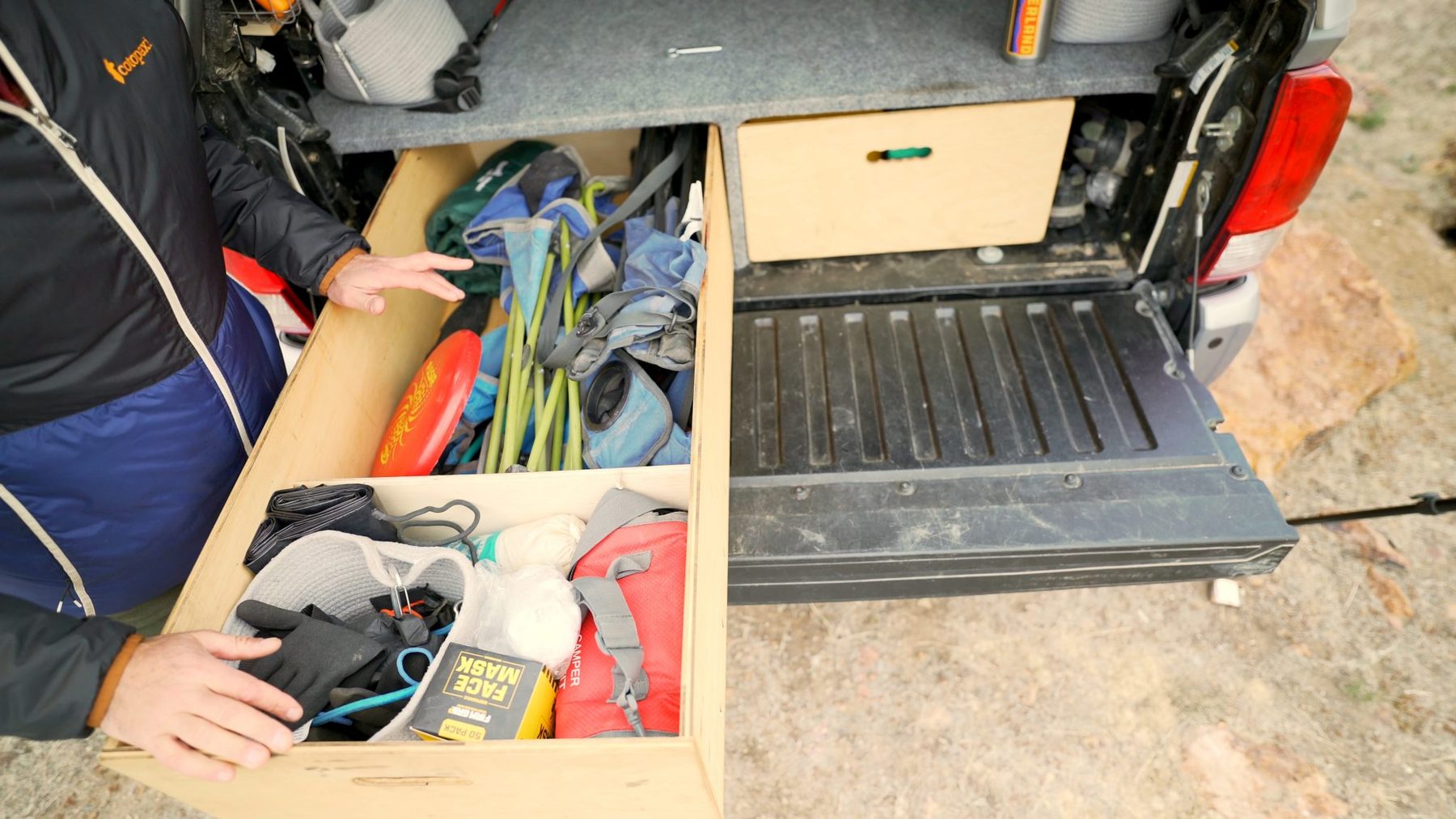
What you get for it is a flat deck over the wheel wells, the full width of the bed, and everything underneath reachable from the tailgate without unloading what is on top. Henderson describes the problem that solves: "Things bounce around in the bed if it’s not full and if it is full then you’ve got stuff stacked on top of other stuff and you almost have to take it all out to get at any of it out."
What you lose is height for anything tall, and the low floor for anything heavy. DECKED lists the cases itself: loose material rides higher and there is room for less of it, sheet goods and lumber need more care to tie down, a motorcycle on top needs its clearance checked, and heavy cargo has to be lifted a foot further.
How did one owner build his at 114 pounds?
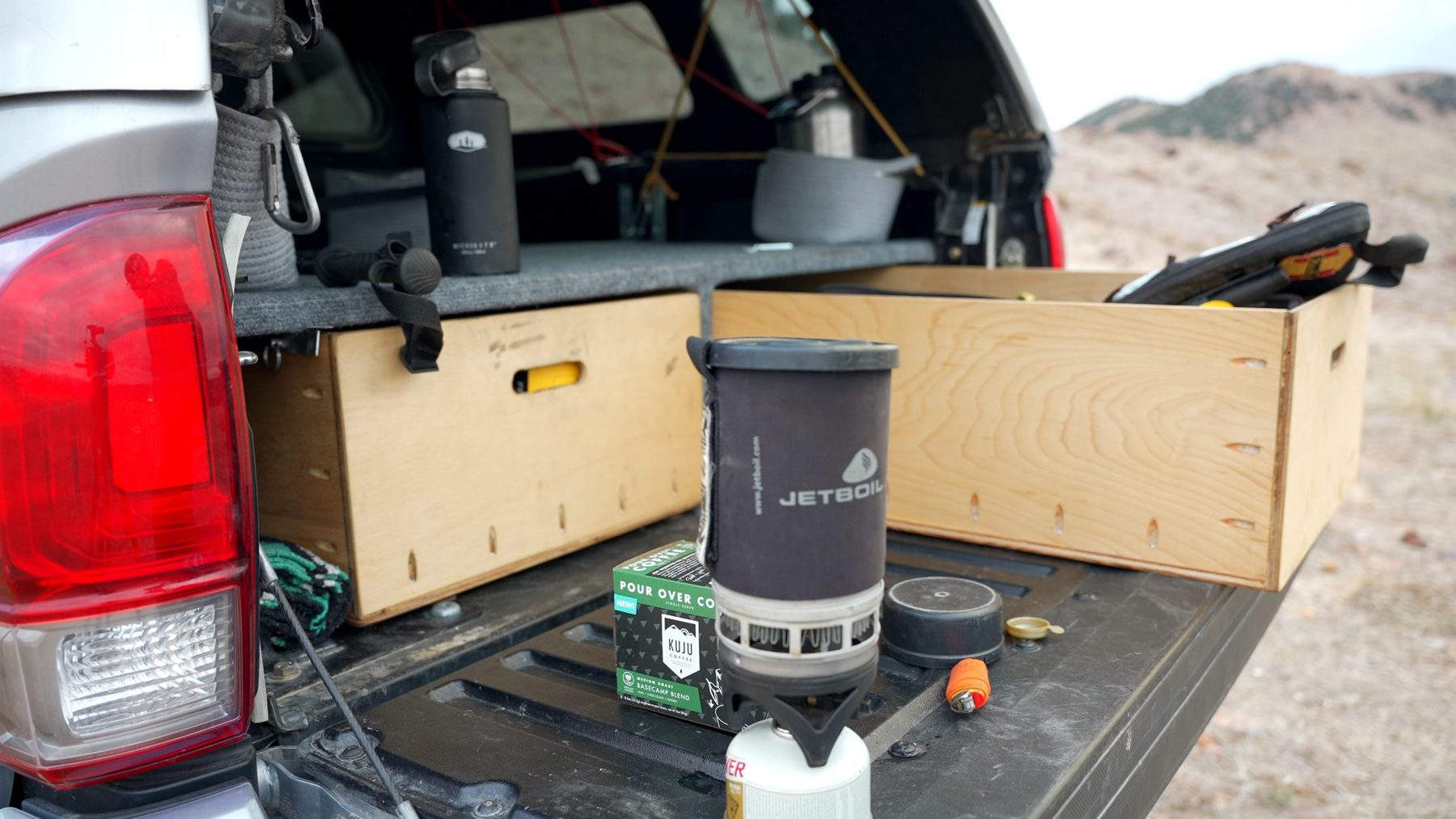
By building less of it. Mike Henderson uses his 2017 Tacoma as a daily driver, a camping truck and the vehicle for his video business, and in 2021 he built a deck and two drawers for its five-foot bed. The usual home-made design is a plywood box, with a top, a bottom and sides, that sits in the bed. His judgement of it: "It’s heavy though, and cuts your drawer size down by 1.5 inches."
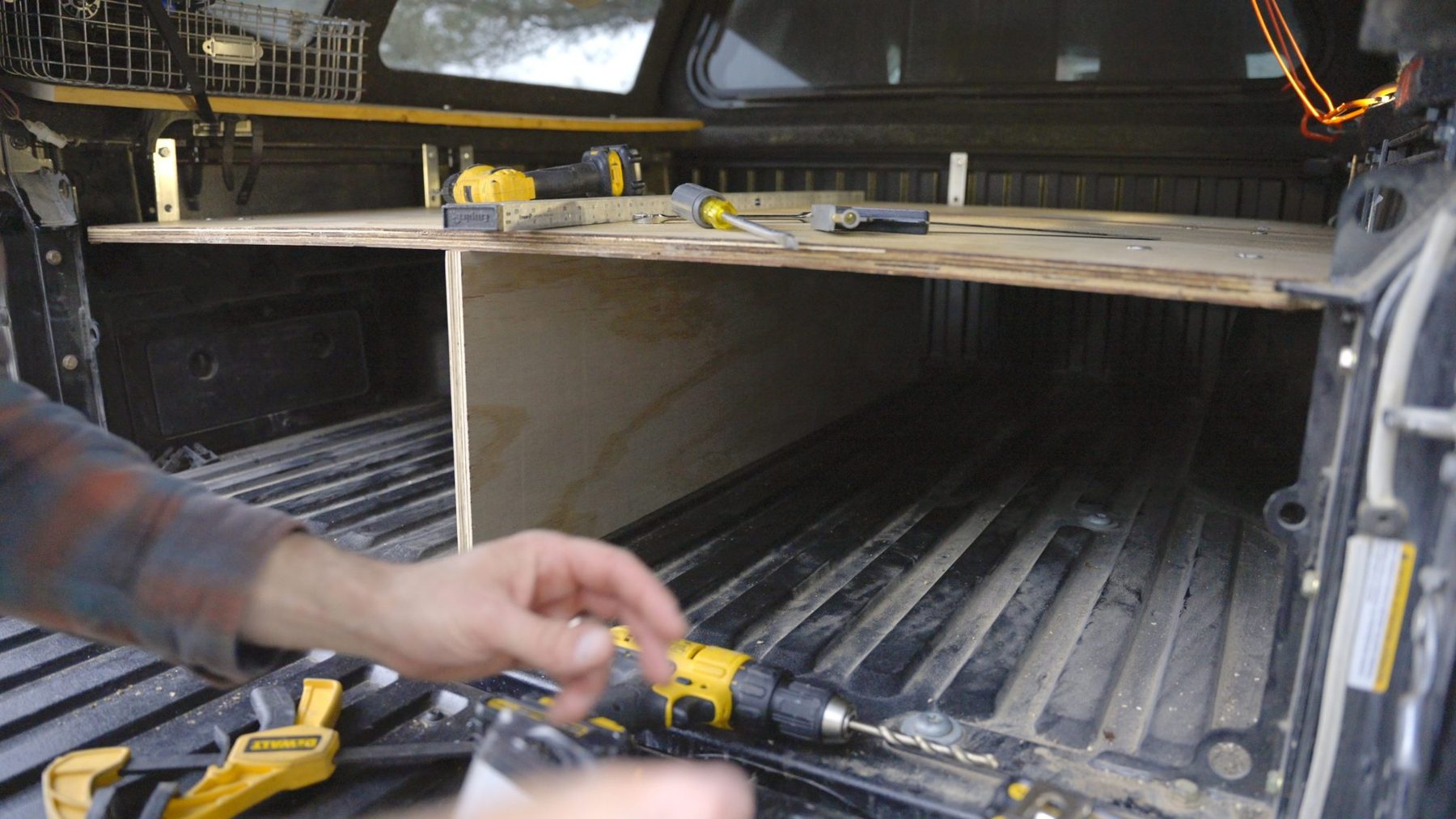
His has no box. The deck is a sheet of 18 millimetre plywood resting on steel angle brackets bolted to the tracks that Toyota builds into the bed sides, with one upright panel down the middle. The drawers are half-inch plywood boxes that slide on the bed floor, with no metal slides: "There are no heavy drawer slides that add mass and subtract storage space." The height of the drawers was set by one thing he carries, a roll-aboard camera bag.
His result: "So this system as it sits weighs 114 pounds." Against the 177 pound bought system for the same bed that is 63 pounds saved, about a third. He does not say how he weighed it, so take it as one owner's figure.
What does building it yourself cost you?
Henderson names some of the costs and the rest can be read from the design. Without slides the drawers are not held shut, so he pins them: "I drilled through the aluminum angle and the drawer and use a cotterless pin to hold them in place on rough roads and 4 wheeling." Plywood is not weatherproof, so the design depends on the cap over it. And the deck's strength is the builder's own judgement. It hangs on the factory bed tracks, and Front Runner, which sells a rack that mounts to the same tracks, advises against loading them with more than 150 pounds.
DECKED's view of home-made systems is the seller's, and it is not wrong on the facts: "There’s no weatherproofing, plywood is heavy, and we've never seen a homemade setup rated for 2,000 lbs". Nobody has rated Henderson's deck for anything.
Lighter materials are possible and cost more effort than they save for most people. Patrick of Take The Truck rebuilt a plywood sleeping platform in aluminium extrusion and saved 45 pounds, then wrote that he would not recommend it "unless weight savings is paramount".
The last cost is that needs change. About two and a half years later Henderson fitted a cap with side doors and took the drawers out: "Since we have such easy access to the bed now, I decided to take out the old deck and drawer system and install this half deck." A $320 plywood system is easy to walk away from. A $1,700 one is a commitment to a way of loading the truck.
How do you keep the load from moving in a crash?
Make sure something solid is in front of it. No rule governs how a private pickup's cargo is restrained, but the federal rule for commercial trucks gives a sense of scale: tie-downs there must hold cargo against a deceleration of 0.8 g forward. At that rate, 300 pounds of drawers and gear pushes forward with 240 pounds of force.
Drawers handle the forward direction well when their front ends bear against the bed's bulkhead or, as on Henderson's, against a divider braced by the wheel wells. The direction to think about is rearward and uphill, where a loaded drawer wants to run out toward the tailgate. A closed tailgate stops it. So does a pin, and bought systems use a catch in the drawer for the same purpose. Loose items on top of the deck are the hazard, and a deck gives them a flat surface and nothing to hold them, so you want tie-down points above the deck once drawers are in.
We found no crash test of any bed drawer system, bought or built.
Who should skip drawers?
Anyone whose truck also hauls. DECKED's own list of people who should look elsewhere is those who "haul bulk materials exclusively, run a dedicated tow rig, or just aren't ready to commit". A truck that tows is on that list for a reason this site keeps returning to: the trailer's tongue weight comes out of the same payload the drawers do.
Anyone already close to the door label number should skip them too. Bins and a ratchet strap weigh a few pounds, come out in a minute, and cost the bed nothing when the truck is needed as a truck. What they give up is access and security: you unstack to reach the bottom one, and nothing locks. A half deck, which is where Henderson ended up, sits between the two.
Drawers earn their weight on a truck that is set up for travel most of the time, carries many small things that have to be found in the dark, and has a few hundred pounds of payload it is not using.
What we do not know
Nobody we read has put a drawer system on a scale. Every weight in the table is the maker's or the builder's own statement, and Henderson's 114 pounds comes with no method. He quotes weights for three bought systems that we could not match to the makers' installed figures, so we have used the makers' pages. His truck's door label is not shown, so the 950 to 1,000 pounds is Toyota's range for his configuration and not his truck's own number.
He does not give his deck height or drawer dimensions, or the hours the build took. The makers' load ratings for decks and drawers come with no test method, two makers' pages contradict themselves on drawer ratings, and DECKED's midsize deck rating has halved between generations, so we have used only the one figure it states consistently now. We did not find a maker's statement on fitting a drawer system under a particular tonneau cover; measure before ordering.
Seen on
Also in the field guide
Terms on this page
Sources
- Minimalist Ultra-light Drawer System and Sleeping Platform for Overlanding by Mike Henderson, All-Terrain Family, read 2026-11-25May 2021. His 114 lb comes with no scale or method, and he gives no drawer or deck heights. The weights he quotes for bought systems are not the makers' installed figures. He posted the same build on TacomaWorld, where he answers questions: https://www.tacomaworld.com/threads/diy-drawer-system-and-sleeping-platform.722597/.
- Minimalist Overland: RSI SmartCap Review by Mike Henderson, All-Terrain Family, read 2026-11-25October 2023. Where he says the drawers came out, and estimates the weight of the cap that rode over them.
- Toyota Tacoma Owner's Manual, document OM04013U: vehicle load limits, Toyota, read 2026-11-25The capacity table by model code. The file carries no model year in its text; it was created in October 2016 and is listed elsewhere as the 2017 manual. Which row is a given truck's is on that truck's door label.
- Drawer System technical specifications, DECKED, read 2026-11-25The maker's installed and shipping weights, dimensions and ratings. Its ratings for the midsize deck have changed between generations. Price from https://decked.com/drawers, height from https://decked.com/pages/faqs.
- Are truck bed drawer systems worth it, DECKED, read 2026-11-25A maker arguing for its product that also lists who should not buy it. Its statement that a drawer system reduces payload is at https://decked.com/blogs/decked/how-much-can-a-decked-system-hold.
- Front Runner pickup truck drawers, Large and Medium, Dometic, read 2026-11-25Medium at https://www.dometic.com/en-us/product/pickup-drawers-medium-ssdr012. Prices on the day were clearance prices, so we give the listed ones.
- Front Runner bed rack kit for the Tacoma's factory bed rail, Dometic, read 2026-11-25A rack, not drawers. It carries a maker's caution about how much the Tacoma's factory bed tracks should carry.
- How to Build an Aluminum 8020 Truck Bed Sleeping Platform, Take The Truck, read 2026-11-25
- 49 CFR 393.102, performance criteria for cargo securement, Electronic Code of Federal Regulations, read 2026-11-25Applies to commercial vehicles and not to a private pickup. Used as a published figure for how hard a stop is.