
What is tongue weight, and how much should it be?
The short answer
Tongue weight is the downward force a trailer's coupler puts on the hitch ball. It should be roughly a tenth of the loaded trailer's weight: Toyota's manual says 9 to 11 percent, and hitch makers say 10 to 15. Too little and the trailer can sway; too much and it overloads the truck's rear axle and lightens its front wheels. It counts against the truck's payload, pound for pound, so it often limits a truck long before the towing capacity does. Craig Lancaster weighed his Toyota Tundra alone at 6,380 pounds and hitched to his trailer at 7,220, which makes the tongue weight 840 pounds, against 850 pounds of payload he had left. To measure yours, weigh the truck alone and then hitched on a truck stop scale and subtract, or put the coupler on a tongue scale.
What is tongue weight?
It is the part of a trailer's weight that the tow vehicle carries. A trailer balances on its axle with most of its weight on its own wheels and the rest pressing down on the hitch through the coupler at the front. NHTSA's towing brochure defines it as "the amount of the trailer’s weight that presses down on the trailer hitch". Trailer makers call the same thing hitch weight, and on a fifth wheel it is pin weight.
It is a separate number from how much the trailer weighs and from how much the truck can pull. A truck rated to tow 11,000 pounds does not have 11,000 pounds of anything to spare at the hitch. What it has there is whatever payload is left once the people, the fuel and the gear are aboard.
How much should tongue weight be?
About 10 percent of what the trailer weighs loaded, and the sources do not agree much more closely than that.
| Source | Says |
|---|---|
| Toyota, Tacoma owner's manual | 9 to 11 percent |
| SAE J2807, the standard behind tow ratings, as described by Equipment World | Assumes 10 percent |
| Weigh Safe and etrailer, who sell hitches and scales | 10 to 15 percent |
| Expedition Portal, writing about off-road trailers | 8 to 10 percent |
| NHTSA's towing brochure | No figure; follow the manufacturers |
The figure that binds you is the one in your own vehicle's manual and your trailer's, so read those first. If they give none, 10 percent is the one figure inside every range above. The percentage is of the trailer as you tow it, with water, propane and gear aboard, and not of the dry weight on the brochure.
What happens when tongue weight is too light or too heavy?
Too light, and the trailer can sway. NHTSA puts it in one line: "Too little tongue weight can cause the trailer to sway." A trailer with its weight behind the axle wants to swing like a pendulum, and the swing can grow with speed. A University of Bath study that towed an adjustable trailer behind a car found that the weight on the nose, how far the trailer's mass sat from its centre, and where its axle was were the main things deciding stability at speed. If a trailer starts to sway, NHTSA's advice is to ease off the accelerator and not to brake the tow vehicle, which generally makes it worse.
Too heavy, and the truck suffers. The hitch is behind the rear axle, so weight on it loads the rear axle by more than the tongue weight and takes weight off the front. NHTSA again: too much can leave "not enough weight on the front wheels", and a tow vehicle in that state is less responsive to steering. The front wheels also do most of the braking.
Where does the weight go? One owner's scale tickets
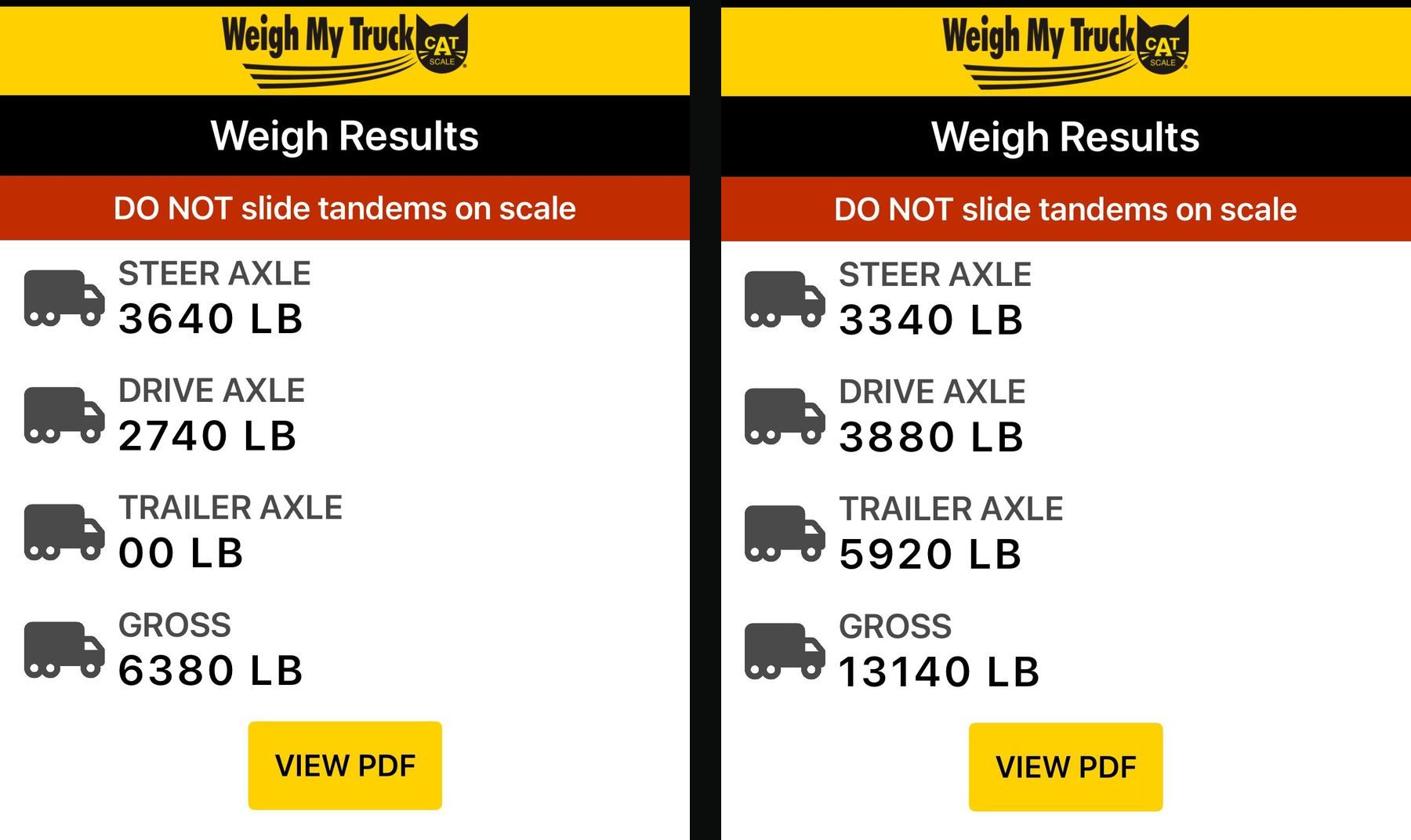
Craig Lancaster tows an Ember travel trailer with a 2026 Tundra and writes about the numbers. He took the rig to a CAT Scale, the kind found at truck stops, which weighs each axle on its own platform, and published the tickets. The truck's door label gives a gross vehicle weight rating of 7,230 pounds, a front axle rating of 4,080 and a rear axle rating of 3,860.
| Weighing | Front axle | Rear axle | Trailer axles | Total |
|---|---|---|---|---|
| Truck alone, loaded to travel | 3,640 | 2,740 | 6,380 | |
| Trailer hitched | 3,340 | 3,880 | 5,920 | 13,140 |
| With a weight distribution hitch | 3,360 | 3,880 | 5,920 | 13,160 |
| Reloaded, plain hitch | 3,520 | 3,720 | 5,960 | 13,200 |
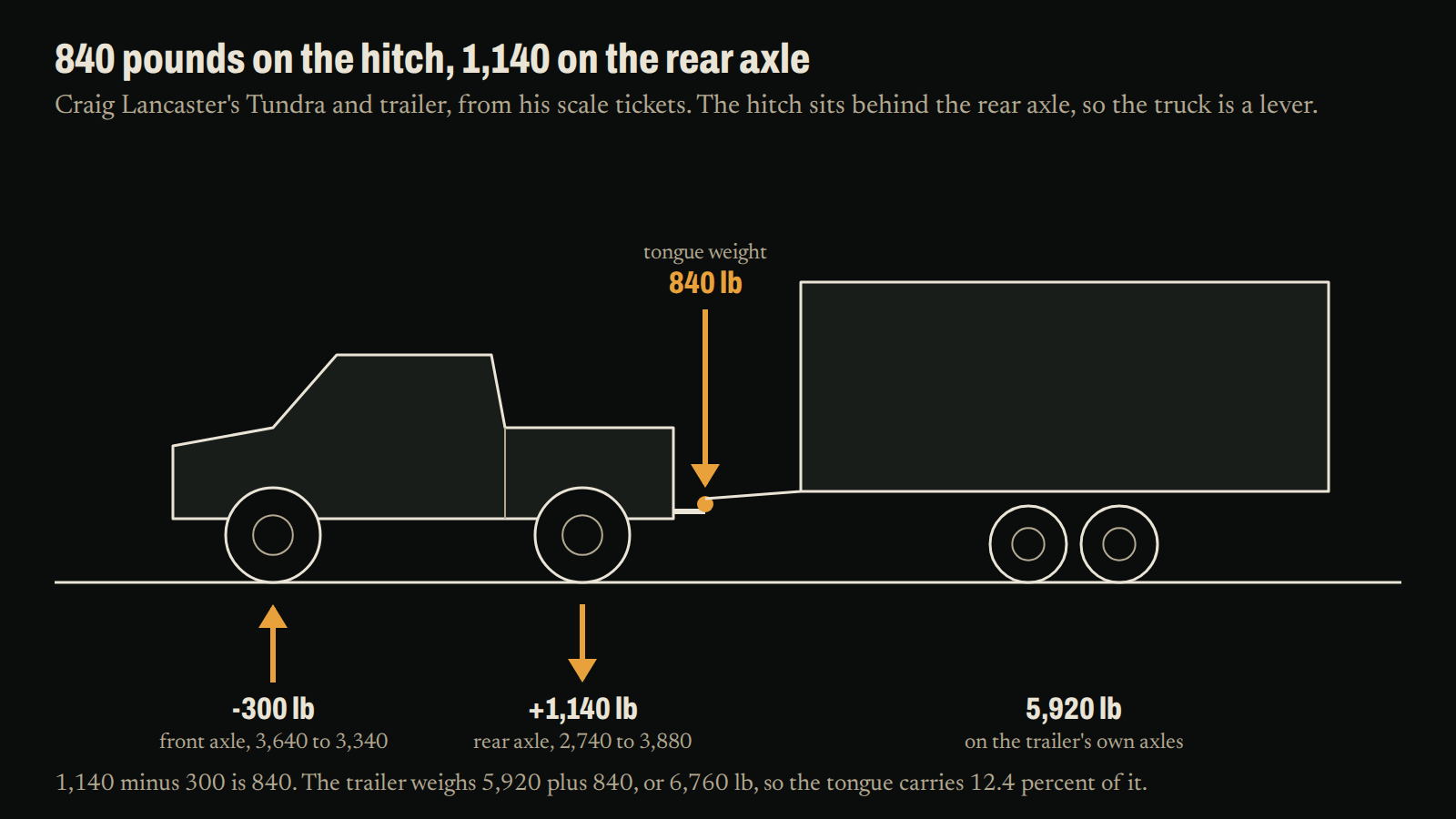
The first two rows are the whole method. Alone, the truck weighed 6,380 pounds. Hitched, its two axles carried 3,340 plus 3,880, or 7,220. The difference, 840 pounds, is the tongue weight. Add it to the 5,920 on the trailer's own axles and the trailer weighs 6,760 pounds, so the tongue is carrying 12.4 percent.
Then look at where the 840 pounds landed. The rear axle went up by 1,140 pounds and the front went down by 300. That put the rear axle at 3,880, 20 pounds over its rating, with a trailer well inside the truck's towing capacity. And the truck's total of 7,220 left 10 pounds under its gross rating. Lancaster's summary: "I’m down to 10 pounds of margin on payload."
A truck rated to tow 11,000 pounds was full at a 6,760 pound trailer, because 840 pounds of it was sitting on the hitch.
Tongue weight calculator
Put in the figures from two scale tickets, the truck alone and the truck with the trailer coupled. It starts filled in with Lancaster's, so the results match the table above. Weigh with any weight distribution bars off: with them on, part of the tongue load is carried to the trailer's axles and the result reads low. The two ratings are on the label in the driver's door opening.
| Result | |
|---|---|
| Truck alone | 6,380 lb |
| Truck with the trailer on | 7,220 lb |
| Tongue weight | 840 lb |
| Trailer weight | 6,760 lb |
| Tongue weight as a share of the trailer | 12.4% |
| Change on the rear axle | +1,140 lb |
| Change on the front axle | -300 lb |
| Payload left under GVWR | 10 lb |
| Rear axle over its rating by | 20 lb |
Why does tongue weight come out of payload?
Because the truck is carrying it. Payload is everything a vehicle carries beyond its own weight, and the rating that caps it, GVWR, does not care whether the load is in the bed or pressing on the hitch. Expedition Portal's definition says so in as many words: payload is what a vehicle can carry "including the tongue weight of a trailer." Lancaster draws the conclusion for anyone shopping: "tow vehicle payload, not towing capacity, is the limiting factor in most setups".
This turns into a quick check before buying a trailer. Take the payload from the door label, subtract the people and gear that will be in the truck, and what is left is the most tongue weight you can carry. Multiply by ten for a rough ceiling on trailer weight. Lancaster used the maker's dry hitch weight as a filter while shopping: one trailer listed 814 pounds before any cargo, which would have used nearly all his margin empty, and the one he bought listed 630. Loaded for a trip, it measured 840. Dry hitch weight is a floor, and what you pack ahead of the axle goes on top of it.
How do you measure tongue weight?
Three ways, and the first is the most useful because it also tells you what each axle is carrying.
On a truck stop scale
Weigh the truck as it will travel, with people, fuel, cargo and the hitch in the receiver. Then weigh it with the trailer coupled, front axle on the first platform, rear axle on the second and the trailer's axles on the third. Add the truck's two axle weights from the second ticket and subtract the truck's total from the first. If the trailer has a weight distribution hitch, leave its bars off for this weighing. Every figure on Lancaster's tickets is a multiple of 20 pounds, so a result from two tickets is good to within 20 to 40 pounds, which is close enough to decide with.
With a tongue scale
A tongue scale is a small scale rated for a ton or so that sits under the coupler or the tongue jack and reads the load directly. Some ball mounts have a gauge built in and read it whenever the trailer is hitched. Either is quicker than a trip to a truck stop and lets you see the effect of moving cargo while you are still in the driveway. etrailer notes that the gauge type does not work with a weight distribution system.
With a bathroom scale and a lever
For a light trailer, a plank and two pipes turn a bathroom scale into a tongue scale. Lay the plank across two pipes, one resting on the scale and one on a block of the same height, and set the coupler on the plank one foot from the block's pipe and two feet from the scale's. The scale then carries a third of the load, so multiply its reading by three: 250 pounds on the scale is 750 on the tongue. The trailer has to be level and on level ground.
What does a weight distribution hitch do?
It moves load between axles. It does not reduce what the truck is carrying. A weight distribution hitch uses spring bars to lever some of the tongue load forward onto the truck's front axle and back onto the trailer's axles. Toyota's manual says to adjust one until the front axle is back at the weight it carried before the trailer was connected, and Toyota's specifications for the Tundra say such a hitch is necessary for a trailer above 5,000 pounds. Hitch makers rate receivers higher with one: CURT lists a Class 4 hitch at 1,000 pounds of tongue weight alone and 1,400 with weight distribution.
Lancaster tried one and weighed the result, which is the third row of the table. The front axle gained 20 pounds of the 300 it had lost, the rear axle did not change, and the total went up by 20 pounds, the weight of the hitch. Twenty pounds is one step on that scale. As he had it set, the hitch was doing almost nothing, and he took it off. His point is that such a hitch only "redistributes weight. Sends it somewhere else."
That is one truck and one adjustment, and he does not say how the bars were tensioned. By Toyota's instruction, a hitch that returns 20 pounds of 300 is not yet adjusted. His trailer is also above the weight at which Toyota calls for one. So take two things from his tickets and leave the verdict open: a weight distribution hitch has to be set up and then checked on a scale, and it cannot fix a payload problem, because the weight it moves stays on the truck's own axles or goes to the trailer's.
How does loading change tongue weight?
A great deal, because the trailer is a seesaw on its axle. Anything ahead of the axle adds to the tongue and anything behind takes away. Toyota's instruction is to "Place heavier loads as close to the trailer axle as possible." Lancaster's trailer went from 630 pounds on the tongue empty to 840 packed, a third more, from what went into the front storage. For his last weighing he moved cargo back from the front compartment and reports the tongue at about 675 pounds, with the rear axle back under its rating by 140 pounds.
On an off-road trailer the heavy things are water and fuel, and they are usually carried on the nose, so a full tank and an empty one can be different trailers at the hitch. Makers design around it. The Mammoth Overland TL, an off-road trailer with two axles, lists a tongue weight of 400 pounds against a dry weight of 3,200 and a maximum of 5,200, though the maker does not say at which of those the 400 was taken. Expedition Portal's Scott Brady, who reviewed it, gives the reason people who tow these with half-ton trucks want a low figure: "tongue weight is calculated into available payload". The price of the second axle is width and a trailer that is harder to place on a narrow trail.
What limits tongue weight?
Four numbers, and the lowest one governs: the receiver's rating, the vehicle maker's own tongue weight limit, the payload left on the door label, and the rear axle rating. CURT's table for two-inch receivers gives the hitch side.
| Class | Trailer weight up to | Tongue weight up to |
|---|---|---|
| Class 3 | 8,000 lb | 800 lb |
| Class 4 | 10,000 lb | 1,000 lb |
| Class 5 | 16,000 to 17,000 lb | 2,400 to 2,550 lb |
Lancaster's Tundra has a Class 4 receiver, so his 840 pounds was inside the hitch's limit. It was payload and the rear axle that ran out, which is the usual order on a half-ton. Our page on GVWR covers where those ratings come from and how to read the label.
What we do not know
Lancaster's final tongue weight of about 675 pounds is his figure and cannot be rebuilt from the tickets, because he did not weigh the reloaded truck alone. The last ticket shows the truck's axles at 7,240 pounds, 10 over the gross rating, so the weight he moved off the tongue went onto the truck elsewhere. His text credits about 140 pounds off the rear axle to removing the hitch; the tickets show 160.
We have not read SAE J2807 or the hitch class standard, J684, which are sold and not published; the 10 percent assumption is a trade publication's description and the class table is a hitch maker's. We could not open the US owner's manual for the Tundra, so Toyota's percentage here is from the Tacoma's and the hitch condition from Toyota Canada. We found no published test that varies tongue weight as a percentage and measures sway, so the ranges above are makers' guidance and not test results.
Also in the field guide
Terms on this page
Sources
- Weights and Measures, Redux by Craig Lancaster, Time. Speed. Distance., read 2026-11-25June 2026. Four CAT Scale tickets and the truck's door label, all shown and all read. His figures for the first weighing close against the tickets. His final tongue weight of about 675 lb does not come from a ticket, and he does not say how he got it.
- The weighting is the hardest part by Craig Lancaster, Time. Speed. Distance., read 2026-11-25February 2026. His earlier weighing of a Tacoma and a smaller trailer.
- Towing a Trailer: Being Equipped for Safety, DOT HS 809 433, National Highway Traffic Safety Administration, April 2002, read 2026-11-25Read from a copy hosted by the Coast Guard Auxiliary, because NHTSA's own page for it no longer loads. It gives no tongue weight percentage and points to the manufacturers.
- 2026 Tacoma Owner's Manual, trailer towing, Toyota, read 2026-11-25Toyota's wording, from the Tacoma manual. We could not open the Tundra's.
- Tundra models and specifications, 2026, Toyota Canada, read 2026-11-25The source for the weight distributing hitch condition on the Tundra. The Canadian page; the US owner's manual wording is unread.
- Tow Ratings: SAE J2807 Overview, Equipment World, read 2026-11-25A trade publication's description of the standard. SAE sells the standard itself and we have not read it.
- The Complete Guide to 2 inch Receiver Hitches, CURT Manufacturing, read 2026-11-25A hitch maker's own class table, with the Class 4 figures for a weight distribution system at https://www.curtmfg.com/learn-more-class-4.
- How to Weigh, CAT Scale Company, read 2026-11-25Where each axle goes on the platforms. It does not mention tongue weight; the subtraction is the owners' method.
- How to Determine Trailer Tongue Weight, etrailer, read 2026-11-25A retailer's instructions for the bathroom scale method. It sells tongue scales.
- How to Measure Tongue Weight, Weigh Safe, read 2026-11-25The maker of the ball mount with a built-in gauge.
- An experimental investigation of car-trailer high-speed stability by Darling, Tilley and Gao, University of Bath, Proceedings of the Institution of Mechanical Engineers, Part D, 2009, read 2026-11-25Read from the abstract. A car and a caravan in Britain, and no tongue weight percentage.
- Understanding Weights and Ratings, Expedition Portal, read 2026-11-25
- Mammoth Overland TL, specifications, Mammoth Overland, read 2026-11-25The maker's figures, with no loading condition given for the tongue weight. Scott Brady's review for Expedition Portal is at https://expeditionportal.com/the-mammoth-overland-tl-trailer-field-tested/.