What are ditch lights for, and how should you aim them?
By Chad Sig · Published · Updated
The short answer
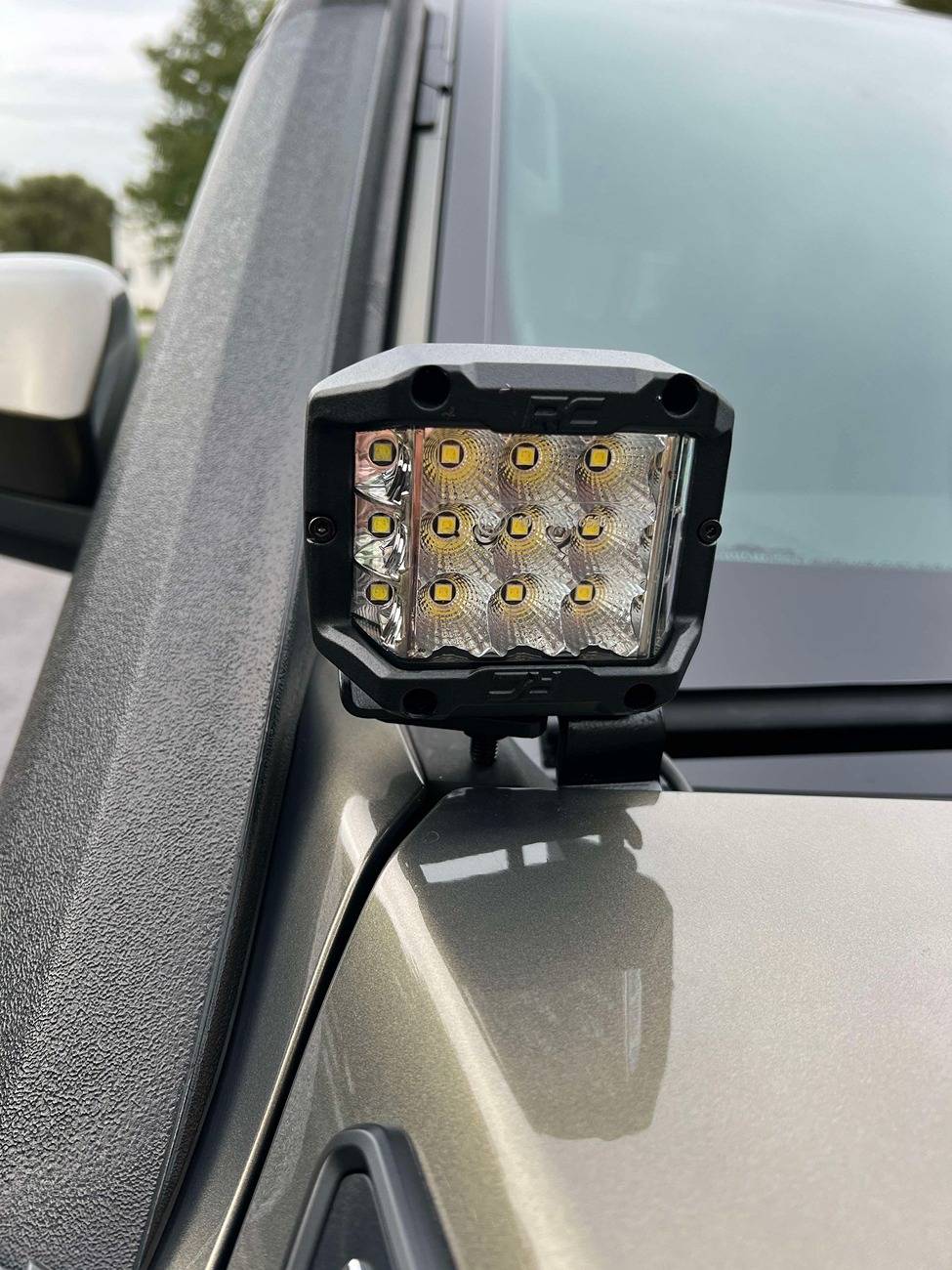
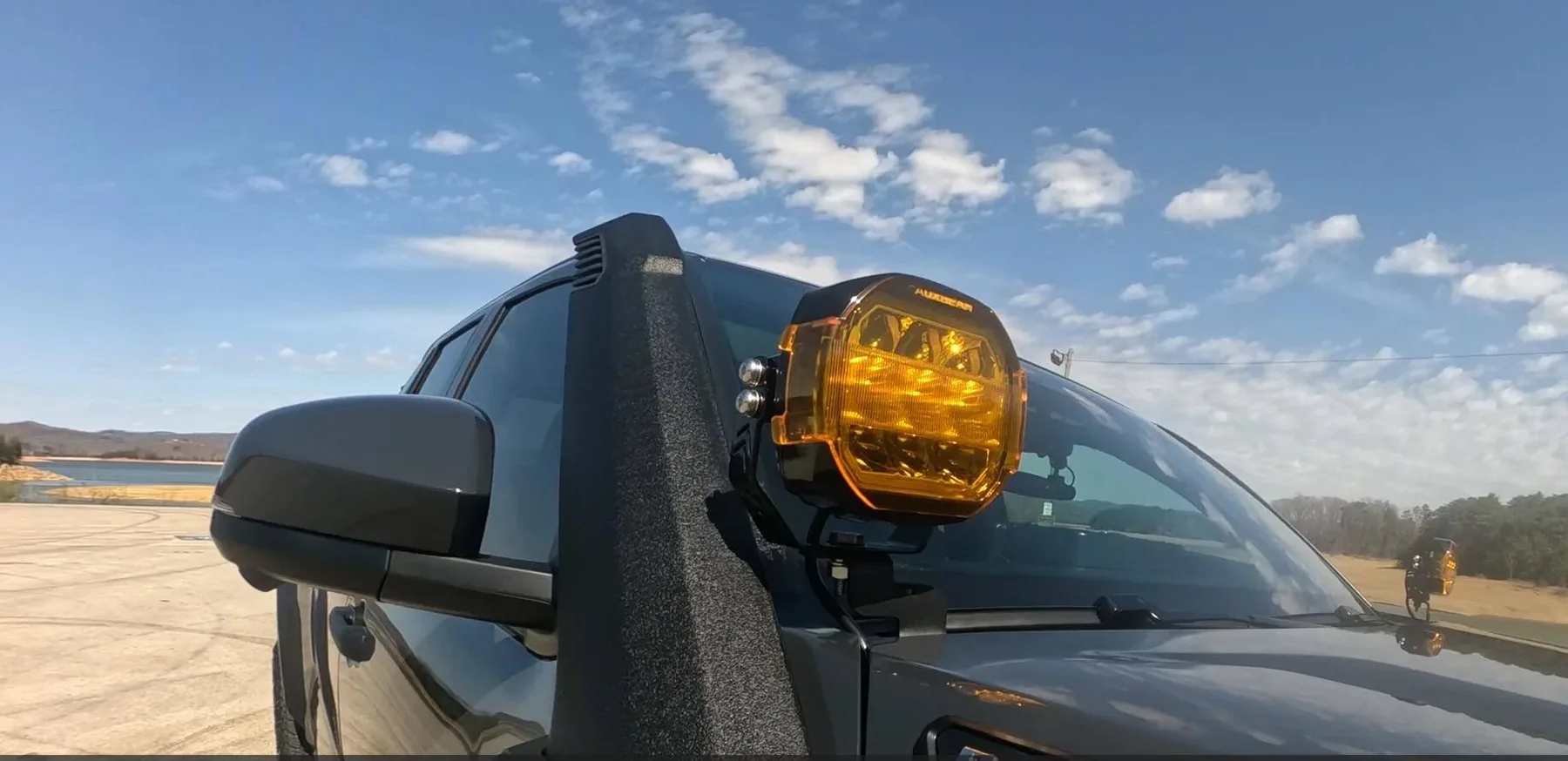
Ditch lights are the pair of auxiliary lights mounted at the base of a truck's A-pillars or the rear corners of its hood, and they are cornering lights. Their job is to fill the peripheral space either side of the trail so you can see what is coming into it, not to add reach straight ahead, and they should be aimed outward rather than forward. That aim is not a preference, it is the fix for the position: mounted at the hood corners or the base of the A-pillars, a ditch light sits behind and beside a large painted panel, so a wide beam pointed forward lights your own hood before it lights anything useful, and in dust or fog it also lights the air directly in front of your windscreen. Baja Designs, whose engineers defined the lighting zone this function belongs to, advise avoiding a wide pattern on the A-pillar altogether unless the lights are angled outward. Turn them out, and one aim change solves both problems at once: the hood leaves the beam, and the brightly lit near air leaves your line of sight.
What are ditch lights for?
They fill your peripheral vision. Off-road at night, a pair of forward-facing lights gives you a bright corridor and darkness on either side of it, which is disorienting and hides anything about to enter the trail. Ditch lights light the verges, so you can see the ditch you are about to drop a wheel into, the animal stepping out, and the line of the corner before you are committed to it.
Baja Designs call this Zone 2, cornering, and describe it as lighting that extends to your peripheral view and prevents tunnel vision, illuminating obstacles or wildlife entering the trail. They specify a wide cornering lens for it, the one with the maximum horizontal spread, and they say it should be brighter than your fog lights but not brighter than your main driving lights.
If you bought them to see further ahead, you bought the wrong thing for the wrong place, and the way you will aim them is the way that causes the trouble.
That is the whole misunderstanding, and almost everything else on this page follows from it. Most ditch lights are bought as extra reach, mounted where extra reach is worst served, and then aimed straight down the trail, which is the one direction that puts the beam across your own bodywork. The manufacturer's name for this category is cornering light. The community's name is ditch light. Neither name contains the word forward.
Why the hood corner is a difficult place to put a light
Ditch lights conventionally go at the rear corners of the hood or at the base of the A-pillars, which is the easiest place to mount them and one of the harder places to light from. The problem is not mainly that the position is high. It is that the lamp is behind a large, pale, slightly curved panel, and that panel is inside the beam.
Baja Designs put it plainly in their cornering guidance: it is advised to avoid a wide-pattern lighting setup on the A-pillar, unless the lights are angled outward, as this could lead to perceived glare from the hood. Patrick of Take The Truck, writing independently about choosing off-road lights, names the same positions and the same reflector, warning that lights on the roof or the rear corner edges of the hood are more likely to bounce light off your hood, reducing visibility and causing eye fatigue.
How should you aim ditch lights?
Outward. Baja Designs' placement instruction for the cornering zone is to mount on the outside of the bumper, or off the A-pillar angled outward, and their warning about wide patterns on the A-pillar carries the same exception: unless the lights are angled outward.
The reason a single instruction fixes both problems is geometric. Turning the beam outward swings the hood out of it, which removes the reflector. It also swings the brightly lit volume of near air out of the corridor you are actually looking down, which is what makes the difference in dust. You are not throwing the light away: outward is where the light was supposed to be going, because the job is to fill the space either side of the trail.
Baja Designs do not publish an angle in degrees for this, on the page we read. Outward is a direction, not a number, which is awkward for anyone who wants a torque-spec answer and fine for anyone with a dark road.
One thing aiming will not do is rescue a lamp that is simply in the wrong place, and that is worth understanding before you drill anything.
Why height matters more than aim
Because aim is defined as an angle from the lamp, never as a height above the ground. California requires a fog lamp's high-intensity portion to sit no higher than four inches below the centre of the lamp at 25 feet, which works out to about 1.3 percent, or three quarters of a degree. The United Kingdom requires the upper edge of a front fog beam to be, in its own words, as near as practicable 3 percent below the horizontal. Neither says anything about where the lamp is.
So the distance at which the beam's upper edge finally meets the ground is the mounting height divided by the tangent of the aim angle. It scales with height, directly. A lamp two feet up, aimed at 1.3 percent, puts that edge on the ground about 150 feet ahead. The same lamp five feet up puts it about 375 feet ahead, with 375 feet of illuminated air between you and it, all of it at roughly your eye level. You did not aim it worse. You gave it more air to light.
Raising a lamp does not tilt its beam down. It lengthens the column of lit air and lifts it into your eyeline.
So how high should you mount off-road lights?
It depends on how wide the beam is, and that is the whole answer. What you are managing is the volume of brightly lit dust or fog that falls inside your own line of sight, and height is only one of two things that sets it. Width sets how much air the beam lights. Height sets whether that lit air is in your sightline.
Wide beams belong low, below your eyes. Baja Designs specify their dust and fog, cornering and driving zones low, and recommend that 80 percent of a lighting package stays below the hood line. Tight long-range spots can go high, on the A-pillar or roofline, and they say so, giving glare reduction as the reason. Same company, same hazard, opposite instruction, and the resolution is on their racer spot page: lights in that zone benefit from being higher because the tighter beam negates what would otherwise be a concern of glare coming back into the cab. It is the narrowness that buys the height.
Their own LP9 range makes the point inside one product. The Pro and the Racer Edition are the same housing, the same nine forward LEDs and six peripheral ones, the same 200 degree spread. Only the lens differs. Baja Designs put the Pro in zones one to three, which mount low, and the Racer in zones four and five, which mount high.
What does mounting a light badly actually cost you?
Contrast, which is the thing that lets you see an object at all. Light that hits airborne water or dust scatters, and some of it arrives at your eyes from every direction at once, adding a uniform glow on top of whatever you are looking at. The object still reflects the same amount of light, but the difference between it and its background shrinks, and below a certain difference you stop being able to pick it out.
John Bullough and Mark Rea modelled this in 2016, tracing a hundred million rays through simulated fog at visibility distances from 50 to 600 metres. Shielding a light source so it stopped throwing light where drivers were not looking raised the contrast of a target from 0.13 to 0.14, and giving it a proper 10 degree beam raised it to 0.26. Their measure of visual performance went from 0.328 to 0.647, against a threshold of about 0.8 for comfortable driving. Same lamp, same output, roughly twice the useful vision, purely from controlling where the light went.
Their model is a roadside warning beacon rather than a vehicle lamp, so treat the mechanism as transferable and the exact numbers as not.
What do the standards allow?
SAE J583 governs front fog lamps in the United States, and its photometric table is the clearest statement anywhere of what a lamp designed for bad weather is supposed to do. Set at its standard aim, a compliant lamp must produce at least 2,400 candela one and a half degrees below the horizontal. Two degrees above the horizontal it may produce no more than 295. Anywhere from ten to sixty degrees up, the ceiling is 150 candela, which is next to nothing.
That is roughly an eight to one ratio written into a pass-or-fail test, and it means the same thing as everything else on this page: light above the lamp's own horizon is treated as a defect. The standard also demands a cutoff sharp enough to aim by, with a measured gradient of at least 0.08 and an inclination held within a fifth of a degree. No ditch light is built to this standard, but the shape of it is what a well-behaved beam in bad air looks like.
What is a horizontal cutoff, and why does it matter?
A cutoff is a sharp upper edge to the beam: above a certain angle, the lamp stops throwing light. It is what makes a wide beam usable when the air is full of something. Alan Roach, Baja Designs' engineer, founder and racer, describes their wide patterns as the first HID and LED lights offering both a horizontal cutoff and a wide pattern, so the light could be used in fog or dust without causing blinding backscatter, and fill the cornering zone at the same time.
Read that carefully, because the word doing the work is both. Width and cutoff are separate controls. Width decides how much air the beam lights; cutoff decides whether that lit air sits above or below the lamp's horizontal; and mounting height decides where the lamp's horizontal falls relative to your eyes. Three things, not one.
It is worth noticing that this is the same control SAE J583 specifies in candela. A racing engineer describing what makes a light usable in dust, and a standards committee writing a photometric table, arrived at the same fix independently and wrote it in different units. What a cutoff does not do is license mounting a wide beam high, or pointing one at your own hood.
What height is legal on the road?
The windows are narrow and worth knowing before you drill. California puts a fog lamp between 12 and 30 inches off the ground. It puts an auxiliary driving lamp, meaning one that supplements your high beam and may not be lit with the low, between 16 and 42 inches, and an auxiliary passing lamp between 24 and 42. The United Kingdom caps front fog lamps at 1200 millimetres, about 47 inches, with no minimum.
The cleanest statement of this whole principle in any regulation is the United Nations one, and it is worth reading in full. UN Regulation 48 puts a front fog lamp not less than 250 millimetres above the ground and not more than 800 on a car or light van, and then adds the sentence that matters: no point on its apparent surface shall be higher than the highest point on the apparent surface of the dipped-beam headlamp. Not a number. A relationship. Your fog lamp may not sit above your headlight, whatever the vehicle.
Federally, in the United States, auxiliary lamps are not directly regulated: the requirement is that anything you add must not impair the lighting the vehicle is required to have. Most off-road lights are not road legal in use wherever they are mounted, which is why they come with covers, and ditch lights at hood-corner height are usually well outside the fog lamp window anyway.
You can see that absence in the rulebook itself. FMVSS 108 governs required lighting equipment, and the list of outside standards it adopts, at 49 CFR 571.5, names six SAE documents: bulb sockets, lamp bulbs, two headlamp aiming practices, discharge forward lighting, and Motor Vehicle Driver's Eye Range. SAE J581 for auxiliary high beam lamps and J583 for front fog lamps are not among them. Driving lamps and fog lamps are optional equipment, so the federal standard never reaches them, which is exactly why the height rules worth knowing come from California, from the United Kingdom and from Geneva instead.
The useful thing about those numbers is what they imply. American road geometry is designed around a driver's eye height of three and a half feet, or 42 inches. The entire legal fog lamp window sits below that, by construction. On a lifted truck your eyes are higher still, so a mount that looks low in absolute terms can easily be above the window a fog lamp is allowed to occupy.
Are ditch lights worth it?
For slow, technical, cornering-heavy driving, yes, and they are one of the few upgrades that improves what you can see rather than how far. For fast open running they are the wrong tool, and for fog and dust they are the wrong position: a low, wide, sharply cut-off lamp on the bumper does that job better and is what the manufacturer specifies for it.
The short answer is that ditch lights are worth it if you aim them outward and accept that they are cornering lights. Mounted at the hood corners and pointed straight ahead, which is how most of them are fitted, they add glare, eye fatigue and very little vision.
What about yellow lights?
Two different claims get collapsed into one here, and pulling them apart is most of the answer. The first is that yellow light penetrates dust and fog better, meaning it scatters less on the way to the thing you are looking at. The second is that yellow reduces glare, meaning less of the scattered light bothers your eyes. They are not the same mechanism.
Baja Designs only ever makes the second one. They recommend amber on two of their zone pages, and both times the stated benefit is reducing glare and minimising reflection. Neither says it penetrates anything. More telling is what they build: their forward emitters are exclusively 5000K daylight white, on the stated grounds that it reduces driver fatigue and improves terrain recognition, and amber is a lens you fit over it. A company that defined a dedicated dust and fog zone does not emit amber light in it.
The research agrees with them, and has for a long time. NCHRP Report 95, the Highway Research Board's 1970 review of driving in fog, works through the scattering physics and concludes that in most well-developed natural fogs, light transmission through the fog is essentially independent of wavelength for wavelengths in the visible spectrum. The reason is particle size: fog droplets, and trail dust more so, are one to two orders of magnitude larger than a wavelength of light, and scattering in that regime barely varies with colour. It is the same reason fog looks white rather than blue.
A 2023 study in Scientific Reports is the useful one, because it measured both halves separately. Putting halogen, xenon and LED headlamps through a fog chamber, it found the transmittance of the xenon lamps was two to three percent higher than the others, so the bluest source got through the fog best. But at equal illuminance the participants detected the target fastest under halogen, the warmest source, and the authors attribute that to the white wall effect in the eyes of the participants as a result of the white light reflection in a foggy environment.
Warmer light did not get through the fog better. It came back at the driver less.
That is the two claims coming apart under measurement, in the direction the manufacturers already claim: nothing for penetration, something for glare. Treat it with the caution one study deserves, because it compares three lamp technologies rather than isolating colour, and because it was fog rather than dust. The glare mechanism is real and it is enough on its own. The penetration story is not supported by the sources that address it, and a lamp sold on that story is being sold on the wrong thing.
A truck that turned down the easy mount
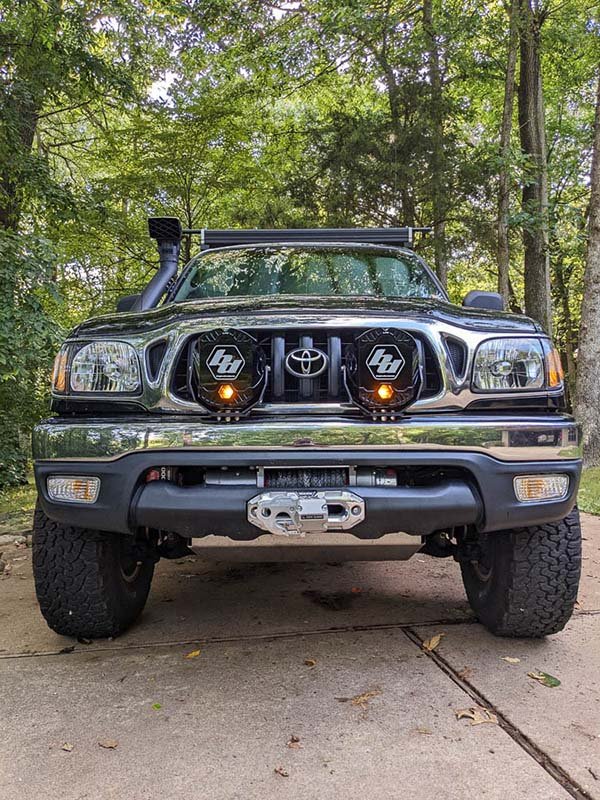
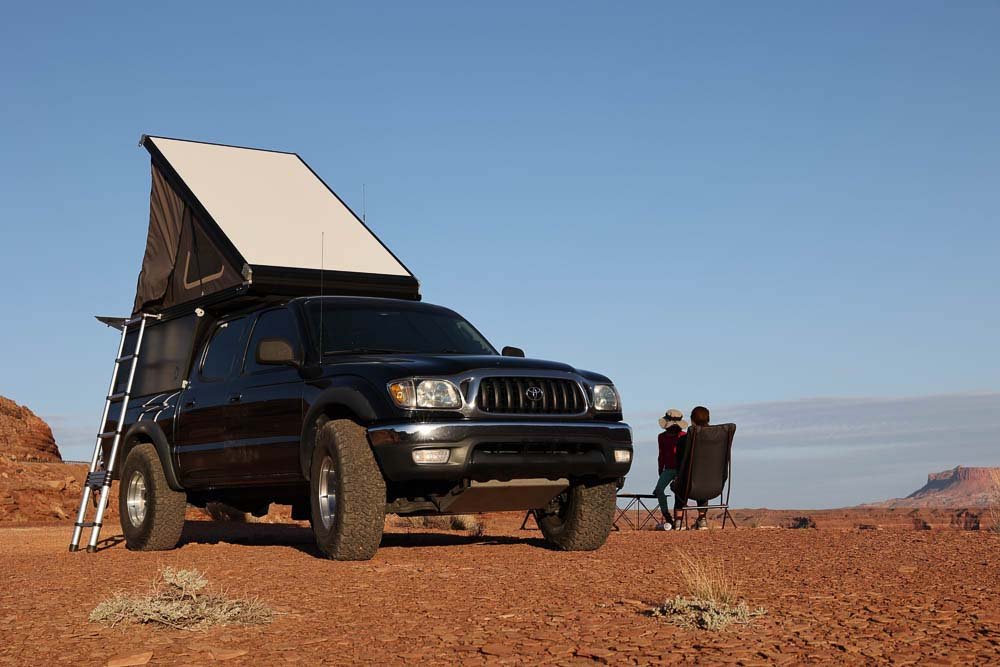
Patrick of Take The Truck had a pair of Baja Designs LP9 Pros to fit to his first-generation Tacoma, and a free place to put them: the front rail of his camper, above the cab, which already had brackets. He rejected it over glare in poor visibility and cut brackets out of leftover rock slider offcuts to hang them off the front bumper instead.
By the manufacturer's own classification he made the right call. The LP9 Pro is a zone one to three lamp, and those zones mount low. His rejected option was worse than a roofline would have been, because a camper front rail sits at about eye height, which is high enough to put lit air in his sightline and not a tight enough beam to earn the position. He is the useful contrast to a ditch light: same problem, different answer, and the answer followed from the beam he had rather than from a rule.
What we do not know
Baja Designs publish no candela, lux or beam-angle figures for the LP9 in any material we could find, so we cannot plot a real off-road lamp against the SAE fog envelope on the same axes. That comparison would be the most useful thing on this page, and the numbers to make it are not published. They also give no angle in degrees for aiming cornering lights outward.
We do not know whether a given amber lens is a filter over the same white emitter or a separate amber one, and no manufacturer we read says. What a filter costs is not in doubt: UN Regulation 19 lets a front fog lamp that makes its selective yellow by filtering a colourless source meet the photometric requirements multiplied by 0.84, which is a regulator writing down a sixteen percent penalty. Paying output for a benefit is the shape of a glare fix rather than a penetration gain. Which of the two a particular lamp is, we cannot tell you.
We still have no measurement of our own. Everything above is read off other people's standards, other people's photometry and one manufacturer's zone system, and the thing that would settle it is a lamp on a stand in real dust at a fixed exposure. That is a measurement piece we have not made yet.
Seen on
Also in the field guide
Sources
- UN Regulation No. 48, installation of lighting and light-signalling devices, paragraph 6.3.4.2, Official Journal of the European Union, L 14, 16 January 2019, CELEX 42019X0057, read 2026-08-27The UNECE's own site refused automated retrieval, so this is the EU Official Journal reproduction, which carries the note that only the original UN texts have legal effect. This is the 06 series; later series exist and we have not checked them.
- NCHRP Report 95, Highway Fog, Highway Research Board, National Research Council, 1970, read 2026-08-27Fifty years old and still the most complete treatment of the problem. Free in full from TRB, and read in full here.
- Performance investigation of different headlights used in vehicles under foggy conditions by Tarik Sefer, Ramazan Ayaz, Ali Ajder and Ismail Nakir, Scientific Reports 13:4698, 2023, DOI 10.1038/s41598-023-31883-3, read 2026-08-27Open access. Compares three lamp technologies rather than isolating colour, so colour temperature, colour rendering, beam pattern and source type all vary together. That its transmittance and detection results point in opposite directions is the finding.
- Lighting Zone 2, Cornering, Baja Designs, read 2026-08-27The manufacturer's guidance for the function ditch lights perform. Carries the A-pillar warning this page is built on. Note they say 'angled outward' without publishing an angle in degrees.
- 2024 Tacoma Trailhunter (or other hybrid) Ditch Light Install - Anyone done it?, Tacoma4G Forum, read 2026-08-27Owners fitting ditch lights to the same truck and comparing notes. The two photographs on this page come from it, posted by the people who did the work. What they discuss is bracket clearance, hood-hinge bolt length and which factory aux circuit to tap, not aim, which is itself worth noticing: the position is treated as settled and the aiming question never comes up.
- How to Choose the Best Off Road Lights for Your Overland Vehicle by Patrick, Take The Truck, read 2026-08-27
- Toyota Tacoma Overland Build by Patrick, Take The Truck, read 2026-08-27
- Lighting Zones 1, 3, 4 and 5, Baja Designs, read 2026-08-27Read across the set. Zone 3 https://www.bajadesigns.com/help/lighting-zones/zone-3-driving-combo/, Zone 4 https://www.bajadesigns.com/help/lighting-zones/zone-4-spot/, Zone 5 https://www.bajadesigns.com/help/lighting-zones/zone-5-racer-edition-spot/.
- ClearView Optics, Baja Designs, read 2026-08-27
- 5000K Daylight, Baja Designs, read 2026-08-27
- LP9 LED Auxiliary Light Pods, product page and LP9 Pro data sheet, Baja Designs, read 2026-08-27Product page and data sheet disagree. The data sheet's 10,245 forward plus 2,302 peripheral lumens sums to its stated 12,547 total; the product page calls 12,547 the forward figure and reaches 14,849. We use the data sheet.
- SAE J583 Test Results, May 2022, photometric testing by Calcoast ITL, Morimoto, read 2026-08-27This is where every J583 number on this page comes from: an independent laboratory report reproducing the standard's Figure 1 test-point table. We have the candela envelope and the cutoff gradient; we have not read J583's own text. The photometry is Calcoast ITL's, but the report was published by Morimoto, whose own two lamps passed and three of whose competitors' failed, which is worth knowing when reading the framing. J583 is not free because it is not incorporated into US federal law: it does not appear in the FMVSS incorporation-by-reference list at 49 CFR 571.5 (https://www.ecfr.gov/current/title-49/section-571.5), fog lamps being optional equipment that FMVSS 108 does not reach.
- California Vehicle Code section 24403, Foglamps, California Legislative Information, read 2026-08-27
- California Vehicle Code section 24402, Auxiliary driving and passing lamps, California Legislative Information, read 2026-08-27
- Road Vehicles Lighting Regulations 1989, Schedule 6, Front Fog Lamps, legislation.gov.uk, read 2026-08-27
- Impacts of Fog Characteristics, Forward Illumination, and Warning Beacon Intensity Distribution on Roadway Hazard Visibility by John D. Bullough and Mark S. Rea, The Scientific World Journal, 2016, DOI 10.1155/2016/4687816, read 2026-08-27Models a roadside warning beacon rather than a vehicle lamp. The mechanism transfers; the absolute numbers do not.
- Improvement of driver night vision in foggy environments by structured light projection by Jaime Quintana Benito, Antonio A. Fernandez-Balbuena, Juan Carlos Martinez-Anton, Daniel Vazquez Molini, Heliyon, 2022, DOI 10.1016/j.heliyon.2022.e11877, read 2026-08-27