
How many auxiliary lights can your motorcycle power?
By Chad Sig · Published
The short answer
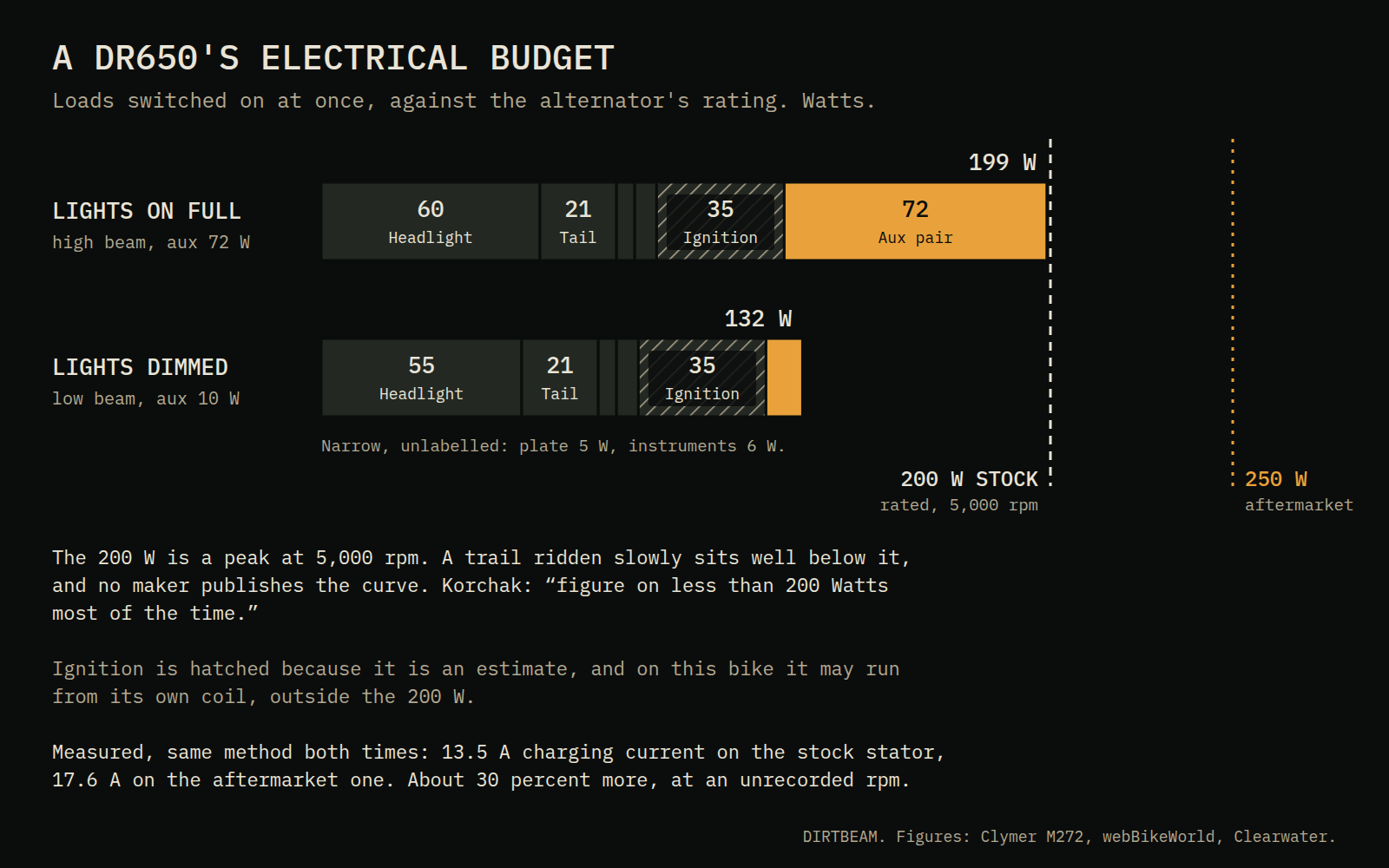
As many as the watts left over, and on a small bike that is not many. Find the generator or alternator output in the owner's manual: a Suzuki DR650 is rated at 200 W at 5,000 rpm, a 2013 KTM 690 Enduro R at 224 W. Then add up what is switched on while you ride: the headlight alone is 55 or 60 W, and the tail light, instruments and ignition take more. On a DR650 those come to about 127 W with the high beam on, which leaves about 70 W on paper, and a rider who tested a stock DR650 with a voltmeter found about the same in practice. It is less at the low engine speeds of slow trail riding, because the rating is a peak. A pair of old-style 55 W halogen driving lights would put the bike in deficit. A pair of LED lights drawing well under 70 W fits, and a pair on a dimmer fits at whatever setting the bike can carry. Fit a voltmeter, and buy a bigger stator only if it shows you need one.
Where do you find your bike's number?
In the specifications at the back of the owner's manual or the shop manual, under a name like generator output, alternator output or charging capacity. Derryn Wong, writing for webBikeWorld in 2009, gave the method in one line: look in the specifications section for an entry called "Generator Charging Capacity" or "Generator Output". His Honda Magna's manual gave 0.374 kW at 5,000 rpm, which is 374 W.
Read the engine speed beside the number, because it matters as much as the number. The Clymer shop manual for the DR650 gives the maximum output as 200 watts at 5,000 rpm, and the regulated voltage as 13.0 to 16.0 volts at the same speed. KTM's 2013 repair manual for the 690 Enduro R gives "Alternator 12 V, 224 W" and no speed at all. Both are the most the system makes, not what it makes at a walking pace up a rocky trail.
| Bike | Rated output | Source |
|---|---|---|
| Suzuki DR650SE | 200 W at 5,000 rpm | Clymer shop manual |
| KTM 690 Enduro R, 2013 | 224 W, no rpm given | KTM repair manual |
| KTM 690 Enduro R, 2019 to 2022 | 300 W DC | Baja Designs' chart |
| Honda Magna VF750C, 2002 | 374 W at 5,000 rpm | Owner's manual, as quoted by Derryn Wong |
How do you add up what the bike already uses?
List everything that is on at the same time while you ride, in watts, and add it. Watts are volts times amps, so a figure given in amps on a 12-volt bike converts at about 14 V, the voltage a charging system runs at. The worst case is the one to plan for, and on most harnesses that is the high beam, because auxiliary driving lights are usually wired to come on with it.
Rick Korchak did this for his DR650 in 2011 and the result is a fair picture of any small dual-sport. The headlight "uses 55 Watts on low beam and 60 Watts on high." The brake and tail light draws 21 W, the plate light 5 and the instruments 6. He added "35W or so to run the ignition", which brought the bike to about 195 W with his two auxiliary lights on, against a 200 W rating. Our note on his build goes through what he did next.
Why is the rated output not what you get on a trail?
Because it is a peak at one engine speed, and nobody publishes the curve below it. Korchak's own advice for his bike: "figure on less than 200 Watts most of the time." A stator's output rises with rpm, so a bike crawling through rocks in first gear, or idling at a trail junction with the lights on, makes much less than its rating.
The one real-world figure we found for a stock DR650 comes from Pro Cycle's how-to, written by a rider who tested his own bike with a voltmeter. He "could power an additional 70 watts of lights/accessories and still keep the battery voltage high enough to stay charged." That is the useful kind of number: not what the stator makes at 5,000 rpm, but what the bike can carry in use without slowly draining the battery.
Running at the limit is not harmful in itself. The same author explains how the common shunt regulator works: "The stator is always putting out as much power as it can at any given rpm." What the battery and lights do not use is shunted to ground as heat. "So using the extra power actually takes some of the load off of the regulator and stator." The risk of adding too much is a battery that runs down over a night ride, not a stator that burns up.
How much do auxiliary lights draw?
Less than they used to. Wong's 2009 rule was built on halogen: a typical driving light used a 55 W bulb, so a pair needed 110 W, and a bike needed room for 110 to 150 W to run them. A DR650 does not. LED lights changed the arithmetic, and dimmable ones changed it again.
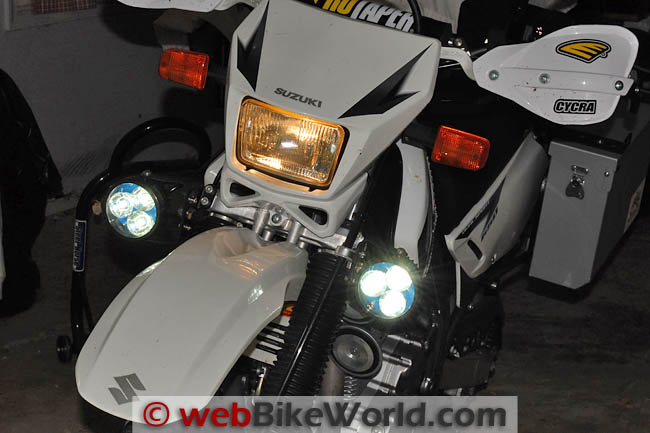
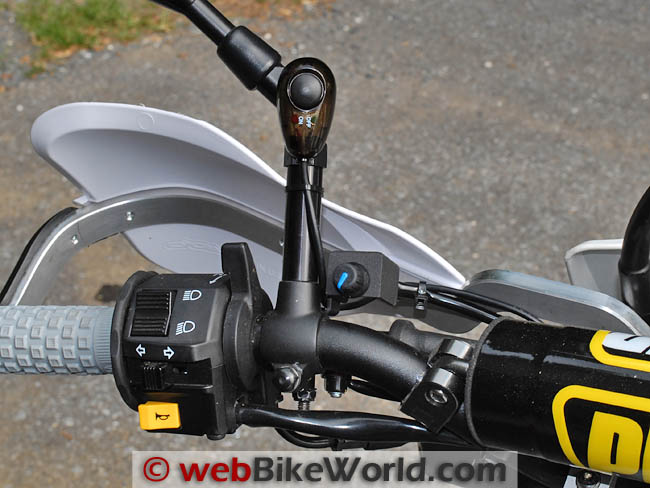
Korchak's Clearwater Kristas show both. By the maker's figures, each draws 36 W on the high beam, so a pair is 72 W, more than the headlight. On the low beam the dimmer runs each from about 30 W down to about 5 W, so the pair can be turned down to 10 W. A light whose draw is set by a dial lets the rider match it to what the bike can carry at the moment, which is a better answer to a small alternator than any fixed wattage.
What can you do before buying a bigger stator?
Replace before you add. The Rolling Hobo wired a single LED spot on his KTM 690's navigation crossbar to the high-beam switch in place of the stock high beam, so he gained a better high beam without adding a load on top of the old one. Our note on his build covers it. An LED tail and brake bulb, and an LED headlight bulb that is a genuine low-draw unit, free watts the same way.
Then fit a voltmeter or a voltage monitor where you can see it, and ride with your lights on at the speeds you actually ride. If the voltage holds, you have your answer for free. Korchak's monitor "always showed green with the original stator, even with the Krista lights on full blast", which is how he learned that the upgrade he went on to fit was margin rather than a fix.
If it does not hold, a higher-output stator is the next step, and it is a real one. For the DR650, Rick's Motorsport Electrics sells a 240 W stator through Pro Cycle, 20 percent over stock, for $231.95. Korchak measured his 2011 equivalent at about 30 percent more charging current than the original, at an engine speed he did not record. The stator sits in the engine's oil, so the job means draining it and a new cover gasket.
What we do not know
No maker we found publishes output against engine speed for these bikes, so the most useful number, what the stator makes at 2,500 rpm in second gear, has to be found with a voltmeter on your own bike. The DR650's 200 W comes from a third-party shop manual rather than Suzuki's own, though webBikeWorld cites the shop manual for the same figure. Every auxiliary-light draw on this page is the light maker's own number.
Seen on
- Counting the watts first: Rick Korchak's DR650 and the lights it could affordA Suzuki DR650's alternator is rated at 200 watts, and only at 5,000 rpm. Rick Korchak, who founded webBikeWorld, added up what his own bike already used before he bought anything: about 195. So he chose lights that dim, fitted a voltage monitor, then bought a bigger stator and measured what it gave him. He noticed no difference, and that is the useful part.
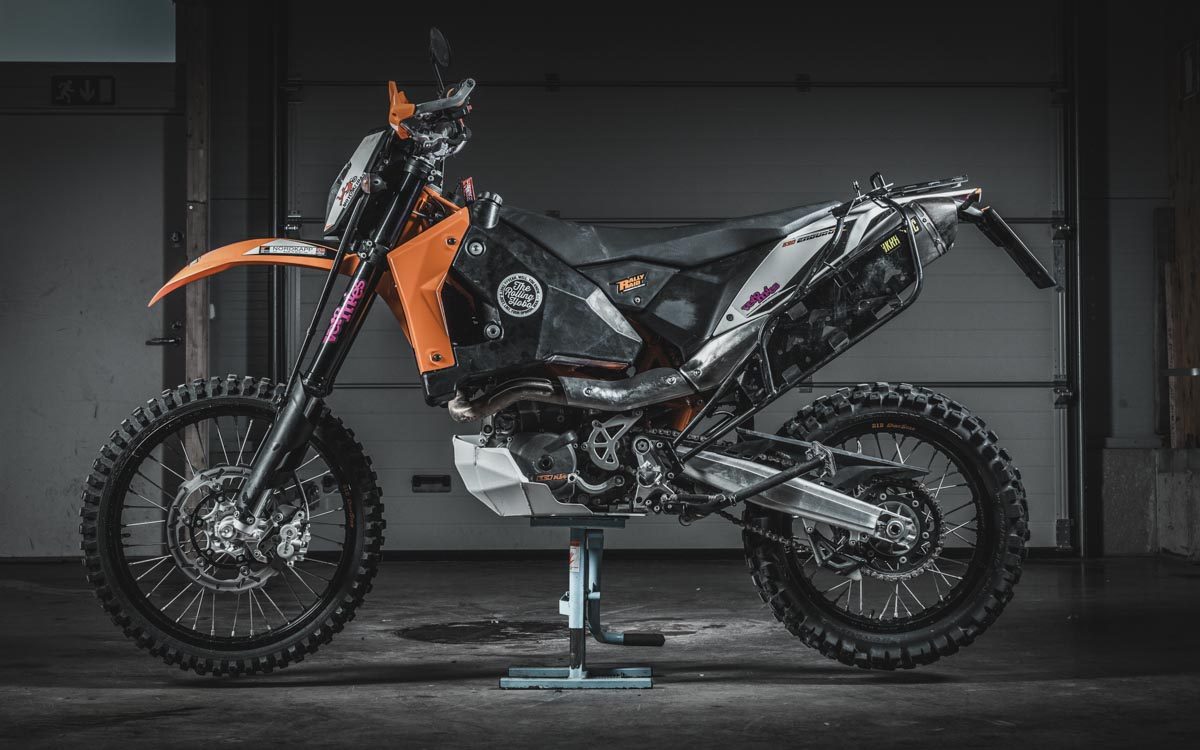
- Higher, further back, and strapped loose: The Rolling Hobo's KTM 690 Enduro RIn 2013 Jussi Hyttinen fitted his KTM 690 Enduro R with side racks chosen for the reason every packing guide gives: they hold the bags low and forward. Five years and tens of thousands of kilometres later he had moved the same bags higher and further back, because hung low they swung, rubbed the side stand and trapped his boot. The rule is right. This build shows where it stops.
Also in the field guide
Terms on this page
Sources
- Suzuki DR650SE 1996-2019 (M272), chapter nine, electrical system, Clymer, reproduced by dokumen.pub, read 2026-10-13A third-party shop manual read from a reposted copy; Suzuki's own manual was not reachable. Source of the DR650's 200 W at 5,000 rpm, its regulated voltage range and its 60/55 W headlight bulb, and of the separate ignition coil.
- KTM 690 Enduro R 2013 repair manual, technical data, KTM, hosted by resmark.se, read 2026-10-13A factory document on a dealer's server. Gives the alternator as 12 V, 224 W with no engine speed, and the same 60/55 W H4 headlight bulb as the DR650.
- KTM Motorcycle Power Output Chart, Baja Designs, read 2026-10-13A light maker's table, not a standard. Used for the 2019 to 2022 690 Enduro R at 300 W DC and for how little a race enduro makes.
- Motorcycle Output Charts, and the questions under them, Baja Designs, read 2026-10-13The point about AC and DC output, from a company that sells lights needing DC.
- DR650 Wye to Delta Stator Conversion, Pro Cycle, read 2026-10-13An unsigned how-to on a parts shop's site, by a rider who tested his own bike with a voltmeter. Gives the 70 W of headroom on a stock DR650 and the clearest plain statement we found of how a shunt regulator handles surplus. Pro Cycle sells stators.
- Stator, High-Output, Rick's Motorsport Electrics Hot Shot (DR650), Pro Cycle, read 2026-10-13A product page. 240 W, $231.95 at the time of reading.
- Pro Cycle 250W Stator Upgrade (DR650) by Rick Korchak, webBikeWorld, read 2026-10-13The worked example on this page. 2011, republished 2017.
- Clearwater Krista LED lights (DR650) by Rick Korchak, webBikeWorld, read 2026-10-132011. The lights' draw figures are Clearwater's own, measured by the maker.
- Bikemaster HID Headlight Conversion (DR650) by Burn, webBikeWorld, read 2026-10-13
- Motorcycle Driving Lights by Derryn Wong, webBikeWorld, read 2026-10-132009. Where to find the figure in an owner's manual, worked on a Honda Magna.