
Higher, further back, and strapped loose: The Rolling Hobo's KTM 690 Enduro R
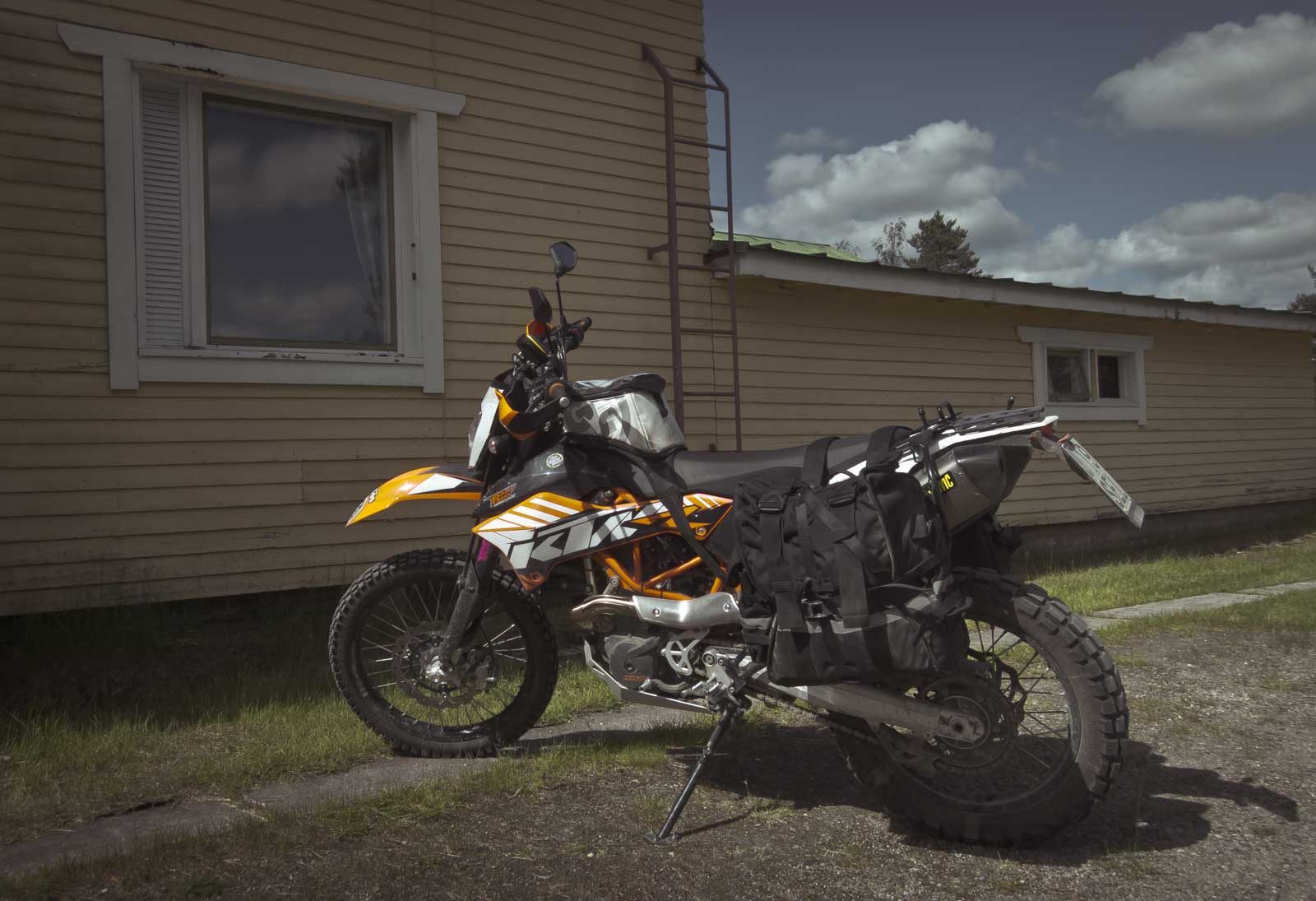
In 2013 Jussi Hyttinen fitted his KTM 690 Enduro R with side racks chosen for the reason every packing guide gives: they hold the bags low and forward. Five years and tens of thousands of kilometres later he had moved the same bags higher and further back, because hung low they swung, rubbed the side stand and trapped his boot. The rule is right. This build shows where it stops.
Built by Jussi Hyttinen (The Rolling Hobo)
By Chad Sig · Published
KTM 690 Enduro R (K13), whose 12 litre plastic fuel tank doubles as the rear subframe. Rally Raid soft luggage side racks, Adventure Spec Magadan soft panniers, Rally Raid 4.5 litre tail tank and EVO-2 front tanks, Rally Raid fork extension and Tractive rally shock.
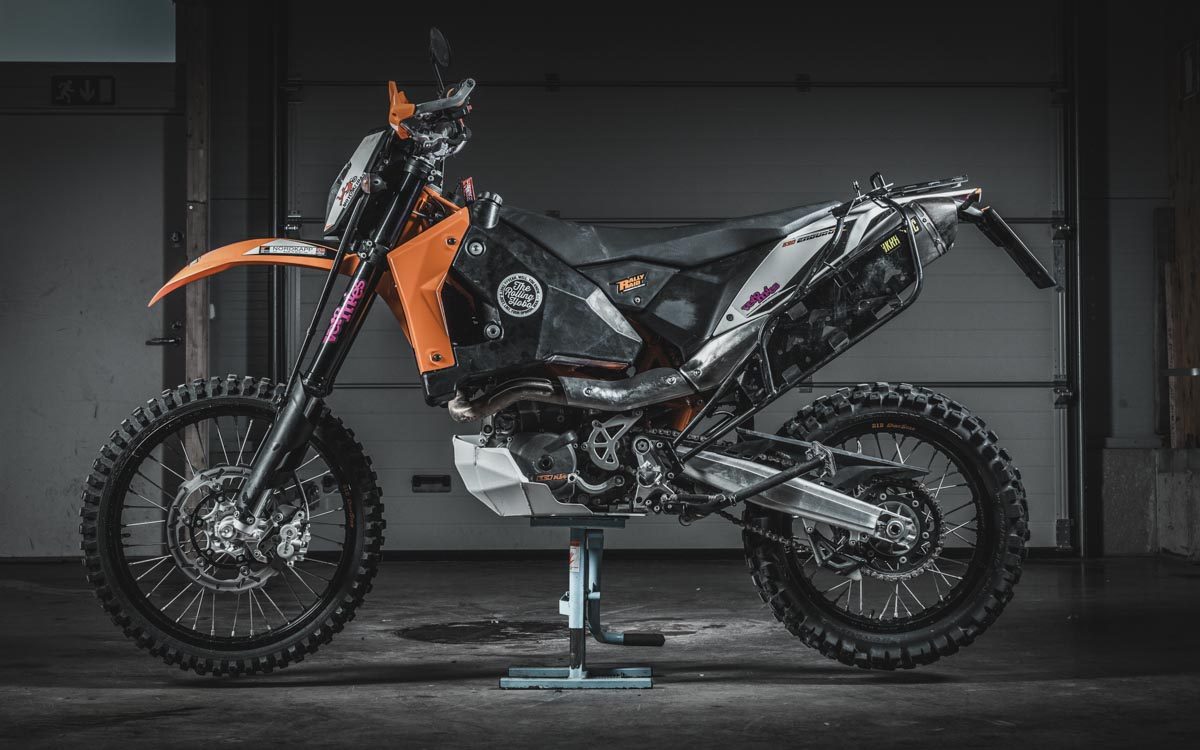
What it is designed for
Technical ground with luggage
Ruts, rocks and mud, ridden standing with feet ready to dab or paddle. That use is what eventually decided where the bags went.
Range without resupply
About 300 km on the stock tank plus a tail tank, which he found was not enough, then about 500 km with front tanks added.
Falling over and riding on
Soft bags, and steel racks that bend in a crash instead of passing the blow into the plastic tank they bolt to.
What it gets right
The standard advice for loading an adventure motorcycle is to keep weight low and close to the middle of the bike. Hyttinen started there, for the stated reason, and the two write-ups he published five years apart show what happened when the rule met a rider who stands up and paddles through ruts. Low bags swung and got in the way of his feet, so he moved them up and back, and he kept the over-seat straps loose so the bags rest on the racks. On a 690 of this generation that last detail matters more than it looks, because the seat sits on a plastic fuel tank that serves as the rear subframe.
In Jussi Hyttinen (The Rolling Hobo)’s own account
- In 2013 he chose his racks for the textbook reason: they hold the bags low and forward.
“You can add passenger foot peg mounts to the RR rack but the mounting plates for the bags are lower and more forward. Personally, this is where I want them. I ride enduro and never carry a passenger so for me the low center of gravity is the most critical thing. I don't want to have my luggage far back and high up.”
Source - And he named the cost of the other rack in the same terms.
“The TT rack has the hoop a lot higher and further back which has a very negative effect on the center of gravity of the bike and of course handling.”
Source - By 2018 the low position had cost him in three ways. The first was wear.
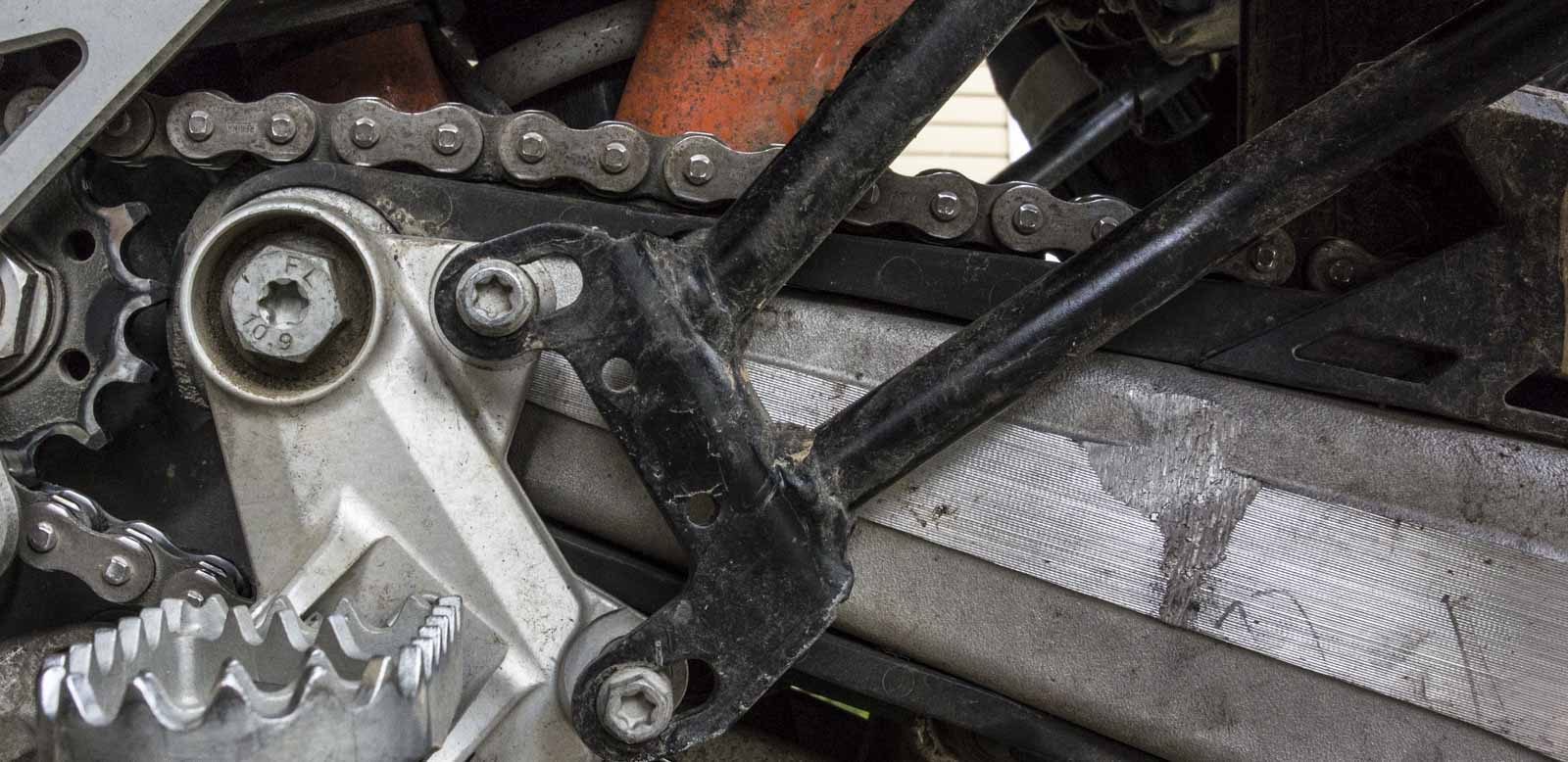
“I used to have them lower, which resulted in the left hand pannier making contact with the side stand. This resulted in minor abrasions.”
Source - The second was handling: a low bag held loosely can swing. The typo is his.
“The bike was felt a little more unpredictable in terms of handling as the luggage could swing a little while hanging low.”
Source - He had said the same in a reply in the article's comments, before the fix.
“It's pretty good, but still allows a lot of swinging of the Mags, when mounted nice and low.”
Source - The third was his feet, which is the one that matters most to a rider who dabs and paddles.
“There was also very little clearance for boots and in technical terrain I kept getting my foot caught between an obstacle and a pannier.”
Source - The fix.
“So I raised the panniers higher up and further back.”
Source - Loose over-seat straps, so the bags rest on the racks. His reason is center of gravity and handling.
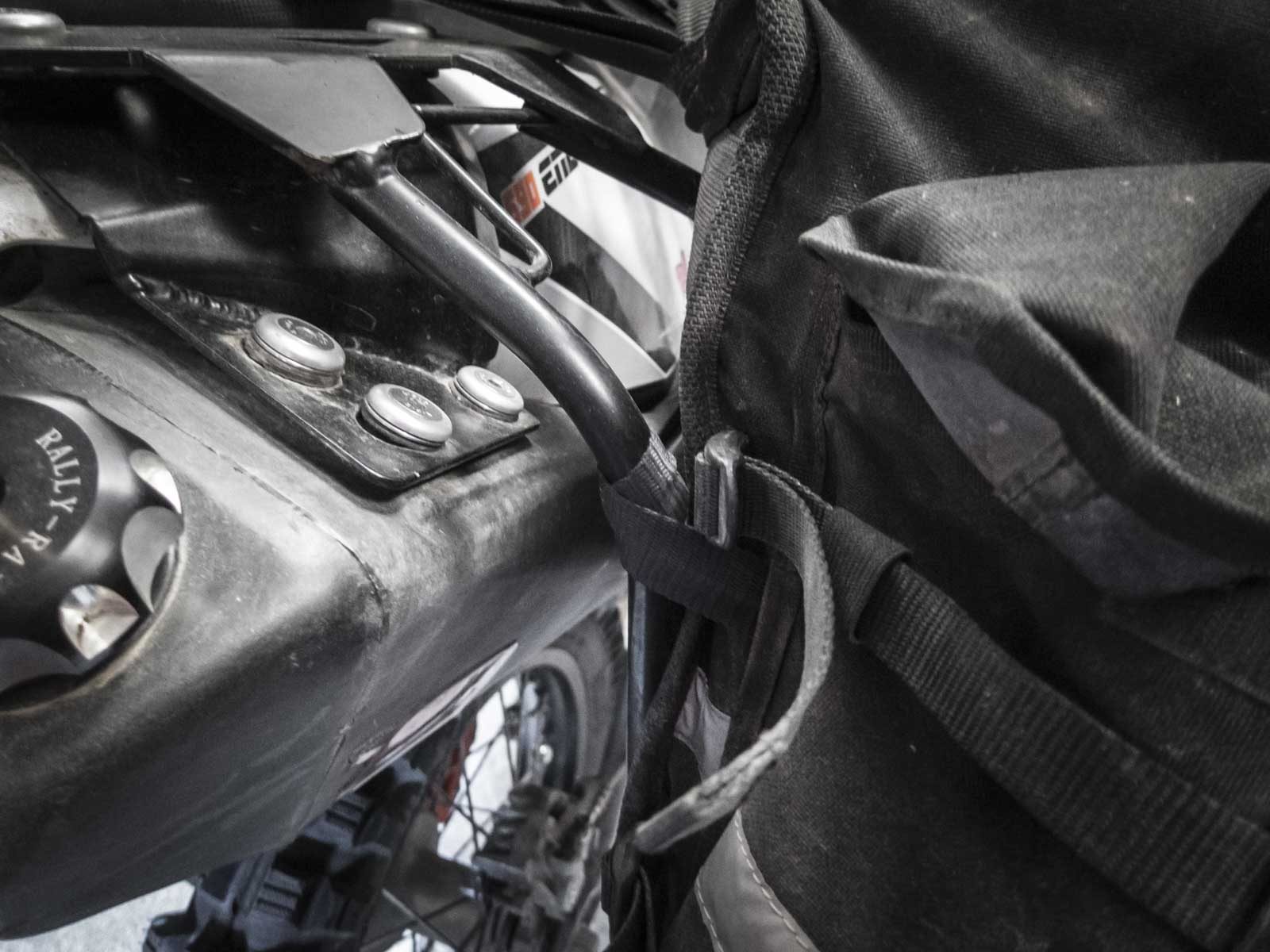
“I keep the velcro straps very loose to make sure the weight of the luggage is on the racks, and not on the seat. This keeps the center of gravity lower and improves handling.”
Source - What the 690's rear end is made of: KTM moved mass rearward by making the fuel tank the subframe.
“To achieve this the 12 litre re-enforced plastic fuel tank forms a monocoque rear sub-frame that also mounts the seat, battery and silencer, effectively doing away with the need for any rear frame tubes all-together.”
Source - What a rack on that tail is rated to carry.
“The luggage rack is suitable for loads up to 5 kg.”
Source - The racks he uses are built to bend, to protect that tank in a fall.
“the plastic deformation of the steel rack absorbs a lot of energy, instead of allowing it to pass directly to the mounting nuts on the plastic rear tank.”
Source - He also replaced the bolts that hold the tank-subframe on.
“The OEM tank and subframe bolts have been known to fail under stress.”
Source - KTM's own loading rule for the bike.
“If you carry any baggage, make sure it is fixed firmly as close as possible to the center of the vehicle and ensure even weight distribution between the front and rear wheels.”
Source
Dirtbeam’s reading
Not stated by the builder. This is what we take the build to show.
- Low and forward is a rule about the bike's center of mass. Boot clearance and a bag that stays put are rules about the rider. On a bike ridden standing through technical ground the second set can win, and this build shows one rider drawing that line. His 2018 position is higher and further back than his 2013 one on the same rack; he does not say it went as far back or as high as the Touratech hoop he criticised in 2013, and we would not assume it did.
- A low soft bag swings because it hangs from its straps with little below it to brace against. Raising it onto the flat of the rack plate, and strapping it to the rack through hitches rather than across the seat, gives it something to sit on. That is our reading of why his handling complaint went away with the move; he states the swing, not the mechanism.
- The loose strap matters more for where the load goes into the bike than for its height, and this is our reading, not his. With the straps tight across the seat, part of the bags' weight hangs from the seat, which sits on the plastic tank-subframe that a top rack is rated to load with 5 kg. With the straps loose, the bags sit on the rack. The Rally Raid rack still bolts to the tail at the top, but its lower leg runs down to the footpeg bracket on the steel frame, so some of the load now reaches the frame directly. We have no measurement of the split.
- The bolt upgrade points the same way. A rider who replaces the fasteners holding his subframe on, and chooses racks designed to bend before they pass a crash into that subframe, is treating the tail as the weak link. The loose strap is the everyday version of the same care.
What it gives up
Moving the bags up and back gave up some of the center-of-gravity advantage he had chosen the racks for in 2013, and he made that trade knowingly. The fuel he added went where there was room rather than where a textbook would put it. And his last word on the 690 was about its total weight, not where the weight sat.
In Jussi Hyttinen (The Rolling Hobo)’s own account
- Range, as he states it, and why he added more.
“I originally had just the OEM tank and a Rally Raid 4.5 l tail tank. That setup gave me fuel capacity of 16.5 l, or more or less a range of 300 km.”
Measured: Self-reported range with no consumption method given. His figure with the front tanks added, 500 km, is stated as what the setup should give 'optimally'. - The tail tank sits on the right of the tail, opposite the silencer, and its rack is rated for less than the top rack.
“which includes a integrated version of our low-profile Tail Pack Rack (max load 2.5Kg) suitable for a dedicated tool bag or other small pack with trail essentials.”
Source - More fuel is two problems, and he fitted extra filters for the second.
“Getting enough fuel onboard is one thing but keeping it usable is another.”
Source - The racks bend in falls, and if they are not bent back they wear the swingarm.
“the bottom of the rack will hit and chafe the swing arm eventually”
Source - The load he carried on the test trip.
“We had roughly 30 kg of luggage each on our test trip and zero problems.”
Measured: 'Roughly'. The page does not say the luggage was weighed. - His conclusion a year later, writing about the lighter KTM 500 EXC that replaced the 690.
“The energy a rider spends on a difficult trail is directly proportional to the weight of the bike.”
Source
Dirtbeam’s reading
Not stated by the builder. This is what we take the build to show.
- Most of the added fuel went forward, on a bike KTM designed to carry its fuel at the back. The front tanks hold 9.5 litres, about 6.8 to 7.4 kg of petrol at 0.72 to 0.775 kg a litre, plus 4 kg of tanks, beside the radiator and ahead of the rider. The tail tank adds about 3.2 to 3.5 kg of petrol and a 3.1 kg kit on the tail. He gives no center-of-gravity reason for this layout; the front tanks may simply be where the room was. Either way, the larger share of the new fuel sits forward of where KTM put the stock fuel.
- A rough load budget against KTM's limits for this generation: 143 kg without fuel, about 19 kg of fuel when full, about 12 kg of racks and tanks, and 30 kg of luggage come to roughly 205 kg before the rider, against 350 kg overall and 200 kg on the rear axle. The rear axle limit is the one to watch, because luggage and the tail tank sit over or behind the rear wheel. This is illustrative arithmetic from published figures, not a weighing of his bike.
- The arc of the build is the lesson for a newcomer. He began with the textbook placement, moved away from it for reasons he could name, and then decided the bigger lever was carrying less on a lighter bike. Where weight goes changes how it behaves. How much of it there is decides how much any of that matters.
The kit
- Lighting
- A Baja Designs SII LED spot on the navigation crossbar, wired to the high-beam switch in place of the stock high beam, so the stock low beam stays on and the spot does the high-beam work. The page gives no electrical figures.
- Storage
- Adventure Spec Magadan soft panniers on Rally Raid steel side racks, a tank bag, and small packs at the tail. The racks run in a single steel tube from the footpeg bracket up to the tail, with large plates the bags rest on. In 2018 the bags sat higher and further back than in 2013, held by cargo straps looped round the rack through hitches so the perforated plate edges cannot cut the webbing, with the over-seat velcro left loose. Fuel is storage too here: 12 litres stock under the seat, 4.5 litres in a tail tank, and about 9.5 litres in two front tanks.
- Recovery
- Not documented as equipment in what we read. What the build does document is getting going again after a fall: soft bags, racks that bend rather than break the plastic tank they bolt to, and a habit of bending the racks back afterwards before they rub the swingarm.