
Counting the watts first: Rick Korchak's DR650 and the lights it could afford
A Suzuki DR650's alternator is rated at 200 watts, and only at 5,000 rpm. Rick Korchak, who founded webBikeWorld, added up what his own bike already used before he bought anything: about 195. So he chose lights that dim, fitted a voltage monitor, then bought a bigger stator and measured what it gave him. He noticed no difference, and that is the useful part.
Built by Rick Korchak (webBikeWorld)
Photographs by webBikeWorld
By Chad Sig · Published
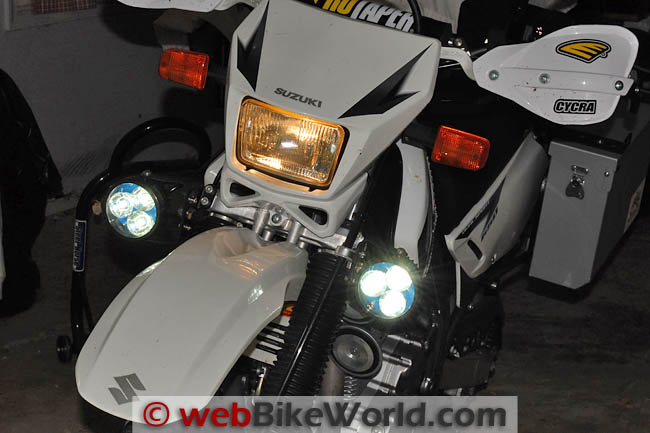
Suzuki DR650SE, a 650 cc air-cooled single dual-sport with a small charging system: 200 W at 5,000 rpm per the shop manual, a 60/55 W halogen headlight and an 8 Ah battery. Clearwater Krista LED auxiliary lights on a mirror-mounted dimmer, a Clearwater Voltage Sentry, and a Pro Cycle stator sold as 250 W.
What it is designed for
A small electrical budget
Everything on the bike shares one modest alternator, so each accessory is a choice about watts before it is a choice about brand.
Seeing a dark trail
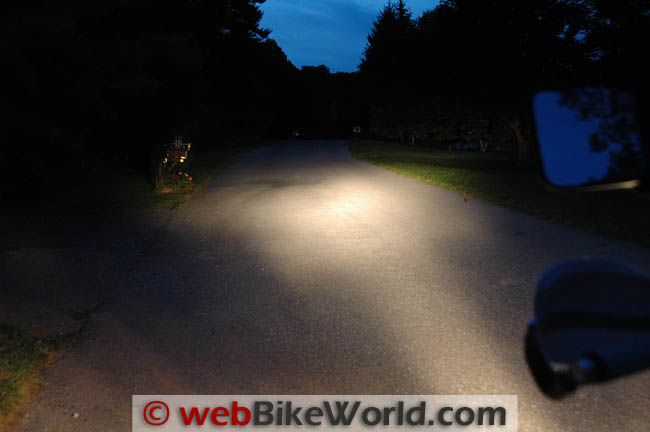
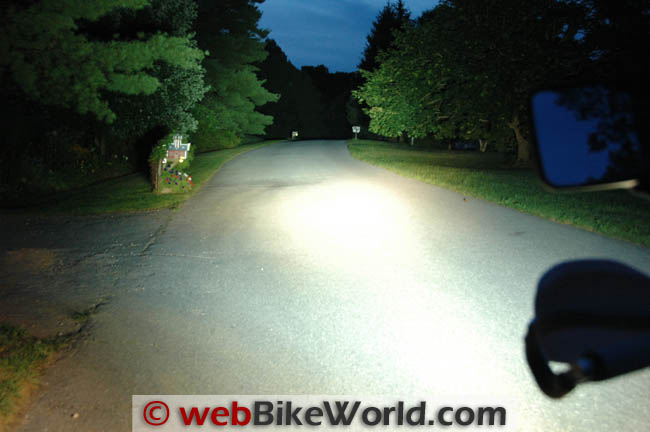
The stock headlight lights a narrow patch of road. The auxiliary lights were bought for width on unlit dirt, not reach on a highway.
Doing it cheaply
A budget series by name. The stator upgrade is costed by the watt, which says a good deal about how the project was run.
Who built it
Rick Korchak founded webBikeWorld and ran it for twenty years. The DR650 was the site's project bike from 2011, written up a part at a time as a budget adventure-touring build, and each post is a review of one change with the reasoning left in. He died in June 2018, so the series is an archive now, and the figures in it are from parts of that era. The arithmetic has not aged.
What it gets right
Korchak did the arithmetic most riders skip. He took the alternator's rated output from the shop manual, listed what the bike already ran with the lights he wanted, and found the total sitting almost exactly at the limit. Then he answered the shortfall three ways rather than one: lights that can be dimmed, so their draw is a dial and not a fixed cost; a voltage monitor in view, so he would know if the system fell behind; and a larger stator for margin, which he then tested with a meter instead of trusting the box.
In Rick Korchak (webBikeWorld)’s own account
- The limit, as a number, and how small it is.
“The DR650’s alternator is rated at a wimpy 200 Watts at 5,000 RPM.”
Measured: A rated figure. The Clymer shop manual's table gives the same: 200 watts at 5,000 rpm maximum output. - And the rating is a peak, at an engine speed trail riding rarely holds.
“Since 5,000 RPM is rarely achieved in normal street/trail riding (although without a tachometer, who knows?), figure on less than 200 Watts most of the time.”
Source - The tally starts with the headlight, the biggest single load on the bike.
“the DR650’s headlight uses 55 Watts on low beam and 60 Watts on high.”
Source - Then everything else that is on at the same time, the lights included.
“The brake/tail light draws 21 Watts and the pair of Krista lights use up to 72 Watts on full power. Figure another 5W for the license plate light and 6W for the instrument lights.”
Source - Which leaves almost nothing.
“Add in the 35W or so to run the ignition and that puts us around 195 Watts.”
Measured: A sum of ratings, and the ignition figure is his estimate. With the high beam on, which is when the Krista lights run at full power, the same list comes to about 199 W. - The lights he chose can be turned down a long way. At the bottom of the dial a pair draws a seventh of what it does at full.
“On low beam, with the pot turned fully CCW, each Krista uses about 5 Watts. A pair uses 10 Watts.”
Measured: Clearwater's figure, from the maker's own scope measurement, not Korchak's. - At full power, with the high beam on, the pair draws more than the headlight does.
“So on high beam (no PWM dimming) each Krista uses 36 Watts. A pair uses 72 Watts.”
Measured: Clearwater's figure. - He measured the stator rather than trusting its label, and said plainly what his method could not do.
“We don’t have a fancy load tester, so we can only estimate the increased output of the new stator.”
Source - The test: a flat battery to make the charging system work, and as much load as he could switch on.
“To test the output, we put a load on the bike’s electrical system by turning on the high beam and the Krista lights and by firing up an electrically operated tire air pump.”
Measured: Charging current on a borrowed Fluke meter, into a battery that had drained to 11.2 V. Engine speed is not recorded. - The stock stator came in where the arithmetic said it would.
“So in this case, the theoretical would be 200W ÷ 14.5V = 13.7A. Our reading was 13.5A, which is pretty close.”
Measured: Measured: 13.5 A. The 14.5 V is an assumed charging voltage, not a reading. - The new one beat its own label.
“But with the new stator installed, we got an actual reading of 17.6A, better than expected.”
Measured: Measured: 17.6 A by the same method, about 30 percent above the stock reading. His 255 W is that current multiplied by the assumed 14.5 V.
Dirtbeam’s reading
Not stated by the builder. This is what we take the build to show.
- The dimmer is the quiet hero of this build. A fixed 72 W of lights would have put the bike at its limit every time they were on. A dial that runs from 10 W to 72 W turns the lights into a load the rider sets to what the bike can carry at the moment, and the voltage monitor beside it tells him when he has set it too high.
- His test measures relative gain more reliably than absolute output. Both readings were taken the same way, so the 30 percent difference between them is sound. Without an engine speed, neither number is a wattage at a known rpm, and he presents 255 W as an estimate, which is right.
- The ignition line may not belong in the tally. The Clymer manual describes the DR650's ignition as running from its own power source coil, separate from the windings that charge the battery and run the lights. If that coil sits outside the 200 W rating, the bike had about 35 W more headroom than his sum suggests. We cannot settle this from the sources, and it errs on the safe side either way.
What it gives up
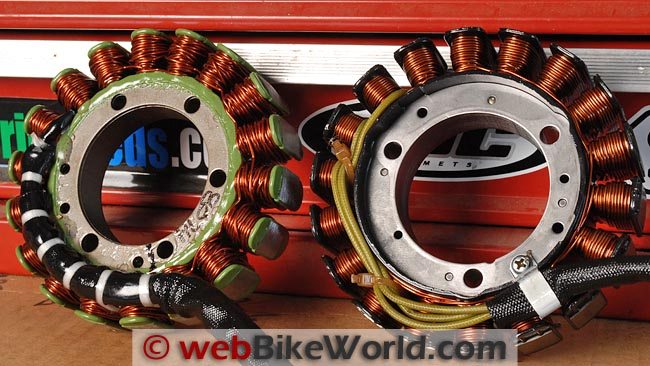
The extra watts cost more per watt than anything else on the bike, meant opening an engine case that runs in oil, and bought a margin he never saw used. The monitor had shown green on the stock stator even with the lights on full. The HID headlight conversion a colleague tried on the same bike, to save watts at the other end, did not pay off either.
In Rick Korchak (webBikeWorld)’s own account
- The price of 50 extra watts.
“That makes it somewhere around $4.40 per Watt!”
Measured: His division: $219.95 for the stator, plus shipping and a $15.99 gasket, over 50 W. - The job means draining the oil: the stator sits inside the engine's left case.
“The stator on the DR650 runs in an oil bath, which seemed strange to me — an electrical system that runs in oil? I guess so…”
Source - Whether it made a difference he could feel.
“Not that I’ve noticed…but then again, who would notice, unless the alternator light turned red?”
Source - The monitor had never complained about the old one.
“The Clearwater Voltage Sentry (review) always showed green with the original stator, even with the Krista lights on full blast.”
Source - A reader added the cost he had not counted.
“Making more Watts = making more heat. Upgrading the Voltage regulator is also a good idea when doing this kind of upgrade.”
Measured: A reader's comment under the article, from his own bike. - The other way to find watts is to use fewer at the headlight. An HID kit was sold on exactly that.
“some retailers claim that the HID bulb takes 35 Watts, compared to 55/60W for the stock bulb.”
Measured: A retailer's claim. Nobody put a meter on it. - It did not earn its place.
“Would we do it again? Probably not.”
Measured: Judged from beam photographs. The post reports a worse low-beam cutoff and a ballast that had to be mounted separately.
Dirtbeam’s reading
Not stated by the builder. This is what we take the build to show.
- That he noticed nothing is the finding, not a disappointment. On this bike the stock alternator was already carrying the dimmable lights, and the stator bought room for things he had not yet added, heated gear being the usual one. A rider with the same bike and the same lights would be better off spending the money on a voltmeter first and a stator only if it went red.
- The HID result points at a general trap. A lamp sold as 35 W is a bulb rating; the ballast that drives it has its own losses, and a reader under the post says it is the ballast that sets the real draw. Without a meter, a watt saved on the packaging is not a watt saved on the bike.
The kit
- Lighting
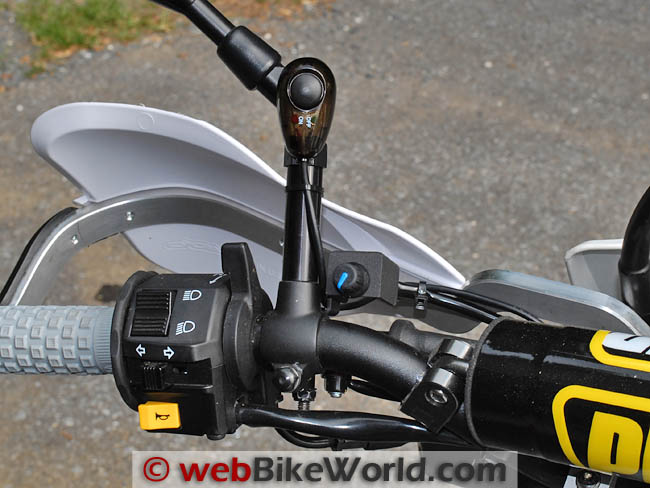
- Stock 60/55 W halogen headlight, plus a pair of Clearwater Krista LED lights on brackets that replace the front side-reflector mounts, beside the front fender. A switch on the mirror stalk and a dimmer on the left mirror bolt, because the DR650 has little room on the dash. The Kristas run at full power with the high beam and at a dimmable level from about 5 W to about 30 W each on the low beam, by Clearwater's figures. A Voltage Sentry shows whether the charging system is keeping up. A later post on the same bike tried an HID conversion of the headlight and did not recommend it.
- Storage
- Not the subject of the posts this note draws on. The series covers luggage in other parts.
- Recovery
- Not covered in the posts this note draws on.