
Do traction boards work, and how do you use them?
The short answer
Yes, on soft ground. In Overland Journal's comparison test a pair of Maxtrax MKII boards got a 6,900 pound Mercedes G-Class out of volcanic cinders on every attempt, while a smooth aluminium plank with no lugs failed on all three. A separate beach test by 4x4 Australia found the same split: stiff nylon boards with teeth worked, and flexible mats and a fibreglass board did not. Boards need three things from you. Dig the tire and the underbody clear first, use low range and first gear, and do not spin the wheels, because a spinning tire melts the teeth off a plastic board. They suit tires with an open tread. They are the wrong tool on hard rock, for a vehicle resting on its chassis, and as a bridge over a gap, which the makers tell you not to try.
Do traction boards work?
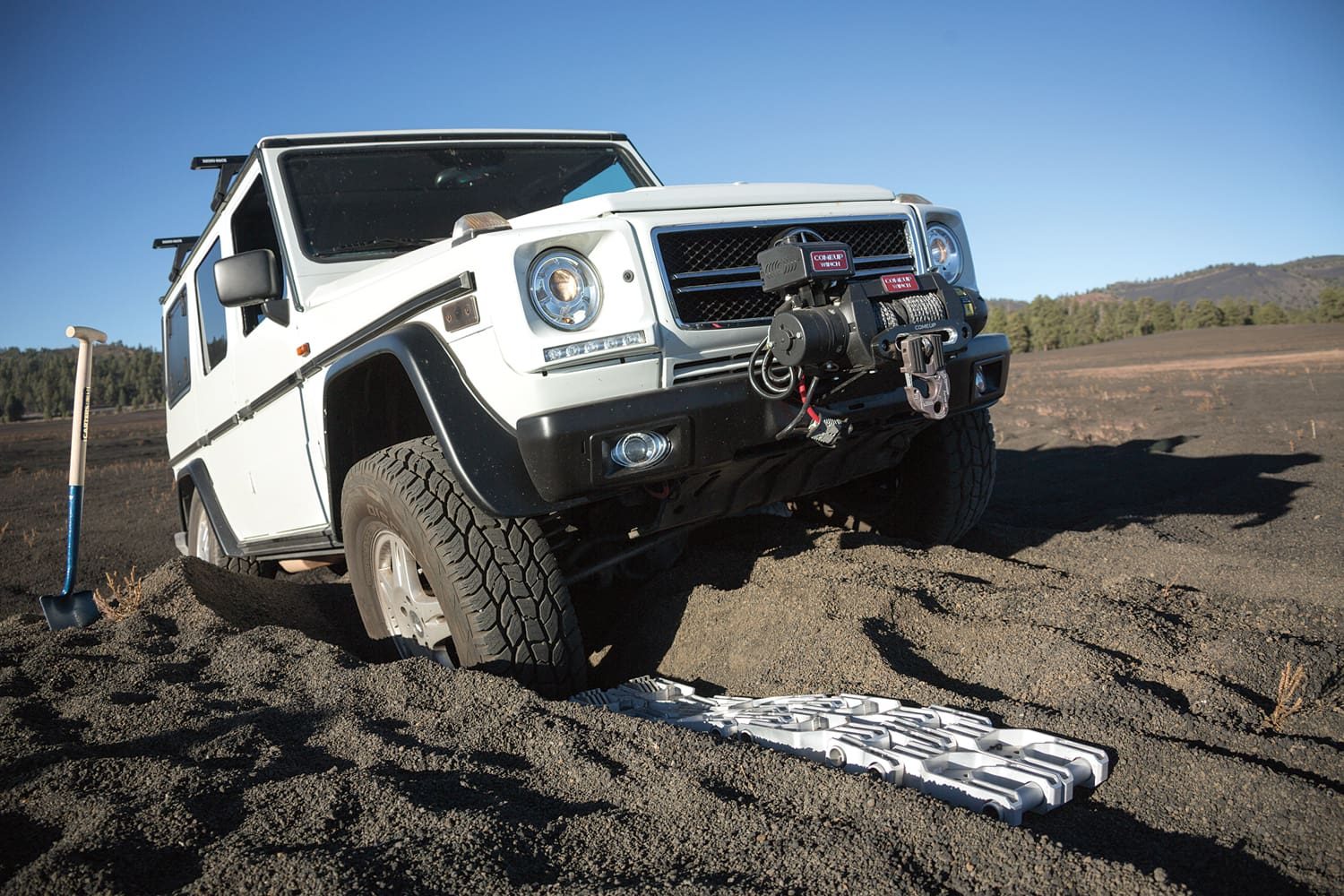
On sand, mud, snow and loose cinders, yes, provided the board is stiff and has something for the tire to grip. The clearest evidence is a test Scott Brady ran for Overland Journal. His team drove the magazine's G-Class up a slope "until the front passenger side tire lost traction, dug a hole, and the suspension reached full extension", then tried six products in the hole, one after another.
The Maxtrax MKII, a nylon board with rows of teeth, recovered the truck every time with no wheelspin. So did an aluminium bridging ladder. A set of smooth perforated aluminium planks did not: they "failed to provide traction and recovery during all three attempts", because the tire had nothing to bite and spun on the metal. A hinged, folding board got the truck out about half the time. The cheapest plastic board in the test worked, and broke cleats doing it.
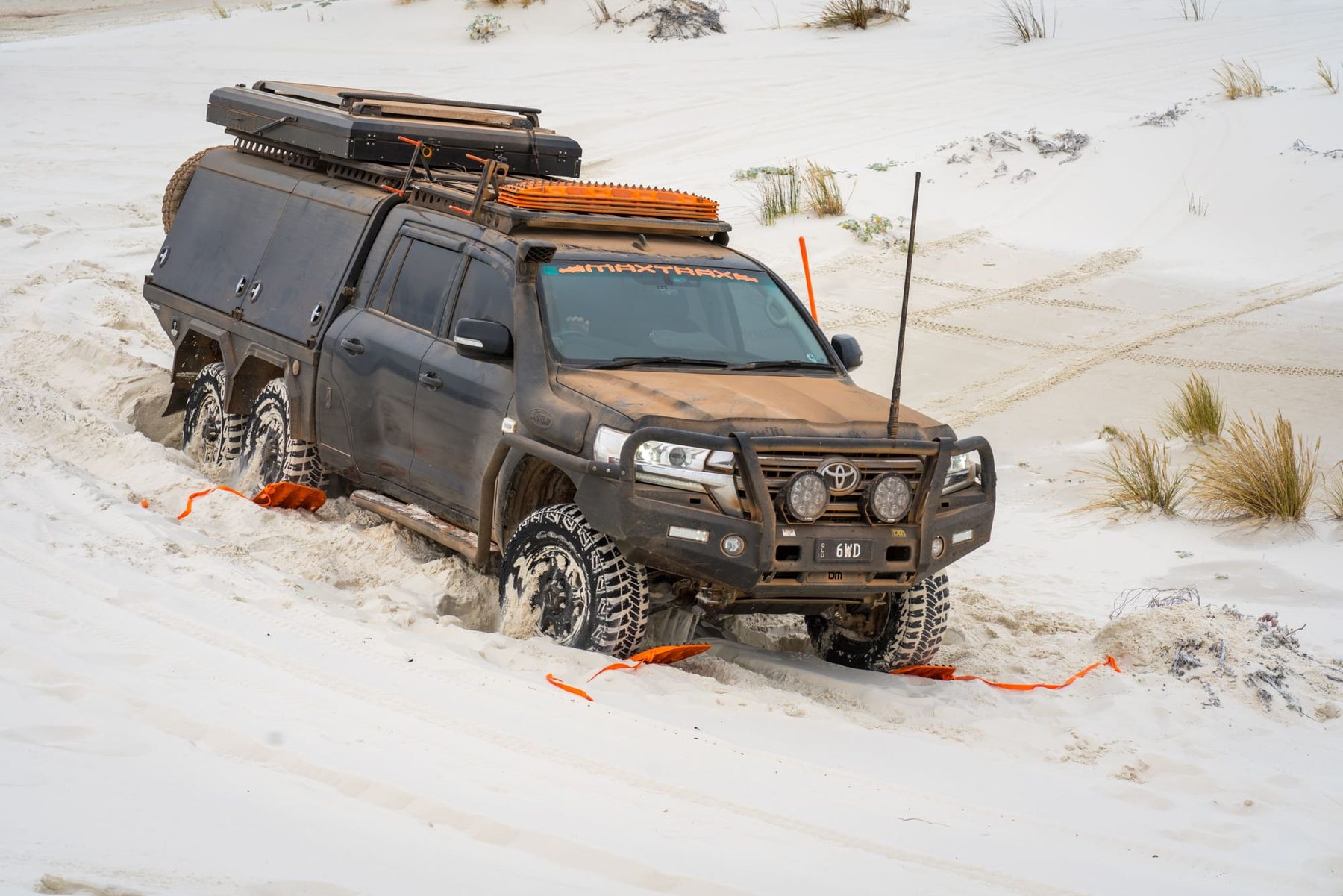
Two years earlier Mark Allen had run a similar test for 4x4 Australia, with a Land Cruiser bogged on a soft uphill beach track and nine devices. The stiff nylon boards from Maxtrax and TRED both worked. A fibreglass board snapped in half on its second attempt, and a rubber mat did little. Brady left flexible mats out of his test altogether, writing that they "should be considered a poor choice for vehicle recovery."
Put the two tests together and the pattern is about shape more than brand. A board works when it is rigid enough that the tire climbs it and does not drag it through, when it has lugs that key into the tread, and when its end is ramped so the tire can get onto it. Both tests used one vehicle on one surface and described what happened without measuring forces, so they rank boards against each other better than they tell you what any board will do in your mud.
How do you use traction boards?
Maxtrax publishes a procedure, and it is the only maker's instructions we found. In order:
| Step | Why |
|---|---|
| Stop as soon as the vehicle stops moving forward | Spinning digs the tires in and sets the chassis down on the ground |
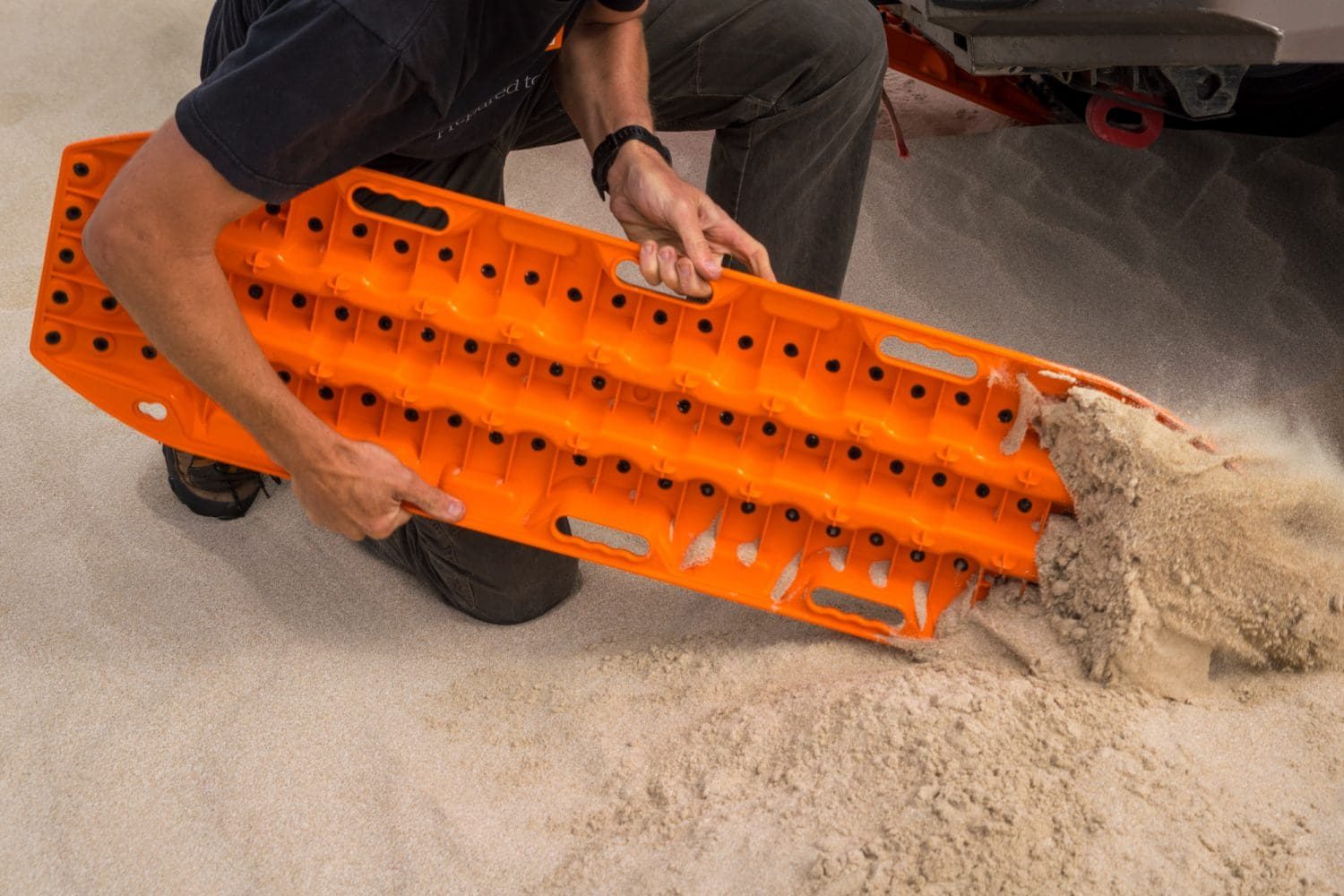
| Dig out in front of the tires and under the body | The weight has to be on the wheels. A board can be turned over and used as the shovel |
| Wedge the board hard against the tread, at an angle | The tire has to catch the first teeth and pull the board under itself |
| Move everyone clear | A board that is spat out leaves fast |
| Low range, first gear, gentle throttle | The tire should walk up the board, not spin on it |
| If the tire does not grab, stop and set the board again | More throttle only melts the teeth |
| Keep moving until you are on firm ground | Stopping on the soft patch starts the job again |
The maker puts one instruction in capitals: "Engage low ratio, first gear and GENTLY accelerate. DO NOT SPIN YOUR WHEELS!" A tire spinning on nylon makes enough heat to melt the teeth flat, and the maker does not cover that under warranty. Brady says the same from the driver's seat: "Excessive wheelspin creates heat and can damage the MKII teeth."
Two things help before the board goes down. Lower tire pressure lengthens the tire's footprint; the beach test was run at 20 psi. And tie a bright leash to each board, because a board that has done its job is usually buried where the tire left it.
What tires do traction boards need?
Ones with an open tread: all-terrain or mud-terrain. The teeth on a board work by sitting in the gaps of the tread, and a highway tire does not have gaps big enough. Maxtrax says so directly: "We strongly advise against using MAXTRAX with highway type tyres as the sipes (the grooves in the tread) are typically inadequate (too narrow and shallow) to properly engage with the teeth". Brady's test found the same thing from the other side. The more road-biased the tread and the wetter the board, the more likely the tire was to slip on it.
If you drive a crossover on road tires, boards are still worth carrying for snow and sand, with the expectation set lower and the throttle foot lighter.
How many traction boards do you need?
One pair for most trips, two pairs if you travel alone, far out, or with a trailer. That is the maker's own advice: a pair "will usually do the job", and "We recommend two pair if you're crossing a desert or heading into remote areas, or towing a trailer or a boat." With four, every tire gets a board, or the boards can be laid end to end and moved forward as the truck advances.
Brady's own worst case is the argument for more. In Australia's Great Sandy Desert, more than 500 kilometres from a tow truck, two loaded Land Cruisers went down in mud. "No problem, we had a winch. Well, we did, until the fairlead broke and severed the synthetic line. Then the winch on the Land Cruiser behind us stopped working, turning for a few revolutions until the motor seized. With two 7,000-pound Toyotas bogged down in mud, the only thing that got us out was a lot of physical effort and 12 (yes, 12) traction ramps."
Two winches failed in one bog. Twelve boards and a lot of digging got both trucks out.
He had resisted boards before that, and says why: "I will also admit my previous bias against carrying them, earlier examples proving to be too heavy and difficult to store." Afterwards: "From that sticky point forward, I have rarely traveled without a set of traction ramps".
What do traction boards weigh, and where do they go?
About 15 to 20 pounds a pair for the nylon boards most people buy, and about 45 inches long by 13 wide, which is the awkward part. Brady's advice on size is a floor: "we recommend a unit at least 10 inches wide and 40 inches long."
| Board | Weight, pair | Size, each | Stacked, pair | Maker's vehicle limit |
|---|---|---|---|---|
| Maxtrax MKII | 15 lb | 45 x 13 in | 3.7 in | 5,000 kg (11,000 lb) |
| Maxtrax Xtreme | 20 lb | Not stated | 3.9 in | Not stated |
| ARB TRED Pro | 18.1 lb | 45.7 x 13 in | 3.4 in | 9,900 lb |
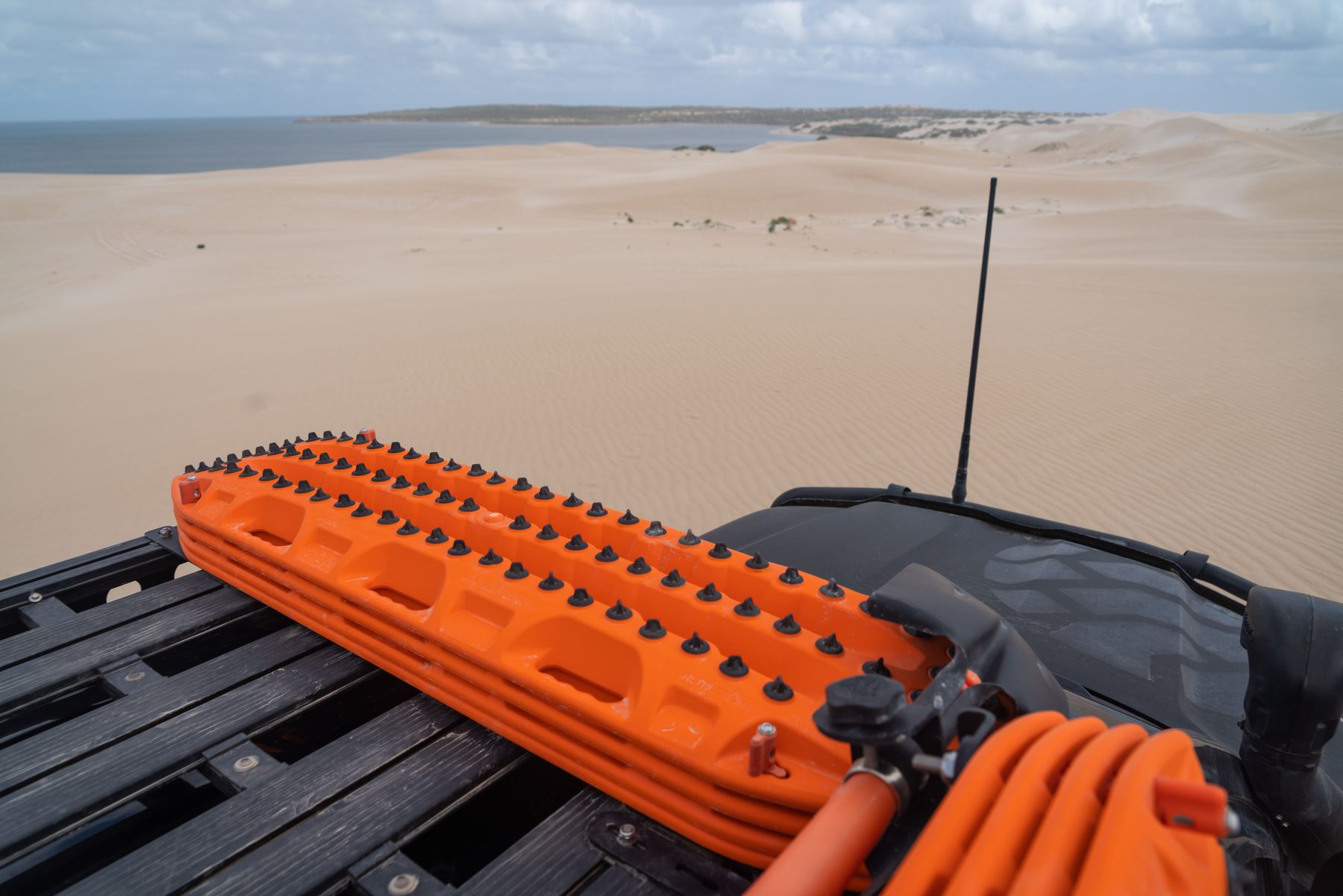
Two pairs are 30 to 40 pounds, which comes out of payload like everything else, and they are usually carried high. Most go on a roof rack on mounting pins, which keeps mud out of the cabin and puts the weight in the worst place for it. The 4Runner owner whose kit we read mounts his on a rack crossbar and says not to carry them inside after a muddy recovery. A spare-wheel mount or the side of a bed rack keeps them lower and easier to reach when the truck is leaning in a hole. Wherever they go, the test is whether you can get them off with the vehicle stuck. Maxtrax also notes that boards left in the sun for years fade and lose some of their give, so a board that lives on the roof ages faster than one that rides inside.
Can you use traction boards as a bridge?
The makers say no, and the tests show why. Maxtrax's instructions list it among the things not to do: "DO NOT USE MAXTRAX on hard and rocky surfaces, as a bridge or a ramp, at temperatures below -20C or on vehicles weighing more than 5000kg." ARB's page for the TRED Pro says nothing about bridging either way. No maker we read publishes a load its plastic board will carry across a gap.
Brady tried it anyway, across a gap 36 inches long and 13.5 inches deep. His report on the Maxtrax: "While the MKII is not advertised for bridging, we have used them successfully for small spans with light vehicles. A nested pair easily supports the weight of a typical wagon, but struggled under the load of the G-Class, bending far into the gap." The boards sprang back afterwards. The aluminium ladders built for the job barely moved, and they weigh 31 to 56 pounds a pair where the nylon boards weigh 12 to 19.
An experienced tester has bridged small gaps with light vehicles and tells you where it stopped working. The company that makes the board tells you not to. If crossing gaps is part of your travel, that is a job for a bridging ladder, and its weight is the price.
Traction boards or a winch?
They do different jobs, and boards come first for most people. A winch needs something to pull against and a working electrical system. A kinetic rope needs a second vehicle. A board needs neither, costs a fraction of a winch, adds no weight to the front axle, and has no parts to fail. Brady tells the origin of the Maxtrax in those terms: its inventor "needed a way to perform an efficient self-recovery when using a winch was difficult or impossible."
His bog is the case for carrying both. The winches failed at two separate small parts, a fairlead on one truck and a motor on the other, and the boards were what was left. It also shows the cost of boards as the only tool: twelve of them, moved forward by hand over more than 100 metres of mud. A winch pulls a truck up a ledge or off a rock, and a board cannot do either. The 4Runner owner carries four boards and a winch, and says of the boards that they are not the answer to every recovery.
When do traction boards not work?
When grip is not the problem. A vehicle resting on its chassis has no weight on its tires, and a board under a hanging wheel does nothing until you have dug the underbody clear or lifted the truck. The same goes for a wheel dropped in a hole on rock, where the maker says not to use boards at all.
They also have limits of their own. The standard Maxtrax is not for use below minus 20 Celsius, or minus 4 Fahrenheit, where nylon turns brittle. Its maker's pages give two different vehicle limits, 3,500 kilograms as the design weight in one place and 5,000 as the maximum in another. ARB rates the TRED Pro for vehicles up to 9,900 pounds. None of these figures comes with a test method, and we found no standard that would make one maker's number comparable with another's, which our glossary entry on traction boards goes into.
And cheap boards are a gamble that nobody has tested well. The least expensive board in Brady's test, at about half the price of the others, got the truck out of the cinders but broke cleats, and his judgement was that anything harder would damage it and leave the vehicle stuck. We found no independent test of the low-priced boards sold online now, so we cannot tell you whether they are better than that one.
What we do not know
Nobody we found has measured what a board does: no pull force with and without one, no count of recoveries across different ground. Both tests are a small number of attempts by one team, described and not instrumented. Brady's conclusion and his results table disagree about how one board did as a ramp, so we have left ramp results out.
Brady describes a bog with broken winches in two articles, with slightly different details, and does not say whether they are one event. We have told it from the fuller account. He reports the Xtreme as about a pound heavier per board than the MKII, and the maker's own figures put it nearer two and a half. The Maxtrax pages we read do not say which of their two vehicle limits is current.
Seen on
Also in the field guide
Sources
- Get a Grip by Scott Brady, Expedition Portal, first published in Overland Journal's Gear Guide 2018, read 2026-11-25A comparison test of six boards and ladders in three set scenarios, with the account of the bog that changed the author's mind about carrying them. One team, one heavy vehicle, on volcanic cinders. Brady is the publisher of the magazine that ran it, and some of the makers tested advertise there. His conclusion and his results table disagree about one board's ramp result, so we quote no ramp ranking.
- MaxTrax Extreme: First Field Test by Scott Brady, Expedition Portal, read 2026-11-25January 2019. Written from the maker's launch of the Xtreme board in Australia, which Brady attended. It opens with a second account of a bog that broke a winch, a winch line and a fairlead; whether that is the same event as the one in Get a Grip is not stated.
- Instructions for MAXTRAX Use, MAXTRAX, read 2026-11-25The maker's own procedure and its list of things not to do. The only board maker's usage instructions we found.
- Frequently asked questions, MAXTRAX, read 2026-11-25Gives the board as designed for vehicles of around 3,500 kg, where the instructions page sets 5,000 kg as the limit. The maker's pages also disagree on the board's height.
- MAXTRAX MKII, product page, MAXTRAX, read 2026-11-25
- MAXTRAX Xtreme, product page, MAXTRAX, read 2026-11-25
- TRED Pro recovery boards, product page, ARB USA, read 2026-11-25States a vehicle weight rating with no test method, and nothing about bridging or how to use the boards.
- Recovery boards comparison by Mark Allen, 4x4 Australia, read 2026-11-25May 2016. A second, independent test: nine devices under a Land Cruiser bogged on a soft uphill beach track. The boards are the models of that year. Results are described, not measured.
- 4Runner Recovery Gear Setup by Gus (@SenseiDad), Trail4Runner, read 2026-11-25An owner's account of where his boards ride and what he carries beside them. The page carries affiliate links.