
Airing down tires: what pressure, and why does it work?
The short answer
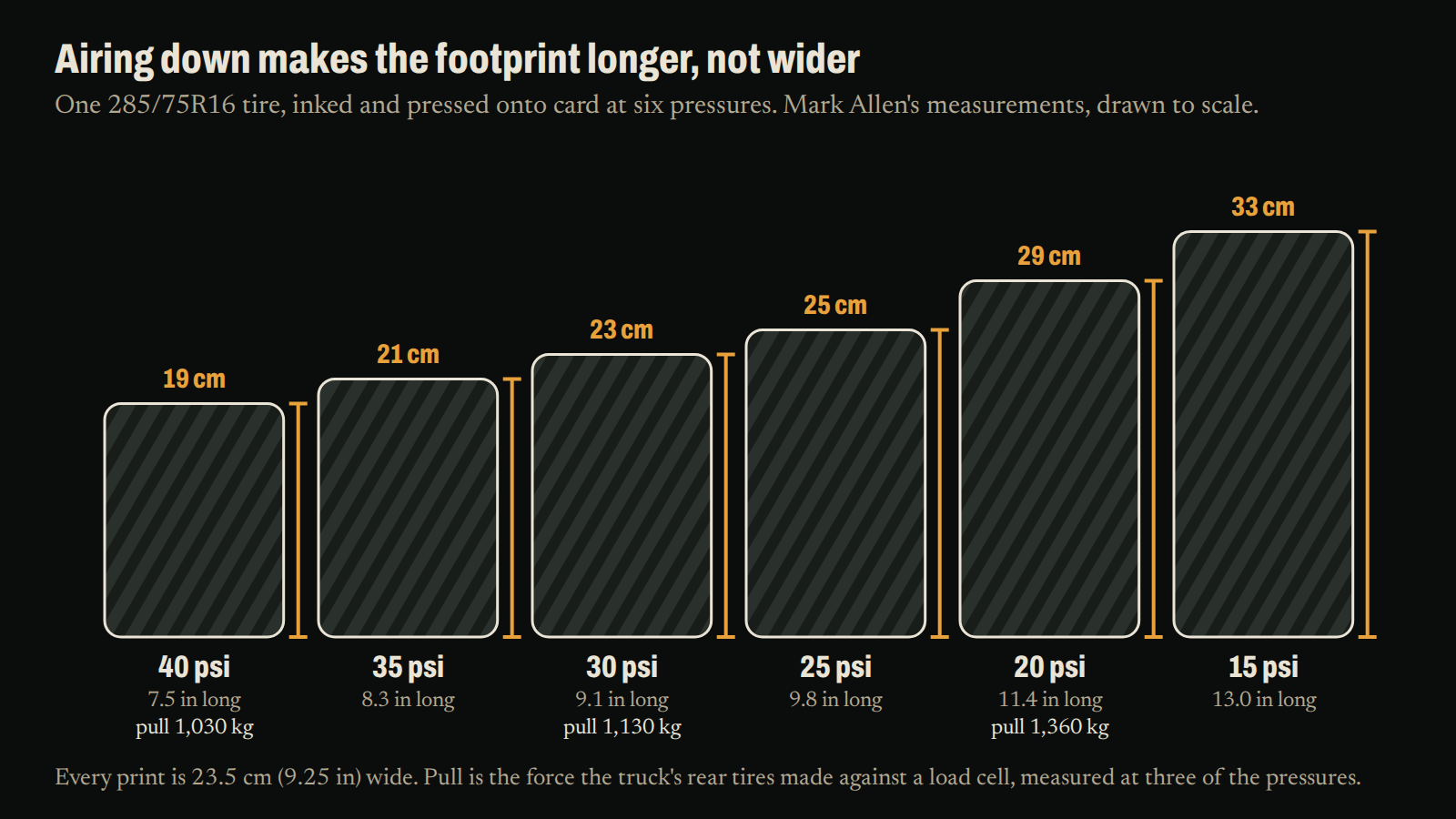
Airing down works because a softer tire flattens against the ground and its footprint gets longer, spreading the same weight over more surface. It does not get wider. In a test by Mark Allen for Unsealed 4X4, one tire's print grew from 19 to 33 centimetres long between 40 and 15 psi while staying 23.5 centimetres wide, and a Land Cruiser pulled 32 percent harder against a load cell at 20 psi than at 40. For a starting point, Cooper publishes 18 to 26 psi for sand and 22 to 28 psi for rock and mud on light-truck tires, and 26 to 34 for gravel roads. Below about 20 psi on an ordinary wheel the tire can come off the rim, so go slowly, turn gently, and carry a compressor: the tire has to be back at its placard pressure before you drive at road speed.

Why does airing down work?
Because the tire's footprint gets longer. Most people picture an aired-down tire spreading sideways, and the bulging sidewall makes it look that way. Mark Allen checked. He jacked one wheel of a Land Cruiser, painted the tread of its 285/75R16 tire with ink, lowered it onto card, and repeated that at six pressures from 40 psi down to 15.
| Pressure | Footprint length | Footprint width | Area against 40 psi |
|---|---|---|---|
| 40 psi | 19 cm (7.5 in) | 23.5 cm (9.25 in) | Baseline |
| 35 psi | 21 cm (8.3 in) | 23.5 cm | +11% |
| 30 psi | 23 cm (9.1 in) | 23.5 cm | +21% |
| 25 psi | 25 cm (9.8 in) | 23.5 cm | +32% |
| 20 psi | 29 cm (11.4 in) | 23.5 cm | +53% |
| 15 psi | 33 cm (13.0 in) | 23.5 cm | +74% |
In his words, "the tyre tread width that touches the ground stays the same at 23.5cm right through the pressure range." All of the gain is length. With the same weight on a print three quarters larger, the pressure the tire puts on the ground falls: he calculates "a 42.4 per cent decrease in ground pressure" between 40 and 15 psi. A longer print floats better on sand and snow, puts more tread lugs to work on dirt, and lets the tire fold over a rock instead of balancing on top of it.
The bulge at the sidewall is a cost. It adds almost nothing to the footprint, and it puts the thinnest part of the tire out where a sharp rock can reach it.
How much traction does airing down add?
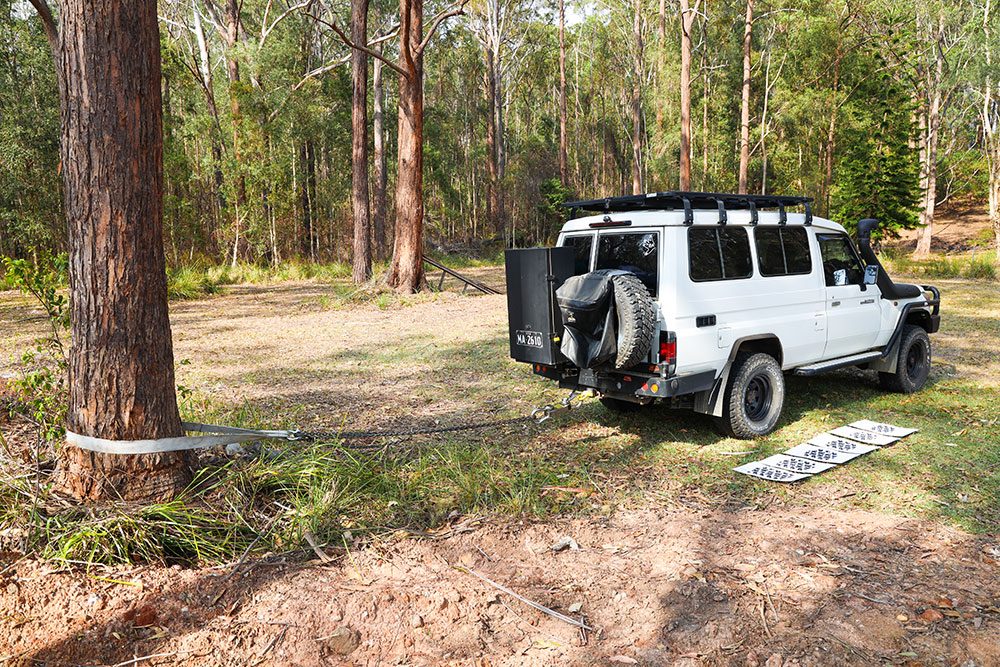
About a third in the two tests that measured it, on surfaces where the tire was the limit. Allen chained the Land Cruiser to a tree through a load cell, which reads the force on the chain, and drove against it in two-wheel drive and low range with the rear differential locked. He locked it for a stated reason: "If the locker wasn’t on, there would be a chance that drive would swap from one side to the other, affecting the readings from our load cell." He lengthened the chain between pulls so that each one started on undisturbed ground.
The result: "Starting at 40psi in the rear tyres, our first readings saw 1030kg of tractive force applied to the load cell. Dropping down to 30psi returned 1130kg, and at 20psi we saw 1360kg applied to the load cell." That is 32 percent more pull at 20 psi than at 40, and most of the gain came in the second step, between 30 and 20.
Allen wrote that this had not been measured before. It had, on much bigger trucks. In 1995 the US Forest Service measured the drawbar pull of a logging truck fitted with a system that changes tire pressure from the cab. Unloaded, the truck pulled 31 percent more on packed snow and 37 percent more on ice at 50 psi than at 100. Loaded, the gain was nothing on snow and 6 percent on ice. An earlier Forest Service test on a sandy road found 34 percent more pull at 65 psi than at 100, and no further gain at 30.
A magazine with a load cell and the Forest Service with a logging truck got nearly the same answer: about a third more pull.
Two cautions come with those figures. The gain depends on load and surface, and it flattens out: the loaded logging truck gained almost nothing, and the sand test found a floor below which more deflation did not help. And Allen's is one pull at each pressure on one patch of ground. It shows the direction and a believable size.
What tire pressure for sand, rocks and gravel?
There is no standard, and vehicle makers mostly decline to give a figure. Ram's owner's manual explains the practice for its off-road trucks without naming a pressure. The numbers that are published come from tire makers and from the people who manage beaches. Cooper's table is the fullest.
| Surface | Pressure |
|---|---|
| Paved road | 32 to 38 psi |
| Gravel, fast and smooth | 28 to 34 psi |
| Gravel, slow or rough | 26 to 32 psi |
| Mud | 22 to 28 psi |
| Rock | 22 to 28 psi |
| Sand | 18 to 26 psi |
For sand, the National Park Service gives figures at three seashores that allow driving. Cape Hatteras recommends under 20 psi for most vehicles. Cape Lookout says 20 to 25. On Cape Cod's soft-sand camping corridor the recommendation is 11 psi, and vehicles may not start above 15. Allen's own practice is close to these: "I often drop to about 18psi to 20psi on soft sand. I then drop lower to get out of trouble but I would be extremely careful not to drive too fast or turn too sharply". An Australian test of one pickup on one steep dune shows why people bother. At road pressure it got a third of the way up, at 25 psi two thirds, and at 16 psi it reached the top.
For gravel and washboard, a rule published by Toyo in Australia is to take 20 percent off your road pressure, so 36 psi becomes 29, and to keep below about 50 mph. For snow we found no figure from a tire maker or a land manager.
Does a heavier truck air down less?
Yes. Allen puts it as a rule: "The heavier your vehicle, the less pressure you should let out and the more care you should take when doing so." Air pressure is what carries the load, and the tire industry's own tables show how fast the capacity goes. An LT285/75R16, the size Allen inked, is rated to carry 3,750 pounds at 80 psi, 2,755 at 50 and 2,130 at 35. The table stops there. Below 35 psi a loaded truck is outside the published figures, which is acceptable at walking pace on a trail and is the reason the speed has to come down.
It works the other way too. A light vehicle needs less air to make the same footprint. The pressures above assume a mid-size or full-size truck on light-truck tires. A small, light four-wheel drive can run well below them, and a loaded camper or a truck with a slide-in should stay toward the top of each range.
How low is too low?
On an ordinary wheel, treat 20 psi as the line you cross on purpose. Air pressure is the only thing holding the tire's bead against the rim, and Cooper says pressures below about 20 psi raise the risk of pushing the tire off it. Ram's manual warns of "tire unseating with total loss of air pressure". It happens under side load: a sharp turn, a rut, a rock against the sidewall. People do go lower in soft sand, as the Cape Cod figure shows, and they do it slowly and in straight lines.
The other limit is heat. A soft tire flexes more on every turn of the wheel, and flexing makes heat. Allen: "the lower your pressures are set, the lower your speeds should be to prevent overheating (from sidewall flex) and having a tyre pop off the rim." BFGoodrich's British guidance for sand is the only maker's figure we found that ties the two together: never below 1.5 bar, which is about 22 psi, and no faster than 20 km/h, about 12 mph, at that pressure.
There are smaller costs. The tire sits lower, so the vehicle loses a little ground clearance. And the bulged sidewall is exposed: "It’s this sidewall bulge at low pressures that can allow a tyre to be staked or cut from sharp rocks or other protrusions, so be careful with wheel placement."
Do you need beadlock wheels to air down?
Not for the pressures on this page. Every figure above, from Cooper's 18 psi on sand to the parks' 20 to 25, is meant for ordinary wheels. A beadlock wheel clamps the tire's bead to the rim so that it cannot come off when the air is not enough to hold it, and it earns its cost when a vehicle is run in single digits, mostly for rock crawling. One beadlock maker says its design allows pressures below 5 psi, which is the maker's claim. Our glossary entry on beadlock wheels covers how they work and where they are road legal.
How do you air back up, and why before the highway?
With a 12 volt compressor, to the cold pressure on the vehicle's tire placard, before you drive at road speed. Ram's manual makes carrying the means to do it a condition of airing down at all: "be sure you have a way to return the tires to their normal on road air pressure". The reason is the same heat that limits speed off the road. Toyo's safety guidance says too little air overheats a tire and can cause it to fail suddenly, and at highway speed that happens quickly. A soft tire also brakes and steers worse on pavement. The park services say to reinflate as soon as possible after leaving the sand.
One detail catches people on long sand drives. Tires warm up as they work and their pressure rises with them. Cape Cod's rules note that it may be necessary to stop and let air out again. Check with a gauge.
What does airing down do to the ride and the trail?
Both get better. A softer tire absorbs the small, sharp hits that the suspension passes straight through, which is why a washboard road is so much calmer at 28 psi than at 38. BFGoodrich describes the tire as additional suspension, and the Forest Service's truck tests recorded an improved ride for the driver.
The same tests found that the road came off better too. Trucks at reduced pressure left shallower ruts, and in one trial washboard formed under the truck at high pressure and not under the one at low pressure. Those were logging trucks, so take the direction only. Allen makes the same point for four-wheel drives: "With lower pressures, you’ll also minimise track damage, as your tyres are less likely to lose grip and spin."
What we do not know
Allen's test is one vehicle, one tire and one pull at each pressure, with no repeats, on ground he does not describe. The article never names the vehicle beyond calling it a Land Cruiser, and its photographs suggest the pull and the ink prints may have been made with two different ones. He never pulled at 15 psi, so the longest footprint in the table has no pull figure beside it. His footprint areas treat the print as a full rectangle, which overstates the rubber on the ground and leaves the comparisons between pressures intact.
Nobody we found has published a pull test of a pickup or SUV across pressures and surfaces. The Forest Service work is on logging trucks at far higher pressures. The pressure figures by terrain come from one tire maker's Australian table, and the American pages of the same brands give none. We found no published figure for snow.
Also in the field guide
Sources
- How to: Off-road tyre pressures and improving traction by Mark Allen, Unsealed 4X4, read 2026-11-25Published May 2020. The load-cell pulls and the inked footprints both come from here, and his arithmetic checks. One pull at each pressure, one tire, one patch of ground. The photographs suggest the pull and the prints may have used two different vehicles, and the article does not say. Its photographs carry no photographer's name.
- Performance of a logging truck with a central tire inflation system, Research Paper NC-322 by John A. Sturos, Douglas B. Brumm and Andrew Lehto, USDA Forest Service, North Central Forest Experiment Station, 1995, read 2026-11-25Read in full. Drawbar pull of a logging truck at two tire pressures on snow and ice, with a summary of earlier Forest Service tests on sand and clay roads. Heavy trucks at 30 to 100 psi, so it shows the shape of the effect and not figures for a pickup.
- Tyre Pressure Guide, Cooper Tires Australia, read 2026-11-25A tire maker's own pressures by terrain, given as an average across sizes and for light-truck tires only.
- Airing Down For Off-Road Driving, 2022 Ram 2500 and 3500 owner's manual, Ram Trucks, read 2026-11-25A vehicle maker's own text on the practice. Gives the mechanism and the warnings and no pressure figure.
- 4x4 tyre tips: driving on sand, BFGoodrich UK, read 2026-11-25The one maker's page we found that gives both a lowest pressure and a speed at it. The BFGoodrich pages for the United States and Australia give no figures.
- The 20 per cent rule, Toyo Tyre Australia, read 2026-11-25A driving instructor's rule of thumb for gravel roads, published by a tire maker.
- Load and inflation tables for LT-metric tires, Toyo Tire U.S.A., reproducing the Tire and Rim Association table, read 2026-11-25Toyo's document, read from a copy hosted by a third party. The table stops at 35 psi.
- Tire Safety Information, Toyo Tire U.S.A., read 2026-11-25
- Off-road vehicle frequently asked questions, Cape Hatteras National Seashore, National Park Service, read 2026-11-25
- Tips for Beach Driving, Cape Lookout National Seashore, National Park Service, read 2026-11-25
- Self-Contained-Vehicle Camping, Cape Cod National Seashore, National Park Service, read 2026-11-25
- Pressure Test: Driving on Sand, Tyre Review Australia, read 2026-11-25One pickup on one dune, up to three runs at each pressure, with momentum acknowledged as a factor.
- Beadlock technology, Hutchinson Industries, read 2026-11-25A beadlock maker describing its own product against a competing design. Its figures are claims, not tests.