
AWD vs 4WD: what is the difference, and which do you need?
By Chad Sig · Published
The short answer
Part-time four-wheel drive (4WD), the usual kind on trucks and off-road SUVs, is a system you switch on for low-traction ground: a transfer case locks the front and rear driveshafts together, and most add a low range for slow, steep terrain, but it should not be used on dry pavement. All-wheel drive (AWD) is always on and decides for itself, using a centre differential or a computer-controlled clutch so the axles can turn at different speeds on any surface, usually without a low range. Neither helps you stop or steer: Consumer Reports found winter tires shortened a 60 mph snow stop from almost 700 feet to about 300, while AWD made no difference. For most driving, tires matter more than the drivetrain. Four driven wheels earn their cost in steep snow, soft sand and mud, unplowed roads, and places like Colorado, whose Traction Law accepts tires alone only on AWD and 4WD vehicles. Choose AWD for changeable roads you do not want to think about, and 4WD with low range for slow, hard ground and deep snow.
What is the difference between AWD and 4WD?
The short version: four-wheel drive is a system you engage, built for low-traction ground and usually with a low range for crawling; all-wheel drive is a system that is always on, built to manage traction on roads by itself, and usually without one. Both can drive all four wheels. What separates them is who decides when, and what happens between the front and rear axles while they do.
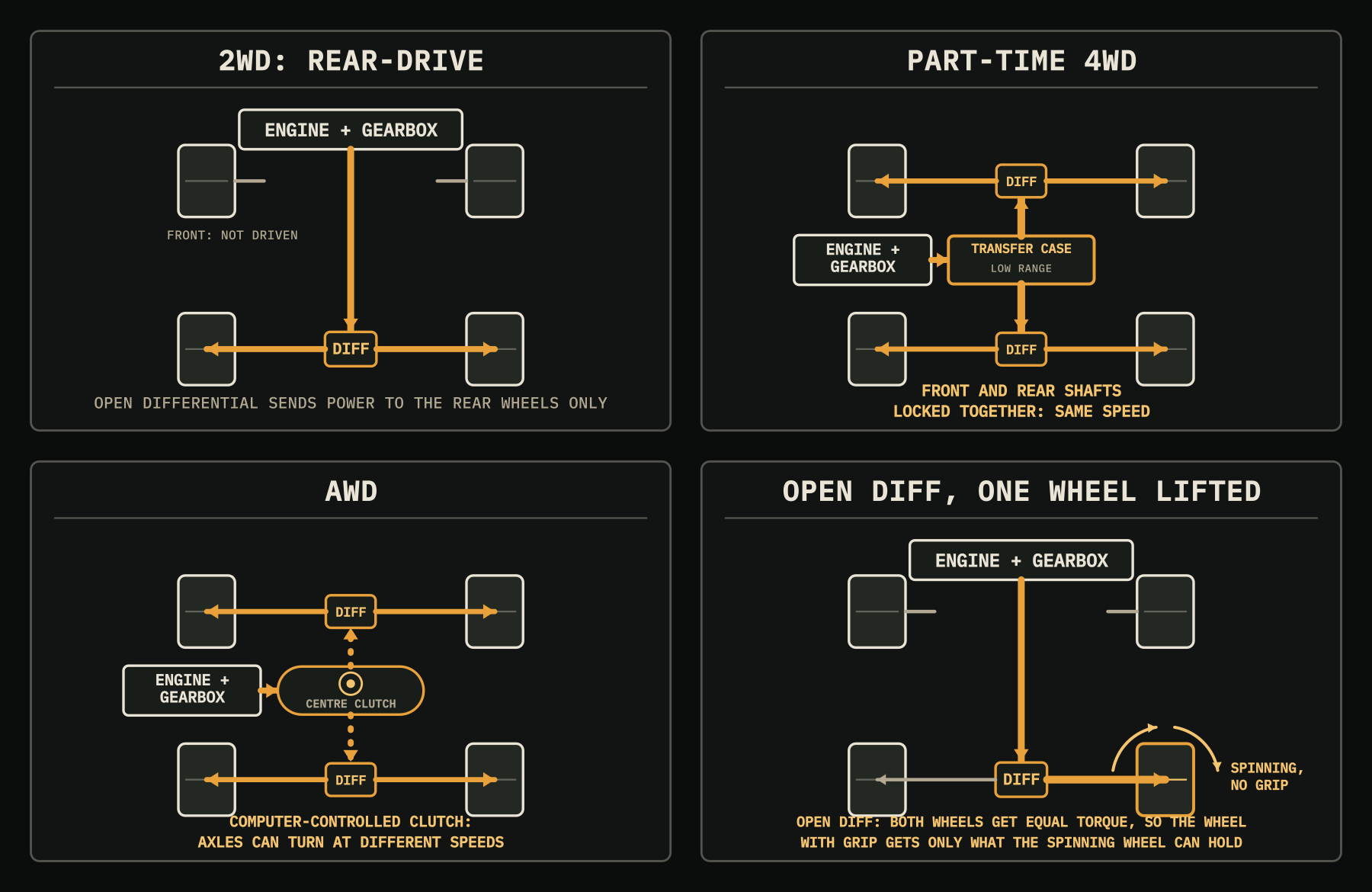
Classic part-time 4WD drives the rear wheels on the road. When you select four-wheel drive, a transfer case locks the front and rear driveshafts together so they turn at exactly the same speed. That is excellent on mud, sand and rock, because neither axle can spin away from the other. It is unusable on dry pavement, because through a turn the front wheels travel further than the rear ones, and with the shafts locked something has to give. Most 4WD transfer cases also carry a low range, a reduction gear that multiplies torque for steep, slow ground.
AWD puts something between the axles that lets them turn at different speeds: a centre differential, or more commonly now a clutch pack that a computer tightens and releases. Because the axles can differ, it can stay engaged on every surface, including dry tarmac. What sends power to the axle that has grip is the clutch, a limited-slip centre differential, or traction control braking the slipping wheels. A plain open centre differential does the opposite, like any open differential, which is why AWD systems pair one with traction control. The price of that flexibility is that none of it is a rigid lock, and most AWD systems have no low range.
| 2WD | Part-time 4WD | Full-time 4WD | AWD | |
|---|---|---|---|---|
| Wheels driven | Front or rear only | All four, when you engage it | All four, always | All four, split by the vehicle |
| Who engages it | Nobody | The driver | Always on; the driver can lock the centre | The vehicle |
| On dry pavement | Fine | Only in two-wheel drive | Fine | Fine |
| Low range | No | Usually | Usually | Rarely |
| Typical vehicles | Most cars, many vans and trucks | Pickups, Wranglers, many off-road SUVs | Some Land Cruisers and Land Rovers | Crossovers, AWD vans, many cars |
| Best for | Dry roads and good tires | Slow, hard ground and deep snow | Mixed use, including hard ground | Changeable road conditions |
Why does four-wheel drive not mean four wheels pulling?
Because every axle has its own differential, and an ordinary open differential sends power to whichever wheel is easiest to turn. On an axle with one wheel on ice or in the air, that is the wheel with no grip. A 4WD with open differentials front and rear can end up with one spinning wheel per axle and the vehicle going nowhere, with four-wheel drive fully engaged.
FarOutRide make the point about their own Transit precisely. Its AWD system balances torque between the front axle and the rear axle, but not between the left and right wheels on an axle, which is why they recommend the limited-slip rear differential even on the AWD van. Getting power to the axle with grip and getting it to the wheel with grip are two different problems, and a drivetrain badge only speaks to the first.
The fixes for the second problem are a locking differential, which joins the two wheels on an axle outright, a limited-slip differential, which biases torque toward the gripping wheel, and brake-based traction control, which brakes the spinning wheel so the differential sends power across. That last one is software, and it is where most modern vehicles now do this job.
4H vs 4L: when do you use each?
4H is four-wheel drive in normal gearing, for traction at road speeds: gravel, snow-covered roads, wet grass, sand you can keep momentum through. 4L engages the low-range reduction in the transfer case, which multiplies torque and divides speed, typically by somewhere between two and a half and four to one. Use it for anything slow and deliberate: rock, steep climbs, deep sand or mud where you need torque without wheelspin, pulling a stuck vehicle, and launching a boat up a slippery ramp.
The use newcomers miss is going downhill. In 4L, in a low gear, the engine holds the vehicle back at walking pace, so you can creep down a steep, loose slope without riding the brakes, and without the wheels locking and sliding. That control is the main thing AWD without a low range gives up, and it is why a vehicle for steep, technical ground usually has a low range or a well-tuned descent control system standing in for one.
Is AWD just software now?
Increasingly, software does. The question used to be mechanical: is there a centre differential, is it locked, what are the gears. On a modern vehicle the more useful question is what the computer does when a wheel slips, because it has three tools and uses all of them. It can tighten a clutch to send more torque to one axle. It can brake a spinning wheel so the differential sends power across to the one with grip. And on an electric vehicle it can simply tell each motor what to do.
Toyota describes its brake-based system, A-TRAC, as controlling engine output and brake pressure so that drive force goes to the wheels that have traction, and says the off-road effect is equivalent to having the centre differential locked and a limited-slip differential on both axles. That is software doing a locker's job with the brakes. Ford's Transit AWD offers five selectable drive modes, including Mud/Ruts and Slippery, each a different set of rules for the same hardware. Mercedes replaced the Sprinter's engageable 4x4, which was fixed at 35 percent front and 65 rear, with an AWD system that varies the split automatically, up to an even split between the axles, decided by the vehicle rather than the driver.
Is AWD or 4WD better in snow?
For getting moving, either helps. For stopping and steering, neither does, and that is the part people get wrong. Braking and cornering grip come from the tires alone: every car already brakes with all four wheels, so driving all four adds nothing once you are on the brakes. The one exception is a steep descent in 4L, covered below, where low range lets the engine hold the vehicle back.
Consumer Reports tested this directly and put it plainly: all-wheel drive is about getting your car moving from a dead stop, not about braking or steering. In their snow testing, winter tires mattered more than all-wheel drive in many situations. On all-season tires it took almost 700 feet to stop from 60 mph in snow; on winter tires a front-drive Camry did just as well as an all-wheel-drive Honda, both stopping in about 300 feet. The tires more than halved the stop. The drivetrain changed nothing.
Van owners who have driven both say the same from experience. OurKaravan, who had owned nothing but four-wheel drives for twenty years before their two-wheel-drive Sprinter, write that a 2WD with winter tires will outperform a 4WD on all-seasons, and that it surprised them. Two Roaming Souls point out that when you brake your tires provide the same traction whether the van is 2WD or 4WD, which is why good winter tires with real tread matter more than the drivetrain.
Between the two systems, the split is by kind of snow. AWD suits mixed winter roads, patchy ice and plowed highways, because it reacts to slip automatically and you cannot always see which patch is ice. Part-time 4WD suits deep, unplowed snow, where a locked transfer case and low range keep pulling. Many clutch-based AWD systems, under long sustained slip in deep snow, sand or mud, heat the clutch and cut torque to protect it; a locked transfer case has no clutch to overheat. Switch back to two-wheel drive when dry pavement returns.
Does 4WD give you more ground clearance?
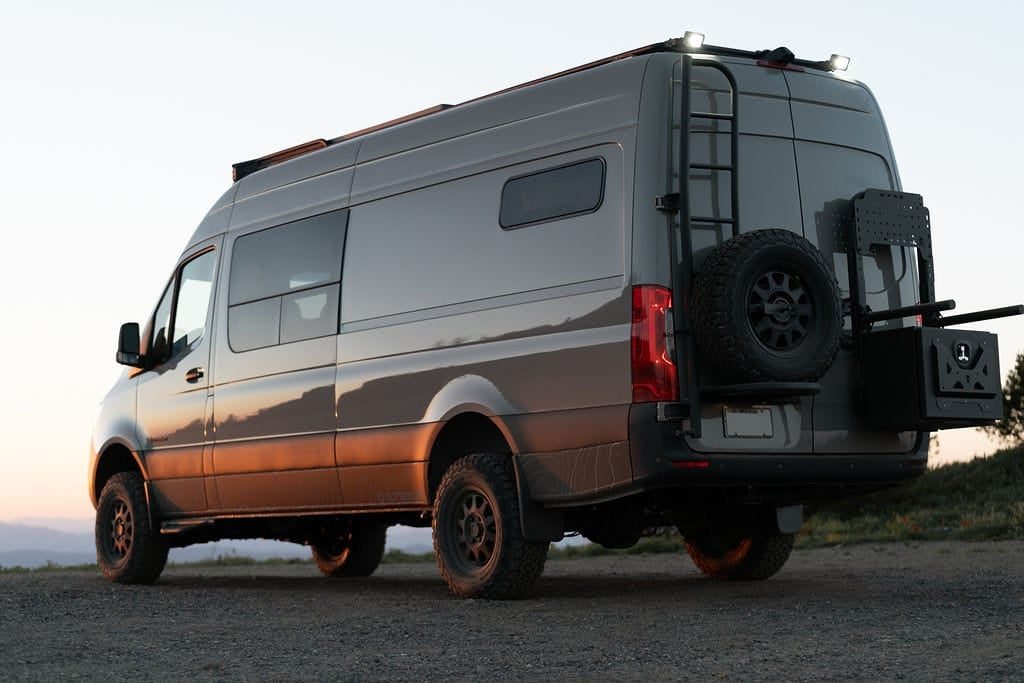
Sometimes, and only as a side effect. On a Mercedes Sprinter, the factory four-wheel drive lifts the body to make room for the front drive, so the 4x4 or AWD van sits a few inches higher than the rear-drive one; on the current configurator the first step rises by about four inches. On a Ford Transit, AWD adds no height at all, and FarOutRide note that their AWD van has the same ground clearance as rear-wheel drive. Driven wheels and ground clearance are separate questions that one manufacturer happens to answer together.
On long vehicles, clearance is usually the tighter limit. A 170 inch wheelbase van drags its middle over a crest long before it runs out of traction, which is the breakover angle, and a nine-foot roof meets branches before either. OurKaravan put it directly: they find the vehicle height to be the biggest limiting factor off-road, not the number of driving wheels. The Wanderful got about two inches of clearance on a two-wheel-drive Sprinter from a suspension lift and larger tires instead.
What does four-wheel drive cost you?
Money, weight, and on some vehicles height. Mercedes' own configurator gives the clearest like-for-like comparison we have found. A 2026 Sprinter 2500 high roof on the 170 inch wheelbase, same High Output engine, costs $6,820 more with AWD than with rear-wheel drive, and on the configurator as we read it weighs about 360 lb more empty, while keeping the same 9,050 lb GVWR. AWD is sold only with that engine, so against the cheapest rear-drive version the price gap is $9,670.
The weight is the cost people miss. GVWR does not rise to cover it, so every pound the drivetrain adds is a pound of payload gone before anything is loaded: on the Sprinter, about the weight of a full 25 gallon water tank plus a battery bank. FarOutRide saw the same on their second Transit, where all-wheel drive, a bigger engine and a larger fuel tank took 530 lb and more than cancelled the heavier rating they paid for. Our GVWR page works through that van.
Then fuel, since driving more shafts costs efficiency, and more parts to maintain. None of that makes it the wrong choice. It makes it a choice with a price, and the price is paid every day while the benefit arrives on the few days the ground demands it.
When do you actually need 4WD?
Across those six, and in the physics, four situations come up where the drive system itself is the difference rather than the tires or the driver.
Steep snow and ice, uphill. Getting moving on a slope is the one job where more driven wheels plainly help, and it is the reason both Ski Burrito and FarOutRide moved to four driven wheels. Soft ground that a heavy vehicle sinks into: sand, deep mud, unplowed snow, where a rear-drive van digs itself in and the front wheels pulling as well can keep it moving. Rutted or cross-axle ground where one wheel lifts, although there the answer is a locker or good traction control as much as four-wheel drive. And the law.
Colorado is the clearest example, and it changed recently. Under the Traction Law as updated in 2025, the tire-only way to comply applies to AWD and 4WD vehicles: 3/16 inch of tread on winter, all-weather or mud-and-snow tires. Any vehicle that does not meet that, including every two-wheel-drive vehicle whatever its tires, needs chains or an approved alternative traction device on its drive wheels. On a posted mountain road in Colorado, the drivetrain decides what you are legally allowed to drive on, even where good winter tires would get a two-wheel-drive van up the hill. Other states and passes set their own rules, so check the ones on your route.
What the drivetrain does not decide is braking, cornering, clearance on a vehicle that is not lifted, and whether a tall, long body fits the road. Those belong to the tires, the suspension and the shape of the vehicle.
How should you decide?
For most people the choice is between everyday vehicles, and the answer is short. A car or crossover with AWD on winter tires covers snowy commutes and ski-area roads better than a 4WD truck on all-seasons. AWD with real ground clearance covers most forest roads and trailheads. A truck or SUV with part-time 4WD and low range is for people who will drive slow, steep, broken ground or deep snow on purpose, and it asks you to know when to engage it.
For a van or a vehicle you live in, start with where you will actually drive, in which months, and whether you will be alone. If it is mostly dry dirt roads and plowed winter highways, good all-terrain or winter tires on a two-wheel-drive vehicle, with recovery boards and a shovel, cover most of it, and the money and payload stay yours. If you chase snow to trailheads, ski areas or steep private roads, need to meet a traction law without chains, or often travel alone somewhere a stuck vehicle is a problem rather than an afternoon, four driven wheels earn their price.
Then choose the kind. AWD for changeable road conditions you do not want to think about. Part-time or full-time 4WD with low range for slow, hard ground and deep snow. A locker or a limited-slip differential if one spinning wheel is your real problem, which it often is. And budget for tires first, because every one of the owners above, on either side, ended up spending their words there.
Do you need 4WD in a van? What six owners decided
Vans are the sharpest version of the question: heavy, long and tall, with an expensive option, and owned by people who write down why they chose. Six who came down in different places:
4x4, three times: Kristen Bor
Kristen Bor of Bearfoot Theory chose the Sprinter because it was then the only van with a factory 4x4, which she called non-negotiable for the snow and rough dirt roads she drives. She kept that choice for three vans in eight years and spent her explanations on everything around it: all-terrain tires, wheels chosen on load rating, and rear springs tuned to the weight over the rear axle. Her second van, she writes, rarely left her feeling limited, other than one time backing down Ophir Pass out of a shale rut. Our build note reads all three vans.
Front-wheel drive, then 4x4: Ski Burrito
Kyle and Melissa chase snow all winter. They thought a front-wheel-drive Travato and chains would do, then found they were avoiding snowy, rough and muddy roads for fear of getting stuck, and moved to a 4x4 Sprinter for the drive, the suspension and the clearance. They add that four-wheel drive does not make them invincible.
Rear-wheel drive for four years, then AWD: FarOutRide
Antoine Gagne and Isabelle Richard drove a rear-drive Transit with a limited-slip differential from Mexico to Alaska and concluded AWD is not mandatory. They bought it on the next van anyway, because some ski areas require AWD or chains and fitting chains in the cold is miserable.
Two-wheel drive by choice: OurKaravan
Four-wheel drive was on their must-have list until they studied the pre-2023 Sprinter system. Six years in a two-wheel-drive Sprinter later, through wet Utah mud, rutted forest roads and foot-deep snow, with tow straps and traction boards aboard, they say the van's nine-foot height stops them more often than traction does.
Two-wheel drive, 150,000 km: The Wanderful
Scott Adamson drove a two-wheel-drive Sprinter from Mexico to the Arctic Ocean, often alone, and was never once unable to follow friends in 4x4 Sprinters. His case for 4x4 is peace of mind when solo and less shovelling in storms; his case for 2WD is a kit list: shovel, traction boards, tow strap, chains, a compressor for airing down, a proper jack, good tires, and the van's weight over its rear wheels.
Rear-wheel drive in the dry Southwest: Two Roaming Souls
Jake Junda and his partner run a rear-drive 2010 Ford E-350 over thousands of miles of mostly dry dirt road, and have been truly stuck twice, getting themselves out both times. For most people, they conclude, the extra cost is not worth it, unless mud, sand, snow or ice are regular.
The owners who bought four-wheel drive name snow and access. The owners who did without name tires, weight over the drive wheels and a shovel. Nobody credits the drivetrain alone.
Seen on
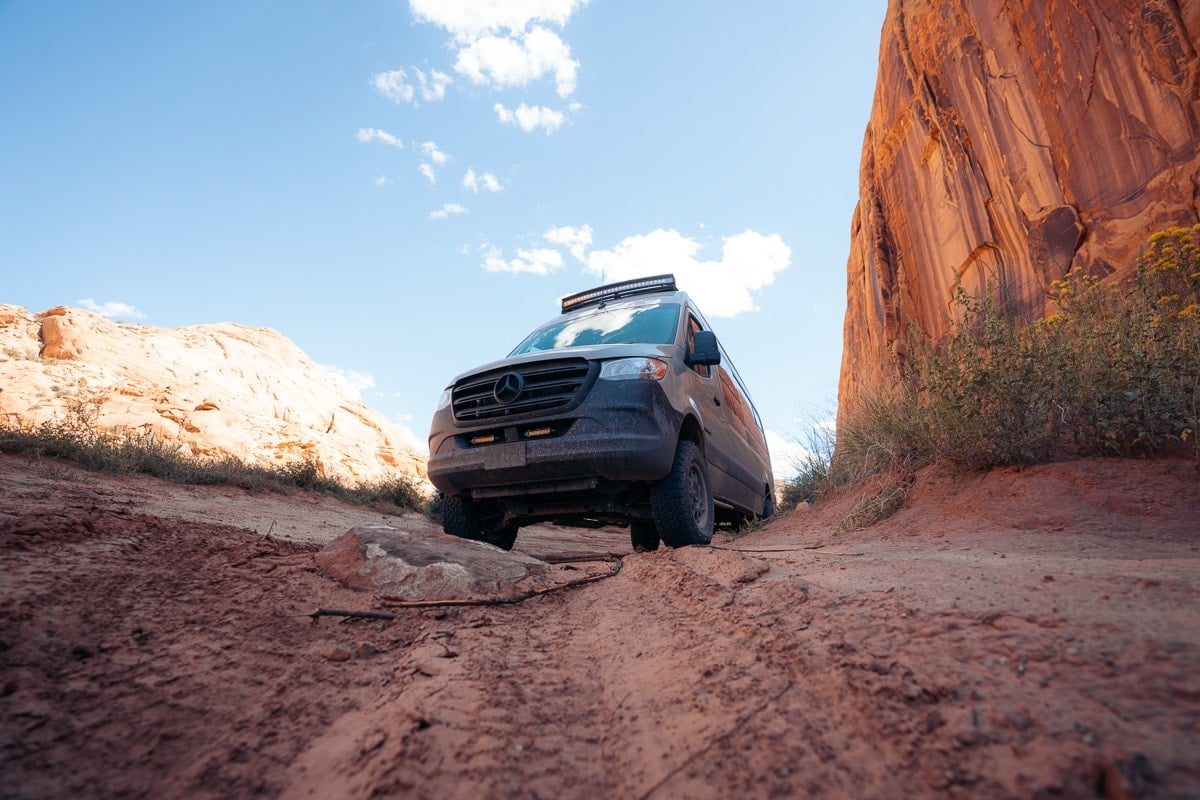
- Three 4x4 Sprinters: the drivetrain was the easy partKristen Bor bought a factory 4x4 Sprinter three times in eight years. The four-wheel drive took her one sentence: snow and rough dirt roads, so it was non-negotiable. The tires, the wheels, the springs, where the water goes and how the family would fit took three vans to get right. Read together, her build pages show where the work in a capable van actually is.
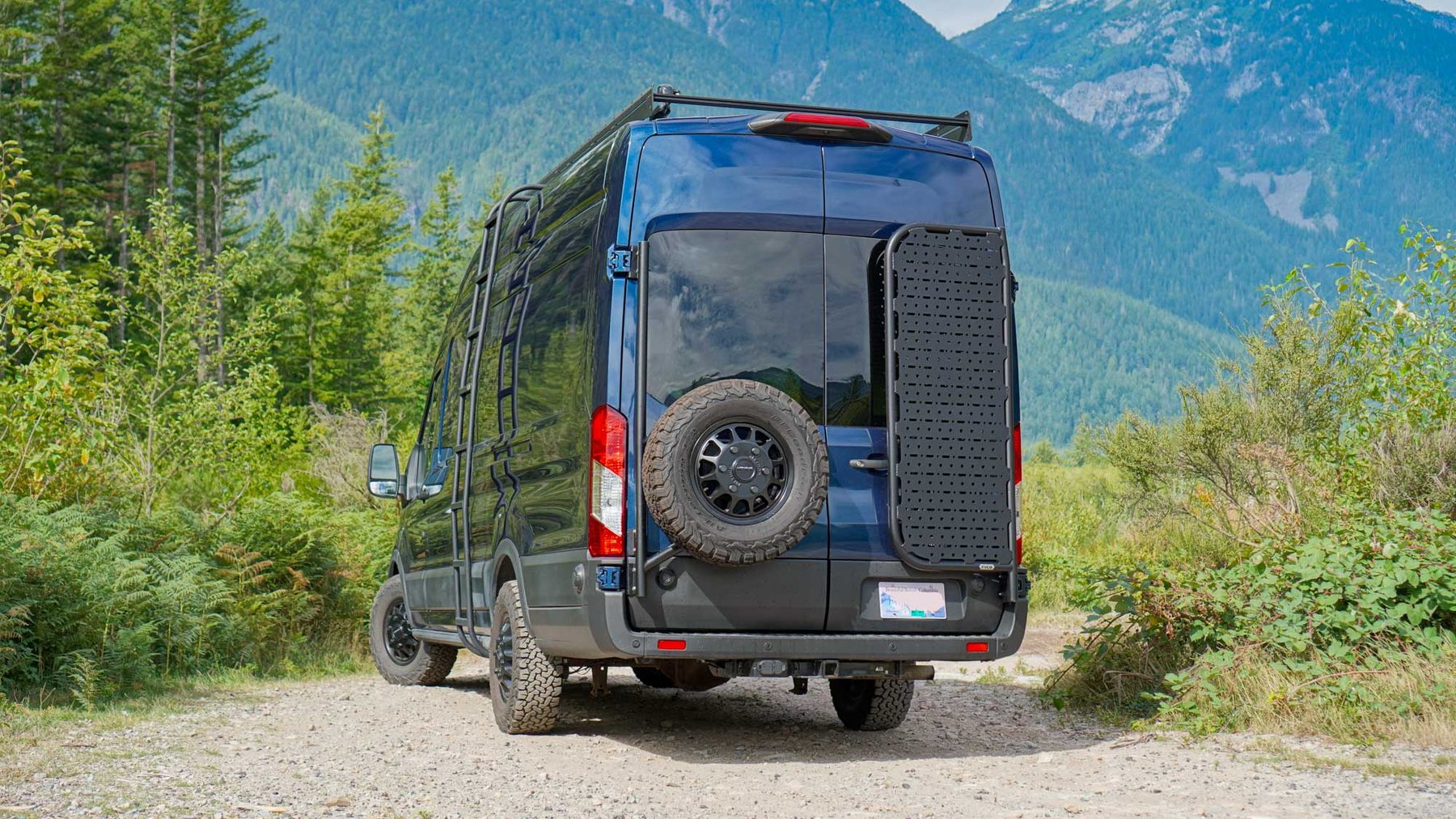
- Buying 500 pounds and losing 30Two engineers took their own advice and ordered their second Transit with 500 lb more weight rating than the first. They bought all-wheel drive in the same order. The van arrived 530 lb heavier empty, and the second build has 30 fewer pounds of payload than the one it replaced.
Also in the field guide
Sources
- 4x4 FAQs, Jeep, read 2026-09-24Jeep's regional site. Defines part-time 4WD, full-time 4x4 and AWD, and warns against part-time 4WD on dry pavement.
- Do you really need AWD in the snow?, Consumer Reports, read 2026-09-24Published test data from 2015: stopping distances in snow on all-season and winter tires, AWD and front drive.
- Passenger Vehicle Traction and Chain Laws, Colorado Department of Transportation, read 2026-09-24
- CDOT, CSP and safety partners share new Traction Law requirements, Colorado Department of Transportation, read 2026-09-24November 2025. States that the tire requirements apply to 4WD and AWD vehicles and that anything not meeting them needs chains or a traction device.
- Anti-lock braking and traction systems, including Active TRAC, Toyota Pressroom, read 2026-09-24
- Mercedes-Benz Vans USA unveils all-new Sprinter AWD system with an advanced engine lineup, Automotive World, reproducing Mercedes-Benz Vans USA, read 2026-09-24Mercedes' release, read on a mirror because the original refused automated fetch.
- 2026 Sprinter cargo van, build and price, Mercedes-Benz Vans USA, read 2026-09-24The weight figures come from the configurator as read on this date. A second listing of the same model gives different curb weights by trim, so we round the AWD penalty rather than print it to the pound.
- 2026 Sportsmobile Sprinter order guide, Sportsmobile, read 2026-09-24Reproduces Mercedes' 2026 pricing, including the $6,820 AWD line on the 170 inch 2500 at 9,050 lb GVWR.
- Adventure Comes Standard: Ford Pro Reveals New 2023 Ford Transit Trail Van, Ford Pro, via Business Wire, read 2026-09-24Read from an archived copy. Source for the Transit's five selectable drive modes.
- Ford Transit order guide by Antoine Gagne and Isabelle Richard, FarOutRide, read 2026-09-24Four years of rear-wheel drive with a limited-slip differential, then AWD. Also the source for AWD not raising the Transit.
- 4x4 / AWD Sprinter and Transit Vans: Cost, Capabilities and Compromises by Ken, OurKaravan, read 2026-09-24
- Why We Traded Our Winnebago Travato for a Revel by Kyle and Melissa, Ski Burrito, read 2026-09-24
- Do I Need a 4x4 Sprinter Van? by Scott Adamson, The Wanderful, read 2026-09-24
- Do You Need A 4x4 Van? 2wd Vs 4wd Vans by Jake Junda, Two Roaming Souls, read 2026-09-24
- Inside My 4x4 Sprinter Camper Van Conversion by Outside Van by Kristen Bor, Bearfoot Theory, read 2026-09-24
- Expedition Truck vs Sprinter Van: Which Is Better for Full-Time Travel? by Kristen Bor, Bearfoot Theory, read 2026-09-24
- Best Vans for Van Life by Kristen Bor, Bearfoot Theory, read 2026-09-24