
Too high and top-heavy: Chris Scott's Desert Riders XR650L, and what he would change
In 2003 Chris Scott and two friends rode three Honda XR650Ls across the central Sahara to the Lost Tree in Niger and back. To get the range, each bike carried a 37-litre tank mounted high above the carburettor, and a steel rack with alloy boxes and jerricans on top. After the trip Scott put "too high and top-heavy" first on his list of dislikes, named the fix, and later wrote the loading rule it taught him. Few builders publish their own correction, and his is a clear lesson in where the weight should go on a motorcycle.
By Chad Sig · Published
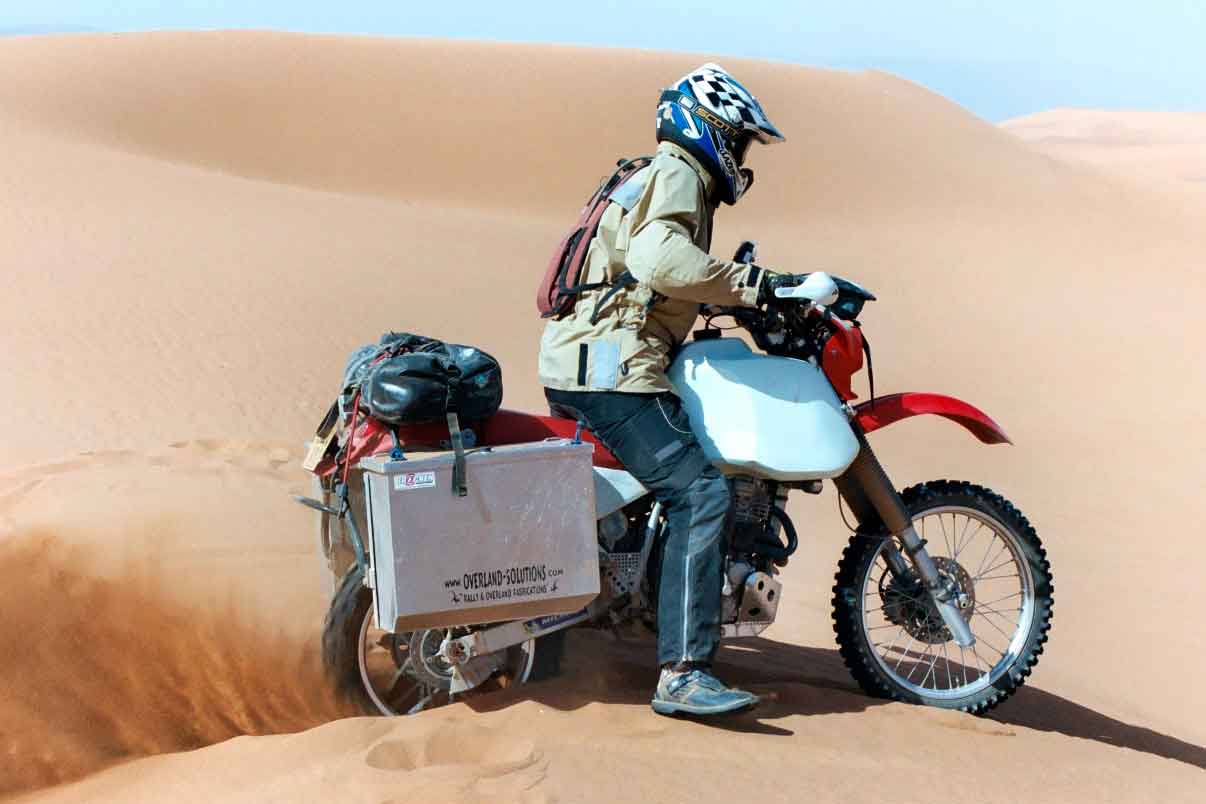
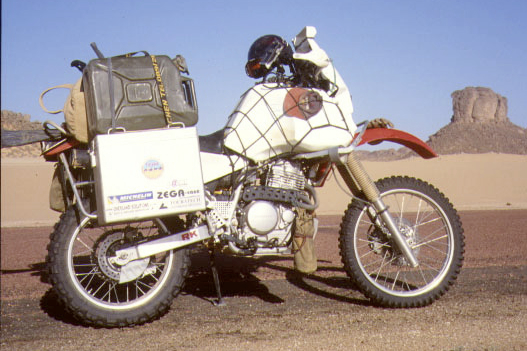
Honda XR650L, three of them, bought from Australia. Acerbis XR600R tanks sold as 40 litres and measured by Scott at just under 37, mounted high for gravity feed to the carburettor. Steel racks by Ernie at Overland Solutions carrying Touratech Zega alloy cases on Scott's bike and larger bolted boxes on the others. Heavier fork springs.
What it is designed for
Range with nothing to break
A tank above the carburettor feeds by gravity, so there is no fuel pump to fail hundreds of kilometres from a road. On a carburetted 2002 bike, that was a real reason.
A cheap, proven platform
Three riders buying three bikes. The XR650L won on economy and price, and on what Scott called proven, decade-old technology.
Strength first
Racks that bore a rider's weight without a creak, with lifting and dragging handles for hauling a bike out of sand. Scott later judged them too much metal.
What it gets right
Where the weight goes on a motorcycle matters as much as how much there is. A bike balances under you, and every kilogram above and behind its centre of gravity makes it harder to hold up at walking pace, slower to steer and harder on the frame. Scott's Desert Riders XR650Ls got three riders to the Lost Tree and back, and every choice on them had a stated reason. What makes the build worth studying is the record: the reason for the high tank written before the trip, the cost written after it, and the rule he drew from both, all in his own words.
In Chris Scott (Adventure Motorcycling Handbook)’s own account
- Why the big tank went where it did: above the carburettor, so fuel reaches it by gravity and no pump is needed.
“The tank sits fully above the carb feed so no fuel pump needed.”
Source - The second reason, which he gave twenty years later: all the fuel in one place.
“you can see the temptation to get the stuff out of the way in one location”
Source - How much it held, by his own fill.
“the '40-litre' XR600R tank (actually it turns out to be just under 37) fits the XRL pretty damn well”
Measured: Scott's fill, not a manufacturer figure. The same diary reports another rider getting 41 litres from his. - Why this bike: price and economy, and an old design seen as a strength.
“In our opinion, for this ride Honda's proven, decade-old technology was an asset.”
Source - He noticed before the trip that his friends' tanks sat better than his.
“The advantage is it's certainly lower and more forward than my set up – ideal in fact, but I think a bit of undersupport would not go amis.”
Source - What he would do now, and it means giving up the gravity feed.
“A lower tank with a fuel pump would lower CoG and improve handling”
Source - The rule he drew for racks.
“What is wanted is a rear rack that attaches to the subframe and other key points as low, forward and close to the bike as possible so the mass follows suit, while allowing for those instinctive corrective dabs when losing control, as well as paddling in soft terrain.”
Source - Where the target is, with a rider and load aboard.
“the mass wants to be as close to the bike's supposed centre of gravity as possible which, with a load and rider aboard, is in the region of the injectors”
Source - Why centralised mass handles better.
“The more central the mass the more predictably the overland-loaded machine responds to the forces of its own inertia as the suspension moves the sprung weight up and down over rough terrain.”
Source - Where his luggage thinking ended up: soft bags, with volume capped to keep the mass low.
“25 litres or more (50 litres total) which I believe is the minimum practical volume for self-sufficient overland travel while keeping the mass low”
Source
Dirtbeam’s reading
Not stated by the builder. This is what we take the build to show.
- The trade is gravity feed against centre of gravity. Before the trip Scott wrote 'no fuel pump needed'; after it, his fix was 'a lower tank with a fuel pump'. He never sets the two lines side by side. Put together, they show that the high tank was not a mistake of ignorance but a price paid for simplicity, and that he decided afterwards the price was too high.
- The numbers make the point. Petrol weighs 720 to 775 kg per cubic metre, so 37 litres is about 27 to 29 kg, against about 8 kg in the 10.5 litre tank Honda's 2023 manual lists for the stock bike. Roughly 20 kg more fuel sat at the top of a tall trail bike, above the engine. That is our arithmetic, and it leaves out the weight of the tank itself.
- A carburetted bike made the high tank tempting. A fuel-injected bike already has a pump, so carrying fuel low costs it far less. On a 2003 XR650L, going low meant adding a pump and its wiring; on most bikes sold today it does not.
- Writing the correction down is the valuable part. Most builders publish the build and move on. Scott published the build, the verdict and the rule, which is why a rider loading a bike today can learn from his in 2003.
What it gives up
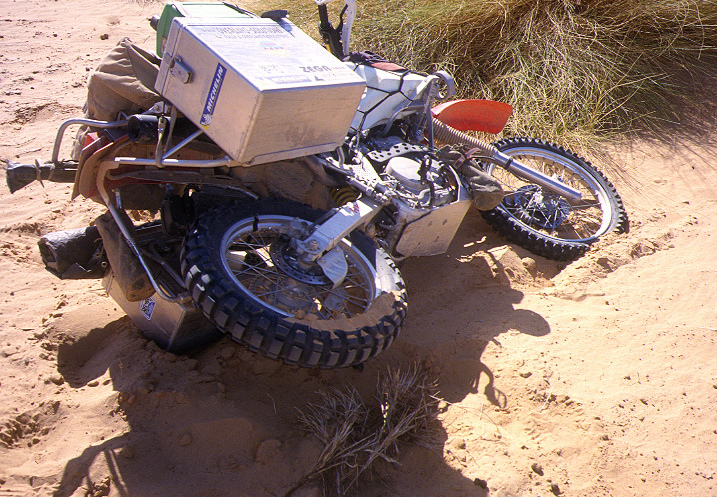
The fuel sat high, and the luggage sat high and behind the rear axle. Loaded, the bikes were heavy at both ends of the worst places to be heavy, and Scott described the result plainly: top-heavy, back-heavy, and hard to hold up in soft sand. The racks were built for strength and ended up heavy themselves, and at least one subframe cracked under the load.
In Chris Scott (Adventure Motorcycling Handbook)’s own account
- The verdict, first on his list of dislikes after the trip, with his own aside.
“Too high and top-heavy with that giant tank (oh really?)”
Source - Twenty years on: he would not repeat it, and he gives the layout he would use instead.
“I wouldn't go with all that high up weight again. I'd sooner get 20 litres and 2 x 10 on the side or at the back”
Source - A tank that big loads both ends of the suspension, not only the fork.
“the tank sits midway so upgrade the suspension on both ends to deal with the weight, not just the front”
Source - How the loaded bikes felt in the hardest ground.
“It was in Oued Samene – our famous 4km day – that the reality of riding our 250kg slugs-on-stilts really hit us.”
Measured: 250 kg is Scott's description of a loaded bike, not a weighed figure. Honda's 2023 curb weight is 157 kg. - And on mountain roads, the rear load in his own words.
“our back-heavy XRLs cutting through the hairpins like half-sunk canoes”
Source - His later judgement of the racks.
“The welding was superb but that rack was over-built, slapping metal over metal in search of strength but actually blinding the function by adding excessive weight.”
Source - The subframes, as reported after the trip: one confirmed, a second possible.
“Rear subframes found cracked on Jon's and possibly Andy's bike.”
Measured: Loads were never weighed. The later rack article puts it as two XRLs cracking their subframes. - The luggage verdict and the next-time change.
“Rough riding with alloy panniers – smaller and soft next time”
Source - The alloy boxes on one rough descent.
“the rough western descent took it out of our alloy panniers (never again!)”
Source - What the quick-release boxes were for besides carrying gear.
“the q/d ability of mine will be handy in the evenings (table and chair)”
Source
Dirtbeam’s reading
Not stated by the builder. This is what we take the build to show.
- His 2024 alternative, two 10-litre containers 'on the side or at the back', is lower than one big tank but not all forward. The usual rider-training advice is to keep loads over or in front of the rear axle. Our reading is that on a tall single, height costs more than a small shift rearward, so long as the containers sit at or ahead of the axle. Scott does not say this; it is a trade-off, not a clean answer.
- The cracked subframes, the heavy racks and the stacked jerricans are one story. Weight on a rack behind the rear axle levers on the subframe at its mounts, and the higher and further back it sits, the harder it levers over every bump. For scale, Honda's 2023 XR650L manual gives a maximum luggage weight of 3 kg including added accessories. That is the current model's figure; we have not found the manual for these bikes, so it is a sense of how little a trail bike's tail is meant to carry, not a rating these riders exceeded. Neither source proves why the subframes cracked.
- Alloy boxes carry their own cost: the box weighs something empty, it needs a rigid rack, and it is the same size however little is in it. Scott's quick-release case doubling as a camp table and chair was a real benefit. On this trip the weight and the rough ground won.
The kit
- Lighting
- Not the subject here, and not documented as a design argument in what we read. We make no claims about it.
- Storage
- Steel racks with narrow ledges carrying alloy cases: quick-release Touratech Zega boxes on Scott's bike, larger bolted boxes on Jon's and Andy's. Jerricans and dry bags rode on top of the cases when the route needed more fuel, which put the heaviest extra load high and behind the rear axle. Tools and oil went in a bag on the bashplate, low, which is the right place for them.
- Recovery
- Ernie built lifting and dragging handles into the rear rack and a front towing handle for winching a bike out of sand or up a slope. With three riders and no support vehicle, the recovery plan was each other.