
Basil: KTM put the fuel low, Poskitt hung the luggage on it
Most riders who want range on a single-cylinder bike start with a stock machine and bolt tanks on. Lyndon Poskitt started from a Dakar rally bike whose 32 litres were already split between two tanks beside the engine and one under the seat, and made it tour. The fuel layout is KTM's engineering. His own change was to the rear tank, which on this bike is also the subframe, so the part holding half the fuel ended up holding the luggage.
Built by Lyndon Poskitt (Races to Places)
Photographs by Adventure Spec and ADVRider.com/Pyndon
By Chad Sig · Published
KTM 690 Rally Factory Replica, a rally bike KTM sold to privateers for the Dakar. Three factory fuel tanks totalling 32 litres; the rear tank swapped for the one from KTM's 450 Rally. Carbureted 654cc single from new, later enlarged to 732cc.
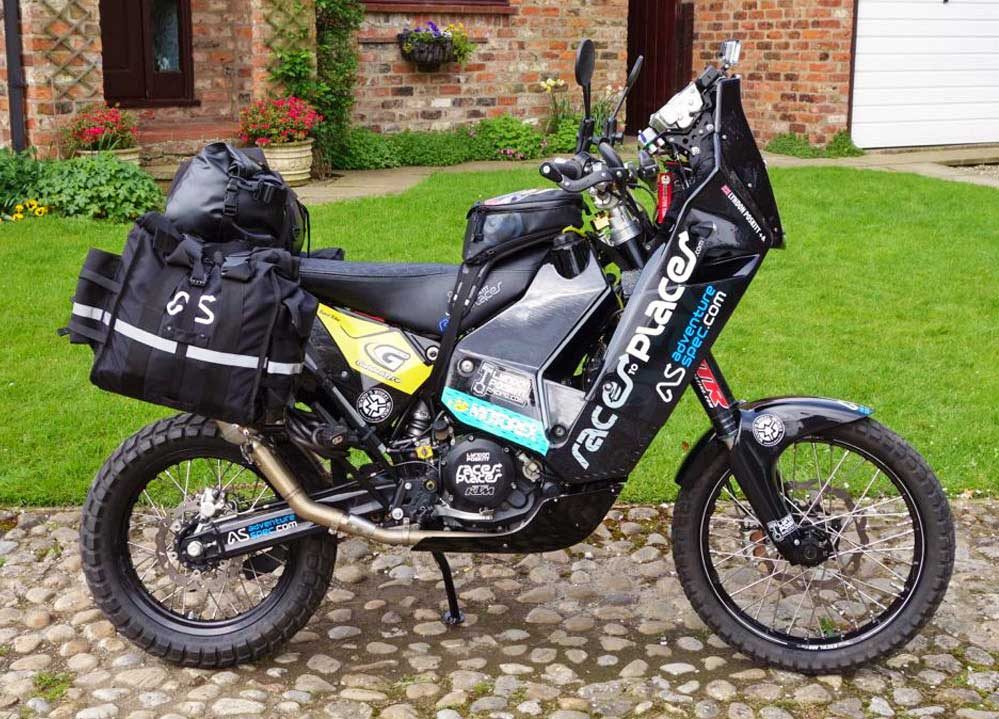
What it is designed for
Range without add-on tanks
32 litres in tanks KTM designed and crash-tested for the Dakar, rather than aftermarket tanks bolted to a bike that was not designed for them.
Fuel low and near the middle
Two front tanks either side of the engine, where the rider's legs sit, and one behind it under the seat. Nothing tall on top of the frame.
Luggage carried through the structure
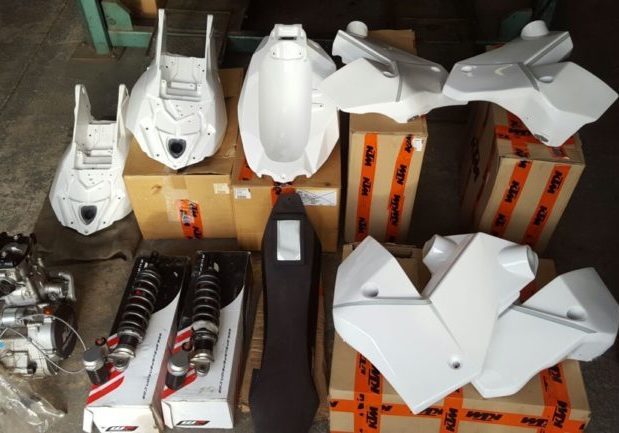
The rear tank is the subframe, so the rack mounts to the tank. The 450 Rally tank he chose gives the rack reinforced mounting points.
Racing on the travel bike
Soft luggage comes off and the racks stay on. The rally chassis and suspension were the reason for the platform in the first place.
What it gets right
Fuel is the heaviest thing most adventure riders add to a bike, and on a long-range single it is also the load that changes the most over a day. Where it sits decides a lot about how the bike handles loaded. KTM's rally answer is to split it: two small tanks low on either side of the engine and one behind the engine under the seat, with nothing on top. Poskitt did not design that layout. His decision was to buy a bike that already had it instead of building an approximation, and his stated reasons are strength and durability rather than centre of gravity: a chassis made to carry weight, and factory tanks that stay on. KTM now sells a production 690 Rally with the same arrangement, which is the plainest sign that this is a manufacturer's answer to where the fuel should go. What is his own is the rear tank. On this bike it is the subframe, and he replaced it with a narrower tank from KTM's 450 Rally so the luggage rack could bolt to it properly.
In Lyndon Poskitt (Races to Places)’s own account
- His first reason for the platform is load, stated before fuel comes up.
“The chassis set-up on the Rally is much more suitable for carrying weight, is stronger and is also way more stable.”
Source - And why the stiffness matters on a travel bike.
“I don't want more flex on a bike that's carrying luggage.”
Source - The fuel case is about how the tanks are made and mounted, not only how much they hold.
“There is no getting away from the fact that the Rally has 32 litres of fuel, in factory tested and produced tanks, bolted sturdily to the chassis with appropriate isolation, unlike many aftermarket kits I have seen.”
Source - The same figure in 2015, written while he was riding Basil, so 32 litres is this bike's capacity and not only the later customer bikes'.
“I do change the rear fuel tanks and some other stuff to strengthen things up for the luggage but there is no getting away from the fact that the rally has 32 litres of fuel”
Measured: Capacity as he reports it. His own site adds that it reads 31 litres on a cold day and 33 in desert heat, from the fuel expanding and contracting. - What he had seen go wrong with bolt-on tanks.
“I have ridden with aftermarket kits and I have seen tanks fall off and riders experience significant vibration due to aftermarket tanks touching the chassis.”
Measured: Observation from riding with others. No failure rate is given. - The front tanks are shaped for crashing, because a tank beside the engine is the first thing to hit the ground.
“The Rally front tanks are designed with a huge chamfered leading edge to prevent them from catching debris in a fall”
Source - He names what the layout does for balance. The layout is KTM's; this is his reading of it.
“A single rear tank and two front saddle tanks help to keep the weight central and low down.”
Source - On this bike the fuel tank is structure.
“The rear gas tank is the subframe on the KTM 690 Rally.”
Source - His change: the same fuel, in a narrower tank the rack can bolt to.
“The 450 RFR rear tank I use is the same 16.8 litre capacity one as the 690 RFR's rear tank but is much narrower and also allows reinforced attachment of the LPR luggage rack that I use on R2P.”
Source - Put another way on his own site.
“this allows me to carry the same amount of fuel but is a nylon structural member so I also have attachment points for a luggage rack”
Source - The frame was reinforced for the luggage as well.
“I modified the chassis quite a bit also to add strength for the extra weight of luggage.”
Source - Why the luggage itself is soft.
“The soft bags are lighter, safer and more resilient to everything I throw at them.”
Source - The scale the choices were tested at.
“He kick-started his long-held dream of riding around the globe and racing on each of the six populated continents.”
Measured: The same page gives 245,000 km and 74 countries. Self-reported. - KTM's current production 690 Rally uses the same arrangement.
“there are no fewer than three fuel tanks: one on each side of the engine, rather than a single one on top, combining to give seven litres of capacity, plus a larger 13-litre under-seat tank at the back.”
Source - And lets the rider choose which tanks feed, which also chooses where the remaining fuel sits.
“A dedicated fuel management system allows riders to actively switch between front and rear tanks via the handlebar-mounted switch cube, with the reserve light corresponding to the selected tank.”
Source
Dirtbeam’s reading
Not stated by the builder. This is what we take the build to show.
- The fuel is worth taking seriously as weight. Petrol weighs roughly 0.72 to 0.78 kg a litre, so Basil's 32 litres are about 23 to 25 kg. That is the weight of a full set of camping gear, and unlike camping gear it is fixed in place by the tank design. The 16.8 litre rear tank alone holds about 12 to 13 kg, just over half of it.
- Splitting fuel into three tanks spreads it along the bike rather than stacking it. The two front tanks sit either side of the engine, low, where the rider's legs are; the rear tank sits behind the engine under the seat. A single big tank on top of the frame, the usual way to add range, puts the same mass above the engine, which makes the bike harder to hold up and to pick up. The comparison is Chris Scott's XR650L.
- Because the rear tank is the subframe, the luggage rack is carried by a fuel tank. That is the reason for his swap: he kept the fuel volume and changed the part so the rack had proper mounting points. It also means the rack rating on bikes built this way is really a tank rating, and it is worth asking what that rating is before loading one.
- Buying the layout rather than building it is a choice any rider can copy in spirit. A 690 Enduro R can get front tanks from the aftermarket, which is the route the Rolling Hobo took. Poskitt's argument is that factory tanks mounted with isolation stay on and do not buzz, and the argument against is the price in the tradeoffs below.
What it gives up
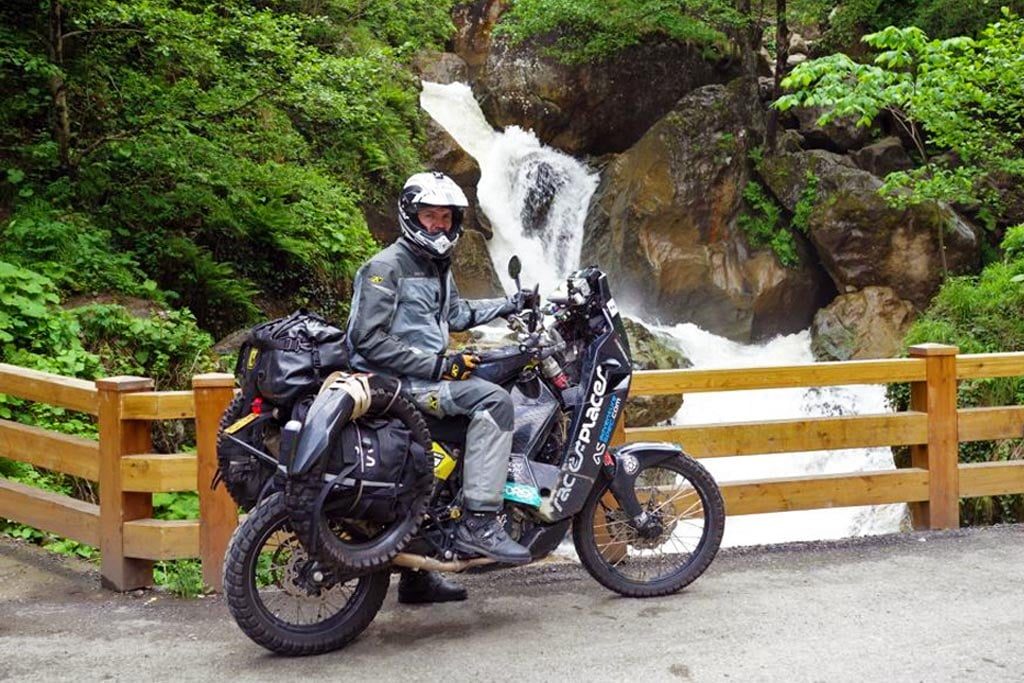
Three costs are on the record: money, weight and fabrication. And the photographs show a fourth that the fuel layout does not touch. The tanks put the fuel low and central; the camping kit still goes on the back, and in the travel shots it rides behind and above the seat.
In Lyndon Poskitt (Races to Places)’s own account
- The money.
“the new price of the 690 Rally Factory Replica was more than three times that of the 690 Enduro in its original state.”
Source - The weight, against the stock bike most riders would start from.
“At 357 pounds dry, it's light for a rally bike.”
Measured: Reported dry weight, method not given. The same article gives about 315 pounds dry for a stock 2014 690 Enduro R, so the rally bike starts around 40 pounds heavier. - The tank swap is not a bolt-on.
“Remember that the chassis has to be modified to fit the 450 RFR rear fuel tank, it's not just a bolt on.”
Source - And it cost packaging under the seat.
“But using the 450 tank meant rearranging the electricals under the seat, fabbing up a battery tray and stuffing a lot of components into a smaller space.”
Source - The factory protection was built for racing, not for years of travel.
“My first Carbon Kevlar bash plate/engine guard lasted about 50,000km before it was totally destroyed.”
Source
Dirtbeam’s reading
Not stated by the builder. This is what we take the build to show.
- The fuel layout solves half the loading problem. The travel photograph shows panniers on the rack, bags stacked on top of them and a spare tyre strapped to the side, all behind the rider and some of it above the seat. That mass is further from the middle of the bike than any of the fuel. Small soft bags keep it modest; they do not move it forward.
- His 2020 essay introduces the tank swap with the words 'for increased fuel capacity', and the same paragraph and his own site say the 450 tank holds the same fuel as the one it replaced. We read the swap as being about the rack, which is what both of his descriptions of the tank itself say.
- The platform is not something a reader can easily buy. KTM built the 690 Rally Factory Replica in small numbers for privateer racers, and used ones are rare and expensive. Anyone wanting this layout on a budget is building an approximation of it, which is the case the Rolling Hobo's bike makes.
The kit
- Lighting
- Baja Designs Squadron LED lights, per ADV Pulse and his own parts list. Not the subject of this note.
- Storage
- Adventure Spec Magadan soft panniers, 25 litres a side in 2015, on a rack of his own design bolted to the structural rear tank, with dry bags strapped on top. He chose soft bags after seeing legs hurt by hard cases in crashes. Tools ride in the lowest place on the bike: a carbon bash plate that doubled as a tool compartment in 2015, later replaced with an aluminium plate of his own with one or two tool compartments. He notes the rack also shields the exhaust, which runs underneath it.
- Recovery
- No recovery kit is documented in what we read. Two self-rescue points are: the carburetor lets him bump-start the bike on a flat battery, and the navigation tower is designed to bend in a crash and be straightened rather than break.