Yellow vs white fog lights: which is better?
The short answer
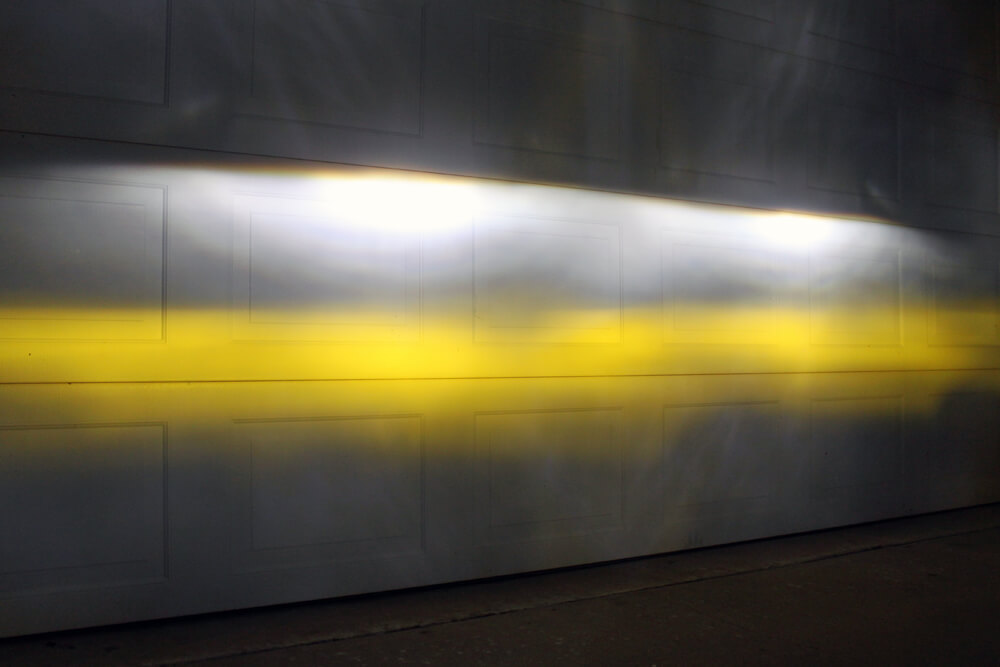
Neither colour sees through fog better. Fog droplets and dust are far larger than a wavelength of light, so they scatter every visible colour about equally, and yellow light does not penetrate them any further than white. What yellow changes is the light that bounces back at you: bluer light is rated as more glaring, and in a 2023 fog-chamber study drivers found a target fastest under the warmest lamp even though the bluest one got slightly more light through. Yellow costs output. By the makers' own figures, the yellow version of the same fog lamp reaches 69 to 92 percent of the white one's peak intensity. Choose yellow if glare from your own lights in dust, snow or fog is what wears you down, and white if you want the most light for the money. Either way a fog lamp is a low, wide beam with a sharp cutoff on top, in whichever colour.
Do yellow fog lights cut through fog better?
No, and this has been settled for a long time. NCHRP Report 95, the Highway Research Board's 1970 review of driving in fog, works through the physics and concludes that in most well-developed natural fogs, light transmission is essentially independent of wavelength across the visible spectrum. The reason is particle size. Fog droplets and trail dust are far larger than a wavelength of visible light, which puts them in what the International Lighting Vocabulary calls non-selective scattering: every colour scatters about the same. It is why fog looks white.
The rule most people have in mind is the one for clear air, where molecules are small enough to scatter blue far more than red. It holds for the sky and stops holding once the particles are the size of a fog droplet. A 2023 study in Scientific Reports measured it directly, putting halogen, xenon and LED headlamps through a fog chamber. The bluest source, xenon, got two to three percent more light through than the others. Blue did slightly better, not yellow.
Why do yellow fog lights feel easier on the eyes?
Because the light that comes back at you is less harsh, and that part has evidence behind it. In the same fog-chamber study, at equal illuminance, participants found the target fastest under halogen, the warmest of the three lamps. The authors put it down to the white wall of reflected light that the whiter lamps threw back into the participants' eyes. More light got through under xenon. People saw better under halogen.
Glare research points the same way. A 2005 study at the University of Michigan had people rate the discomfort of LED, halogen and HID headlamps of different colour and found that "ratings of discomfort glare were linearly related to the amount of short-wavelength content in the light output". Short wavelength means blue. A selective yellow lamp is one with most of the blue taken out.
Yellow does not put more light on the road. It puts less of your own light back in your eyes.
Comfort and performance are not the same thing, and the research keeps them apart. A 2019 paper from Rensselaer compared warm and cool white LEDs as glare sources and found that cool white was judged more uncomfortable, while the time people needed to recover and read a target afterwards was "unaffected by the spectral content of the LED". An earlier paper from the same laboratory, on driving in snow, found that performance on a tracking task fell with the rod-stimulating content of the light scattered back, which is the bluer part, while noting it was "not clear" whether colour made a difference for drivers on a road. So the case for yellow is modest: less discomfort for certain, and a possible edge in falling snow that nobody has shown with a fog lamp on a truck.
How much light does yellow cost?
Some, every time, and the makers publish it. Where a company sells the same fog lamp in both colours and gives figures for each, the yellow one is dimmer at the centre of the beam.
| Lamp | White | Yellow | Yellow as a share of white |
|---|---|---|---|
| Diode Dynamics SS3 SAE Fog Sport | 10,600 cd | 9,050 cd | 85% |
| Diode Dynamics SS3 SAE Fog Pro | 11,900 cd | 10,900 cd | 92% |
| Diode Dynamics SS3 SAE Fog Max | 18,000 cd | 12,500 cd | 69% |
| Rigid D-Series PRO SAE Fog, two-colour | 9,678 cd | 6,992 cd | 72% |
A regulator has put a number on it too. UN Regulation 19 lets a front fog lamp that makes its selective yellow by filtering a colourless source meet the photometric requirements multiplied by 0.84, which is a standards body writing down sixteen percent as the price of the filter.
Why are fog lights yellow?
Partly habit and partly because the rules allow it there and nowhere else on the front of a car. Under the UN regulations most of the world outside North America follows, headlamps must be white, and the front fog lamp is the one forward lamp that may be white or selective yellow, at the maker's choice. The American colour standard, SAE J578, defines a selective yellow region and notes it is used mainly for fog lights. So a yellow lamp low on the bumper reads as a fog lamp everywhere, and makers sell to that expectation.
Regulation 19 specifies the beam in numbers, wide and low with a sharp horizontal cutoff along the top, and then leaves the colour open in a single sentence. A yellow lamp with no cutoff is not a fog lamp, and a white one with the right beam is. Our glossary entry on fog lamps has the figures.
Are yellow fog lights legal?
In most places, yes. Under UN rules the choice of white or selective yellow is written into the fog lamp regulation. In the United States the federal lighting standard requires white headlamps and does not regulate fog lamps at all, which leaves colour to the states. The ones we read either allow yellow in words or say nothing about fog lamp colour.
| State | What the code says about fog lamp colour |
|---|---|
| California | Fog lamps "may be in the color spectrum from white to yellow" |
| Oregon | Fog lights "shall show a white, amber or yellow light" |
| Arizona | Lights visible from the front "shall be amber or white" |
| Utah | An added light at the front must be "white or amber" |
| Michigan | Auxiliary lamps "may emit either a white or amber light" |
| Texas | Says nothing |
| Florida | Says nothing |
| Colorado | Says nothing |
| New York | Unclear |
New York is the one to check for yourself. Its equipment section never mentions a fog lamp, and its rule on coloured lights could be read to reach a yellow one. The codes also separate colour from use: a legal colour does not make a lamp legal to run in clear weather, mounted too high, or alongside too many others. Our page on light bars covers the limits on how many lamps may be lit at once.
Which should you buy?
Start with the beam and the mounting height, because those decide how much of your own light ends up in the air in front of your eyes, and colour only changes how that light feels. A wide beam with a sharp cutoff, mounted low, is what works in dust and fog in either colour. A lamp sold as SAE compliant is not proof of the cutoff: in one independent laboratory report, three of six pods sold that way failed the cutoff test.
Then choose colour by what bothers you. If you drive long stretches in dust, snow or fog and the glare off the air is what tires you, yellow is a reasonable trade, and you will give up somewhere between a tenth and a third of the peak intensity for it. If you want the most light on the ground, or the lamps double as work light, stay white. If you cannot decide, some lamps have both: Rigid lists white and yellow output for a single two-colour lamp, and on others the lens or the bulb can be changed.
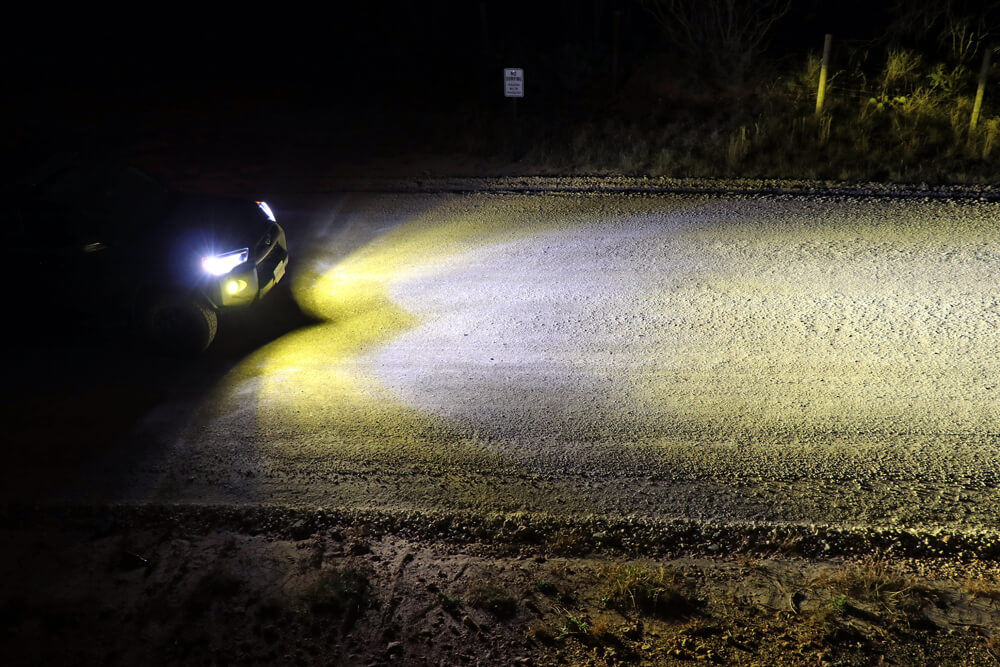
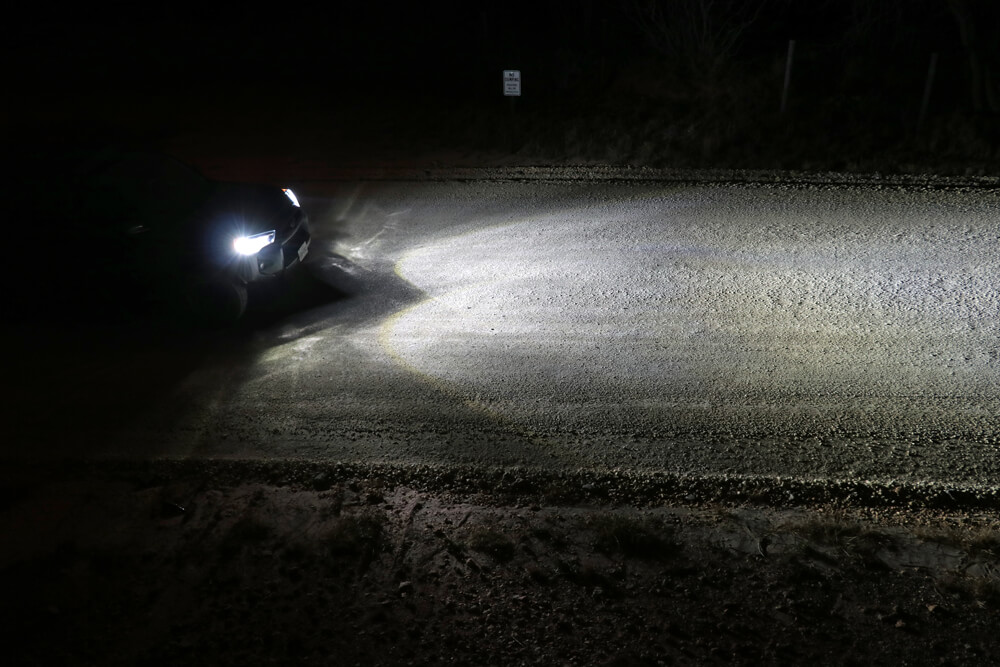
The photographs at the top of this page show it on one truck. In white and in yellow, the fog lamps light much the same patch of ground, because the lamp's position and its beam decide where the light goes. What the photographs cannot show, taken in clear air, is the one thing colour changes: how the light that scatters back feels to the driver.
What we do not know
Nobody we found has tested a yellow fog lamp against a white one of the same beam, on a vehicle, in trail dust. The fog-chamber study compared three lamp technologies, so colour moved together with beam pattern and source type. The glare studies rated discomfort from white lamps of different tint and tested no yellow lamp. We read the two SAE papers and the Michigan study from their abstracts, and the full papers may qualify what the abstracts say. A 1976 Dutch review of white against yellow headlamps exists and we could not open it.
None of the makers we read says how its yellow is made, whether by a yellow emitter, a phosphor or a filter over a white one, and that decides how much output is lost. The intensity figures are each maker's own. Diode Dynamics lists the same lumens for its brightest fog lamp in both colours and thirty percent less peak intensity in yellow, which we cannot explain. On the law, we read nine states and no others, and this is a reading of the statutes, not legal advice.
Also in the field guide
Sources
- Diode Dynamics SLF Fog Lights (Yellow) for the 5th Gen 4Runner by Clint Taylor, Trail4Runner, read 2026-11-10The photographs on this page. Yellow LED bulbs in the 4Runner's factory fog lamps, which he ran in white before. A product review with a purchase link; it does not say whether the bulbs were supplied.
- NCHRP Report 95, Highway Fog, Highway Research Board, National Research Council, 1970, read 2026-08-27Free in full from TRB. The source for fog scattering all visible colours about equally.
- International Lighting Vocabulary, non-selective scattering, International Commission on Illumination (CIE), read 2026-08-27
- Performance investigation of different headlights used in vehicles under foggy conditions by Tarik Sefer, Ramazan Ayaz, Ali Ajder and Ismail Nakir, Scientific Reports 13:4698, 2023, DOI 10.1038/s41598-023-31883-3, read 2026-08-27Open access. Compares halogen, xenon and LED headlamps rather than isolating colour, so beam pattern and source type vary along with it.
- Short-Wavelength Content of LED Headlamps and Discomfort Glare by Michael Sivak, Brandon Schoettle, Takako Minoda and Michael Flannagan, LEUKOS 2(2), 145 to 154, 2005, DOI 10.1582/LEUKOS.2005.02.02.006, read 2026-11-10Read from the publisher's abstract. Rated discomfort only; no yellow lamp was tested and no visibility was measured.
- Influence of LED Spectral Characteristics on Glare Recovery by Nicholas Skinner and John Bullough, SAE Technical Paper 2019-01-0845, read 2026-11-10Read from the abstract; the paper is paywalled. Both sources were white LEDs, one warm and one cool.
- Driving in Snow: Effect of Headlamp Color at Mesopic and Photopic Light Levels by John Bullough and Mark Rea, SAE Technical Paper 2001-01-0320, read 2026-11-10Read from the abstract; the paper is paywalled, so the lamps, light levels and size of the effect are not known to us.
- SS3 SAE Fog, white, specification table, Diode Dynamics, read 2026-11-10The maker's own figures, per pod. No independent laboratory has checked them.
- SS3 SAE Fog, yellow, specification table, Diode Dynamics, read 2026-11-10Lists the yellow as 3000K and does not say how it is made.
- D-Series PRO SAE Fog, yellow and white pair, Rigid Industries, read 2026-11-10The maker's own figures, one set for each colour of the same lamp.
- Squadron SAE, amber lens, Baja Designs, read 2026-11-10Lists 2,420 lumens, the same figure as the clear-lens version.
- UN Regulation No. 19, approval of power-driven vehicle front fog lamps, Official Journal of the European Union, L 250, 22 August 2014, CELEX 42014X0822(01), read 2026-08-27Paragraph 7 gives the choice of white or selective yellow; Annex 6 the 0.84 multiplier for a lamp that makes its yellow by filtering. A European approval regulation, which binds nothing in the United States.
- UN Regulation No. 48, installation of lighting and light-signalling devices, Official Journal of the European Union, L 14, 16 January 2019, CELEX 42019X0057, read 2026-08-27
- 49 CFR 571.108, FMVSS 108, Lamps, reflective devices, and associated equipment, Electronic Code of Federal Regulations, read 2026-08-27Cited for an absence: it requires white headlamps and does not regulate fog lamps.
- SAE J578, Color Specification, 1995 revision, SAE International, reproduced by Public.Resource.Org, read 2026-08-27
- California Vehicle Code section 25950, color of lamps and reflectors, California Legislative Information, read 2026-11-10
- Oregon Revised Statutes chapter 816, section 816.230, fog lights, Oregon Legislature, read 2026-11-10
- Arizona Revised Statutes 28-947, special restrictions on lamps, Arizona State Legislature, read 2026-11-10
- Utah Code 41-6a-1604, auxiliary lights, Utah State Legislature, read 2026-11-10
- Michigan Compiled Laws 257.699, color of lamps, Michigan Legislature, read 2026-11-10
- Texas Transportation Code 547.328, fog lamps permitted, Texas Legislature Online, read 2026-11-10
- Florida Statutes 316.233, spot lamps and auxiliary lamps, Online Sunshine, Florida Legislature, read 2026-11-10
- New York Vehicle and Traffic Law section 375, equipment, New York State Senate, read 2026-11-10Never mentions a fog lamp. Its rule on coloured lights can be read either way for a yellow one, and we do not read it for you.
- SAE J583 compliance testing of six LED fog lamps, Calcoast ITL, published by Morimoto, read 2026-08-27The source for three of six pods sold as SAE compliant failing the cutoff test. Published by a maker whose own lamps passed.