
Should you put your truck camper on a flatbed?
By Chad Sig · Published
The short answer
Put a truck camper on a flatbed only if your truck's payload covers the pair, and on a half-ton it often does not: a full-size aluminium tray starts around 635 lb, the lightest flatbed camper Four Wheel Campers sells for a full-size truck is 1,325 lb dry, and together they already outweigh the 1,940 lb maximum payload Toyota publishes for the best-case Tundra. What a tray changes is geometry, not capacity: gear moves out of one deep well you climb into and into lockable boxes and a rear drawer at standing height, riding low and between the wheels, and the camper bolts flat to the deck. The factory bed you remove buys some weight back, but no manufacturer publishes a bed weight, so do what the tray maker says and weigh the truck after fitment. Springs, air bags and bigger brakes can be built for the load; in the United States the rating on the door jamb does not move with them. Run the camper's wet weight against the placard in the driver's door opening before anything gets cut.
What does a flatbed tray actually change?
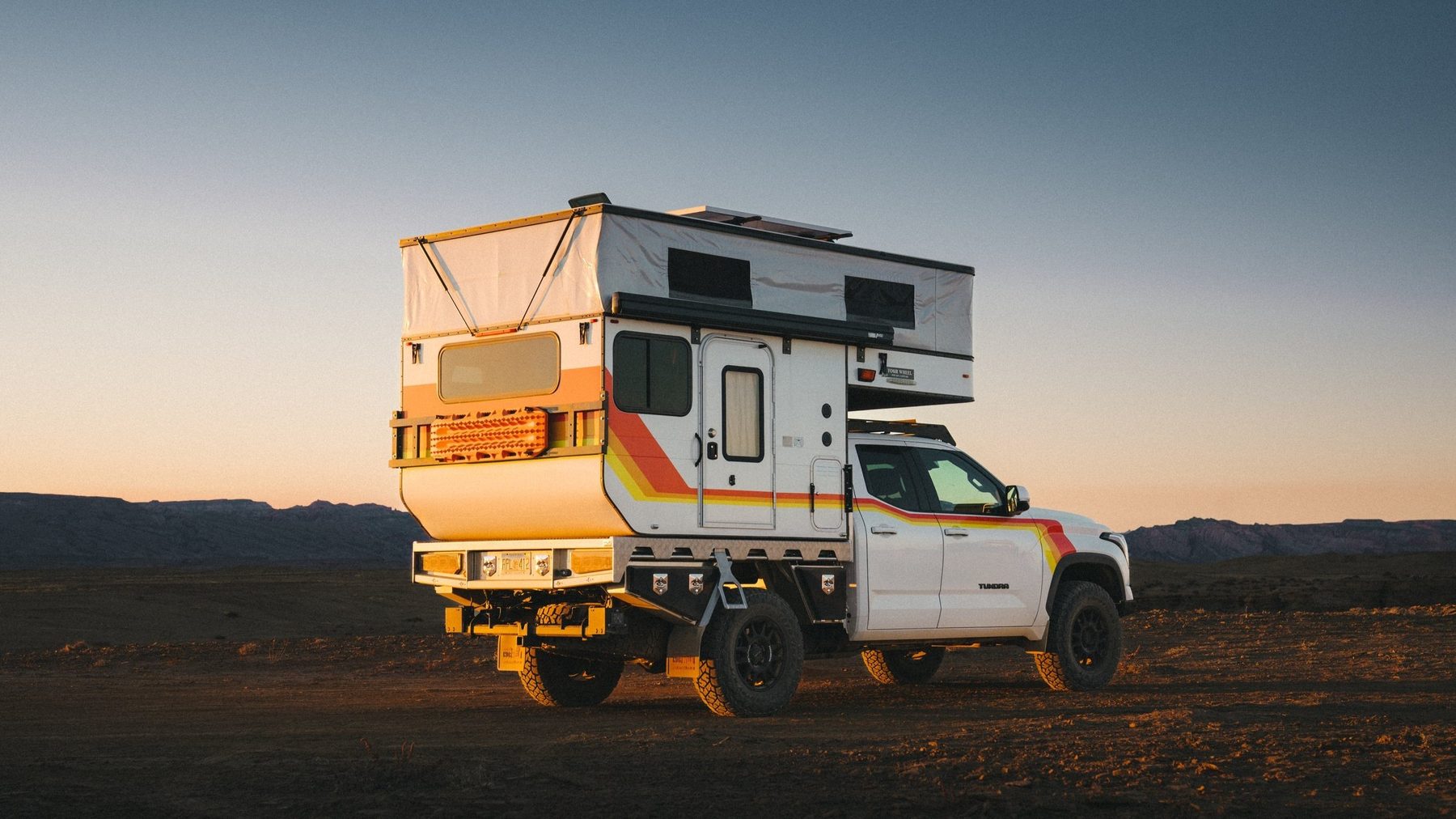
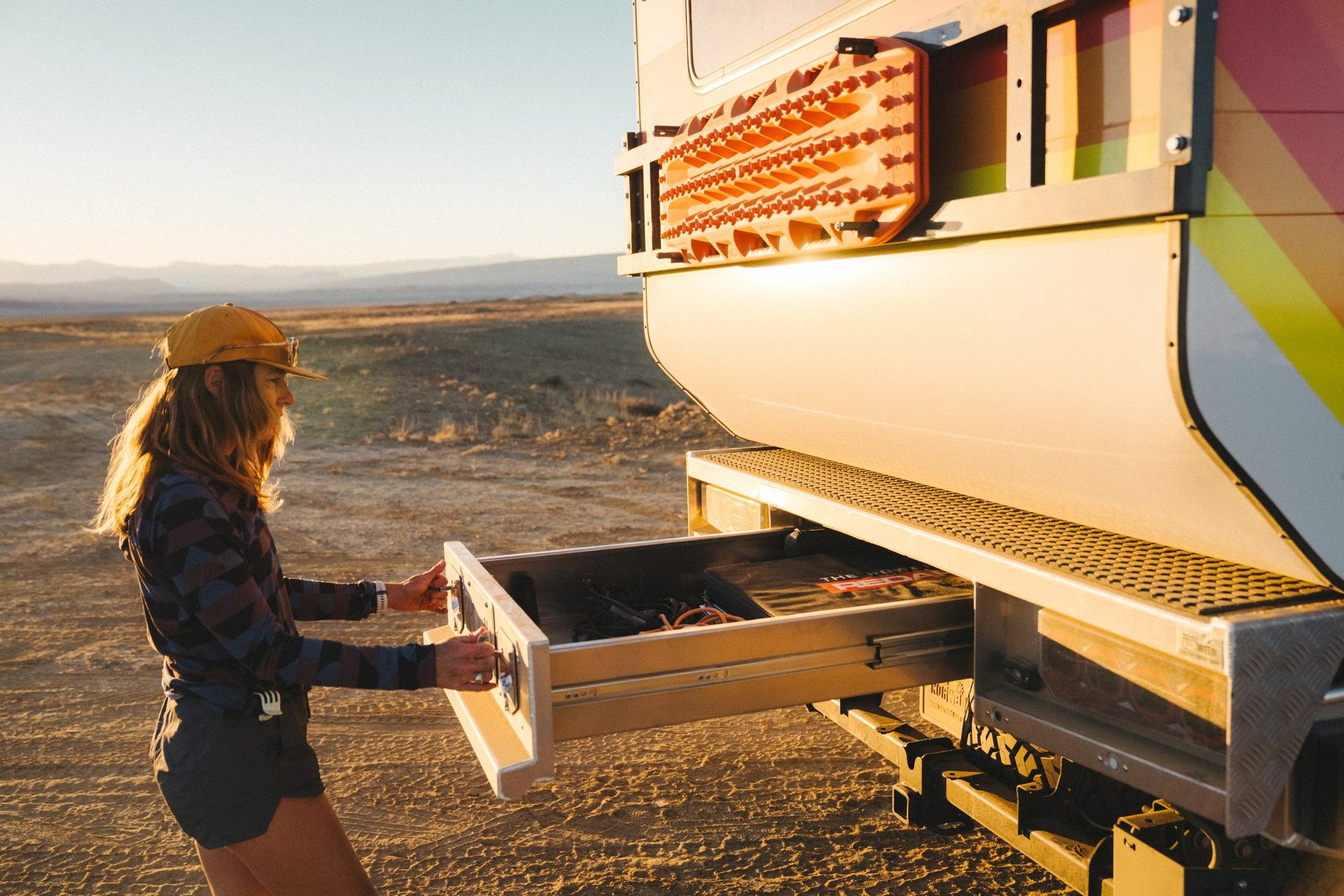
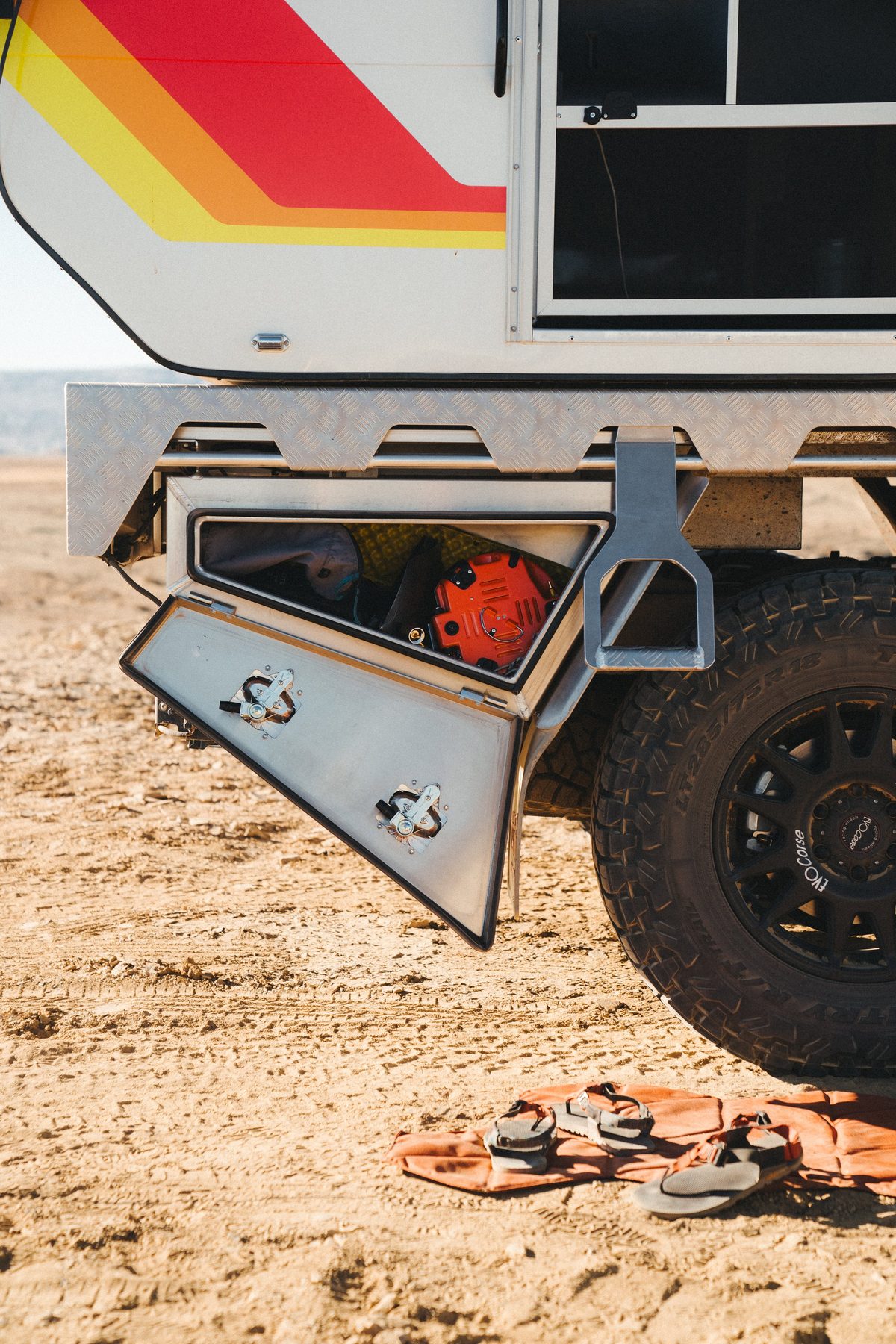
A tray changes the geometry of your storage, not the capacity of your truck. A factory pickup bed is one deep well with high walls, entered over a tailgate, and it sorts gear by volume: whatever went in first is at the bottom, under everything that went in after it. A tray is a flat deck with lockable boxes hung along the flanks and underneath it, so gear sorts by where you stand when you use it. Four Wheel Campers, who distribute Norweld trays in the United States, put the gain plainly: you gain additional compartments along the sides, for tools, recovery gear and outdoor equipment.
The dimensions are worth having in hand rather than imagining. Norweld's Weekender configuration includes four under-tray toolboxes, a rear drawer four feet long, 28 inches wide and six inches deep that opens from behind the truck, and a 16 gallon water tank inside the tray structure. Everything on that list is reached with both feet on the ground, and everything on it rides at or below deck height, beside the chassis rather than stacked above a bed floor.
A tray adds no capacity. It reorganises where the mass sits and how you reach it, and how much mass the truck may carry is set on a label the conversion never touches.
What do a flatbed tray and camper weigh?
A full-size Norweld tray starts at 635 lb, and the lightest flatbed camper Four Wheel Campers sells for a full-size truck, the Hawk Flatbed, is 1,325 lb dry. Both numbers are the makers' own: the tray figure is the from-635-lb floor Norweld's US brochure prints for its F-150, F-250, Ram, Silverado and Tundra trays, and the camper range runs up through the Hawk+ Flatbed at 1,882 lb dry with its 40 gallons of water capacity.
Dry is the word carrying the load in a camper spec, and the camper maker says so itself: our Hawk flatbed model has a dry weight of around 1,325 lbs, but once you add water, propane, batteries, gear, and passengers, the real-world wet weight can reach closer to 2,000 lbs. Water is the quiet item. It weighs 8.34 lb per gallon, so a tray tank and a camper tank together can add 300 lb that appears in no spec sheet, because it arrives from a hose.
Four Wheel Campers' lightest full-size flatbed camper, sitting dry on its empty tray, already outweighs the best payload Toyota publishes for the Tundra.
Can a half-ton truck carry a flatbed camper?
On paper, a Tundra cannot carry even the lightest one dry: tray at 635 lb plus Hawk Flatbed at 1,325 lb is 1,960 lb, against the 1,940 lb maximum payload in Toyota's own press material. That maximum is a family best no camper-ready configuration reaches, because payload is what is left of the weight rating after the truck's own mass, and four-wheel drive, the hybrid battery and the bigger cab each take their share. And the margin closes before any water, before the federal placard's 150 lb per occupant, before food, tools, a winch bumper, a winch, or a single recovery board.
The margin is also thin enough to flip on the tray maker's other sheet: Norweld's Australian page quotes the same truck's tray from 573 lb, which puts the pair 42 lb under the maximum instead of 20 lb over. What tips it back is that both figures are floors for a bare tray, and the boxes, the drawer and the tank all ride on top of them.
One number pulls the total back down: the factory bed that came off. And that number is not published. Toyota describes the composite bed's sheet-moulded-compound construction and its dent and rust resistance, and never gives its mass. No full-size manufacturer we could find publishes one. The single figure that decides whether a finished flatbed build sits inside its rating cannot be computed from spec sheets at all.
The tray maker closes the loop itself. Norweld's Australian page for this truck calls its tray weights approximate and recommends having your vehicle weighed after tray fitment: the company that built the tray telling you the arithmetic on paper is not good enough. A public scale settles it.
Where is your truck's payload limit written?
On two labels in the driver's door opening. The certification label required by 49 CFR 567.4, riveted or permanently fixed at the hinge pillar or door edge, carries the gross vehicle weight rating, which may not be less than the unloaded vehicle weight plus the rated cargo load plus 150 pounds for every designated seat, and a gross axle weight rating for each axle. The tire and loading placard required by FMVSS 110 on every vehicle rated 10,000 lb or less, affixed to the driver's side B-pillar, carries a sentence whose wording the standard fixes: the combined weight of occupants and cargo should never exceed a stated figure, printed for that individual truck.
That placard figure is the number to test a camper against, not the brochure maximum. It reflects the truck as built, with its own options, and it is a legally mandated per-vehicle answer to the question the flatbed buyer is asking. Stack the tray, the camper wet, the occupants and the gear against it, and the decision stops being aesthetic.
Do bigger springs raise your payload rating?
No, and the regulations say so by omission. There is a federal path for changing the number, and it closes at the dealership door: the alterer rules at 49 CFR 567.7 let a person who modifies a certified vehicle, before its first sale other than for resale as 567.3 defines it, fit a new label with new weight ratings, which is how an upfitter can lawfully deliver a modified truck with modified numbers. After first sale, for a private owner, no such path exists. Springs, air bags and brakes change what the truck can do. Nothing changes what it is rated to do.
The federal path to a new weight rating closes at the dealership door. Australia keeps one open for the life of the truck.
One federal rule does reach a bed swap directly. Under 49 USC 30122, a manufacturer, dealer or repair business may not knowingly make inoperative any equipment installed to meet a safety standard, and cutting off a bed removes the tail lamps and reflectors the standard requires. The shop doing the work is on the hook to put lighting back, which is why Norweld trays ship with LED tail lamps built in. The swap is legal, and the lighting must come back.
Can you legally raise a truck's payload rating?
In the United States, not after first sale. In Australia, yes: the process is called a GVM upgrade, and Transport Western Australia's own guidance states both paths. A brand-new vehicle can be re-rated by a federally approved second-stage manufacturer fitting an approved kit. An in-service vehicle can be re-rated by an approved installer of a certified kit, or by a workshop whose suspension work is certified by an automotive consultant and approved by the state regulator. The remedy exists because the tray is Australia's default body for a working four-wheel-drive, the ute tray, and Norweld is an Australian company selling into its home norm.
So an Australian building Bound For Nowhere's Tundra could buy back the margin the camper spends and have the new number on paper. An American doing identical work, same springs, same bags, same brakes, carries the gap personally, because none of it moves the label. The two countries agree on the physics and disagree on whether the sticker can be updated to match it, and knowing which regime you are in is part of the decision.
Do you need bigger brakes for a flatbed camper?
If the build takes the truck near its rating, yes, because the certification stops there. FMVSS 135, the brake standard for vehicles rated 3,500 kg (7,716 lb) or less, which covers a half-ton Tundra, proves stopping performance with the vehicle loaded to its gross vehicle weight rating, each axle in proportion to its rating, and requires a stop from 100 km/h in 70 metres or less with cold brakes. Loaded to the rating, and at no mass above it. Past the number on the label there is no federal stopping requirement at all. The three-quarter- and one-ton trucks recommended later on this page sit above that ceiling and answer to the older hydraulic-brake standard, FMVSS 105, instead.
Kinetic energy rises in step with mass, so every pound over the rating is energy the certification never asked the pads to absorb, on every descent, for the life of the build. PowerBrake, who make big-brake kits for exactly this market, put the field version bluntly: roof tents, bull bars, long-range tanks, batteries and storage significantly increase vehicle weight, which severely affects brake performance and increases stopping distances. They sell the fix they are describing, so read the sentence with that in view, but the physics does not need their motive to be true.
This is why the springs go on first in a serious flatbed conversion. The tray and camper are the visible move; the chassis work is the load-bearing one, and on Bound For Nowhere's Tundra it went on before the camper ever arrived.
How much does a flatbed camper conversion cost?
Roughly $62,000 list for tray, fitting and camper before options, on top of the truck. The parts, each from its own dated sheet: a full-size Norweld Deluxe tray at $16,875 on Main Line Overland's current listing, tray installation at $2,900 as a labour line on Four Wheel Campers' May 2025 spec sheet, and the Hawk Flatbed from $41,995 on its model page. Prices here have moved fast: on the 2020-21 US price sheet, the tray-with-boxes configuration was $11,799 and a bare Lite tray $6,799.
The list prices miss the other costs. The tailgate goes, and with it the factory tie-downs, the tonneau and the whole bed-accessory ecosystem. The truck's resale as a truck goes with them, because the swap does not reverse: the bed that came off was cut loose from a vehicle that will never be stock again.
The counterweight is in Norweld's brochure, and it changes the frame if you let it: the tray and its boxes can transfer to the next vehicle of similar size with minimal change-over parts. The truck depreciates as a modified truck. The system on its back holds value as a system, and the strongest evidence for that claim is behavioural: MAK and Owen of Bound For Nowhere ran a Norweld tray and a Four Wheel Campers Hawk on one Tundra for four years, then bought another Tundra and put a Norweld tray and a Hawk on that one too.
Which truck does Four Wheel Campers recommend?
A three-quarter-ton at least, for most flatbed setups. Their flatbed guide says your truck needs enough payload not just for the camper but for everything else you bring, puts most flatbed setups on a three-quarter-ton truck with payload roughly 3,000 to 4,000 lb and fully loaded rigs on a one-ton, and lists no half-ton class at all. That is the company that sells the camper steering buyers toward a heavier truck than the half-tons its own flagship builds ride on.
Advice that runs against the adviser's easy sale is advice to take seriously, and it reframes the half-ton flagship builds, Bound For Nowhere's Tundra among them, rather than refuting them. A Tundra under a flatbed Hawk is not the recommended case; it is the marginal case, run by people who know it, and the rebuilt suspension and the big-brake kit on that truck are what living at the margin costs. If you are starting from scratch rather than from a truck you already own, the camper maker has already told you the cheaper answer: buy the payload first.
Bound For Nowhere's Tundra, done twice
MAK and Owen of Bound For Nowhere had the bed cut off a 2023 Tundra that was barely broken in and replaced it with a Norweld tray, as they had done to their previous Tundra: a Deluxe this time where the older truck ran a Deluxe Lite, the same Four Wheel Campers Hawk, the same shop in Main Line Overland. Our note on that build reads the whole truck as one weight decision, down to choosing the smaller cab to keep the camper's mass ahead of the rear axle.
The storage layout the build is celebrated for, the four under-tray boxes, the rear drawer, the tank in the tray, is the equipment Norweld's US brochure lists as standard on its Weekender page, item for item, and the shop sells the equivalent tray under Norweld's own Deluxe name: the geometry case for a tray is a product you can buy, not a fabrication project. And the chassis was rebuilt for the camper's weight before the camper arrived, springs, bags and a big-brake kit first, which is the payload case acted out in the build order. No source on that build publishes its finished weight, and the tray maker's instruction stands: weigh the truck.
What we do not know
The weight of a removed factory bed is the missing number in the whole argument, and nobody publishes it: not Toyota, not Ford, not Ram. Forum figures exist and are unverified, so none appears here. One scale ticket for a bare removed bed would produce a number that exists nowhere in public, and it is the measurement this page most wants.
The arithmetic above runs against the Tundra family's best-case 1,940 lb because Bound For Nowhere has never published their truck's placard figures, and a four-wheel-drive hybrid with the off-road package carries more of its own weight than the configuration behind the maximum, which means the real margin is tighter than the worked example shows, not looser. We also do not know whether that build's camper kept its internal water tank alongside the tray's, so its water budget is somewhere between 133 lb and 300 lb full. And we found no primary source on what US insurers or state inspections actually do about a light truck operated over its rating, so this page states what the regulations specify and stops there.
Seen on
Also in the field guide
Sources
- Norweld Aluminium Tray and Canopy Brochure, US market, 2023, Norweld, distributed by Four Wheel Campers, read 2026-08-27The FROM 635LBS full-size tray figure, the Weekender equipment list and the transferability claim come from this sheet. The weigh-after-fitment instruction does not: it lives on Norweld's Australian Tundra page. Hosted by Four Wheel Campers, who distribute the trays and also sell the campers that go on them.
- Toyota Tundra Dual Cab Ute Trays, Norweld, read 2026-08-27The Australian page for the same vehicle says From 260kg, which is 573 lb and does not match the US brochure's 635 lb baseline. Presumably different configurations; neither sheet says. We quote the US brochure for US builds and name the sheet whenever we use a number. This page, not the brochure, carries the approximate-weights caveat and the weigh-after-fitment instruction.
- Hawk Flat Bed Model, Four Wheel Campers, read 2026-08-27Base dry weight 1,325 lb, base price $41,995, 20 gallon fresh tank.
- Hawk+ Flatbed Spec Sheet, Doc. 4WC_25, Rev 05.21.25, Four Wheel Campers, read 2026-08-27The heavier variant: 1,882 lb dry, 40 gallons of fresh water, $43,995 base. Also carries the Norweld tray install as a $2,900 labour line item.
- Is a Flatbed Truck Camper Right for You? Here's What to Know, Four Wheel Campers, read 2026-08-27Published 7 April 2026, three years after the build this page cites, so its truck-class guidance postdates that build. Four Wheel Campers sells the campers and distributes the trays, so it has interests on both sides of the question, which makes its steer toward heavier trucks more credible rather than less: it runs against the easy sale.
- Norweld Products and Prices, 2020-2021, Four Wheel Campers, read 2026-08-27Kept for the price history: a mid-size tray-only at $6,799 against the 2026 full-size Deluxe at $16,875 shows how fast tray pricing moved, and why every price on this page carries a date.
- Full-Size Norweld Deluxe Flatbed Tray, Main Line Overland, read 2026-08-27$16,875 base at retrieval, options by phone. The shop on the build this page cites.
- 2023 Toyota Tundra Adds SX Package to Lineup, Toyota Pressroom, read 2026-08-27Source of the 1,940 lb maximum payload figure, which belongs to the best configuration in the family, not to any truck likely to be carrying a camper.
- Absolute Powerhouse: Next-Generation 2022 Toyota Tundra, Toyota Pressroom, read 2026-08-27Describes the composite bed's sheet-moulded-compound construction and its virtues at length. Gives no weight for it, and neither does any other Toyota document we could find.
- 49 CFR 567.4, Requirements for manufacturers of motor vehicles, Cornell Law School, Legal Information Institute, read 2026-08-27The certification label. Read via Cornell's mirror because the eCFR itself redirects automated readers to a bot-unblock page.
- 49 CFR 567.7, Requirements for persons who alter certified vehicles, Cornell Law School, Legal Information Institute, read 2026-08-27The alterer definition, with its before-first-retail-sale boundary, sits in the neighbouring 567.3.
- 49 CFR 571.110, Tire selection and rims, Cornell Law School, Legal Information Institute, read 2026-08-27The tire and loading placard. Only the placard's cargo sentence is quoted here; the standard's internal definitions were not verified verbatim this pass.
- 49 CFR 571.135, Light vehicle brake systems, Cornell Law School, Legal Information Institute, read 2026-08-27
- 49 USC 30122, Making safety devices and elements inoperative, Cornell Law School, Legal Information Institute, read 2026-08-27
- GVM and GCM FAQs, Transport Western Australia, read 2026-08-27One Australian state's statement of the federal scheme. The two quoted paths, second-stage manufacture for new vehicles and certified kits or engineer sign-off for in-service ones, are national in structure.
- Street-Trail X-Line Big Brake Kits, PowerBrake, read 2026-08-27PowerBrake sells the fix its accessory-weight warning describes, and its kit is on the build this page cites. Quoted with that in view.