
The cab they made smaller
MAK and Owen had the bed cut off a barely broken-in 2023 Tundra and replaced it with an aluminium tray. The choice that explains the rest is quieter: they took the short cab over the big one to keep the camper's weight in front of the rear axle, then deleted the back seats anyway.
Owned by MAK (Bound For Nowhere) and Owen (Bound For Nowhere)
Built by Main Line Overland
Photographs by GonDirtin
By Chad Sig · Published
2023 Toyota Tundra TRD Off-Road double cab, i-FORCE MAX 3.4L twin-turbo V6 hybrid, electronic rear locker, extended-range tank
What it is designed for
Weight in front of the rear axle
The cab length, the tray, and where the heavy things sit in it are all one decision about where the load ends up relative to the back wheels.
Reached from the ground
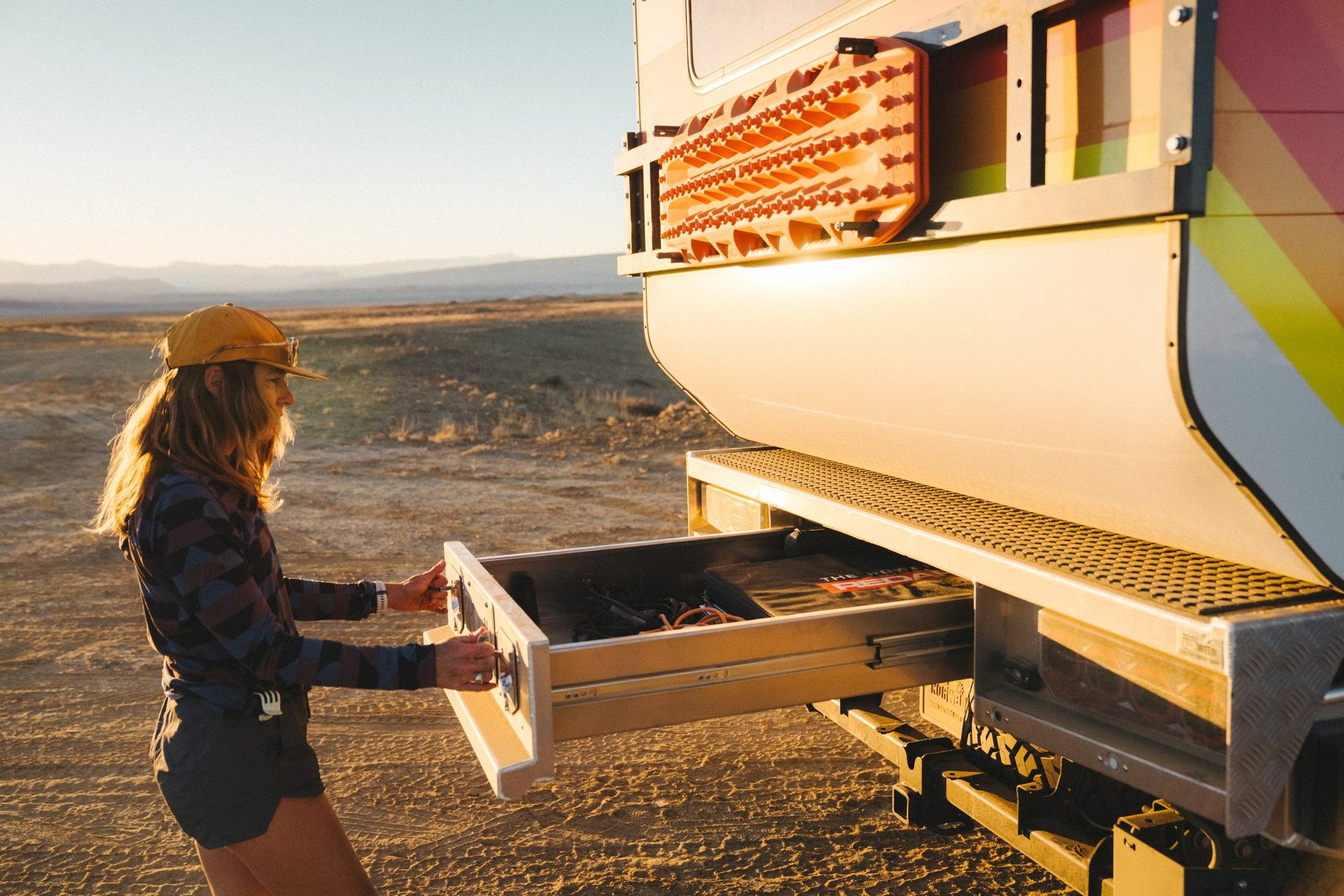
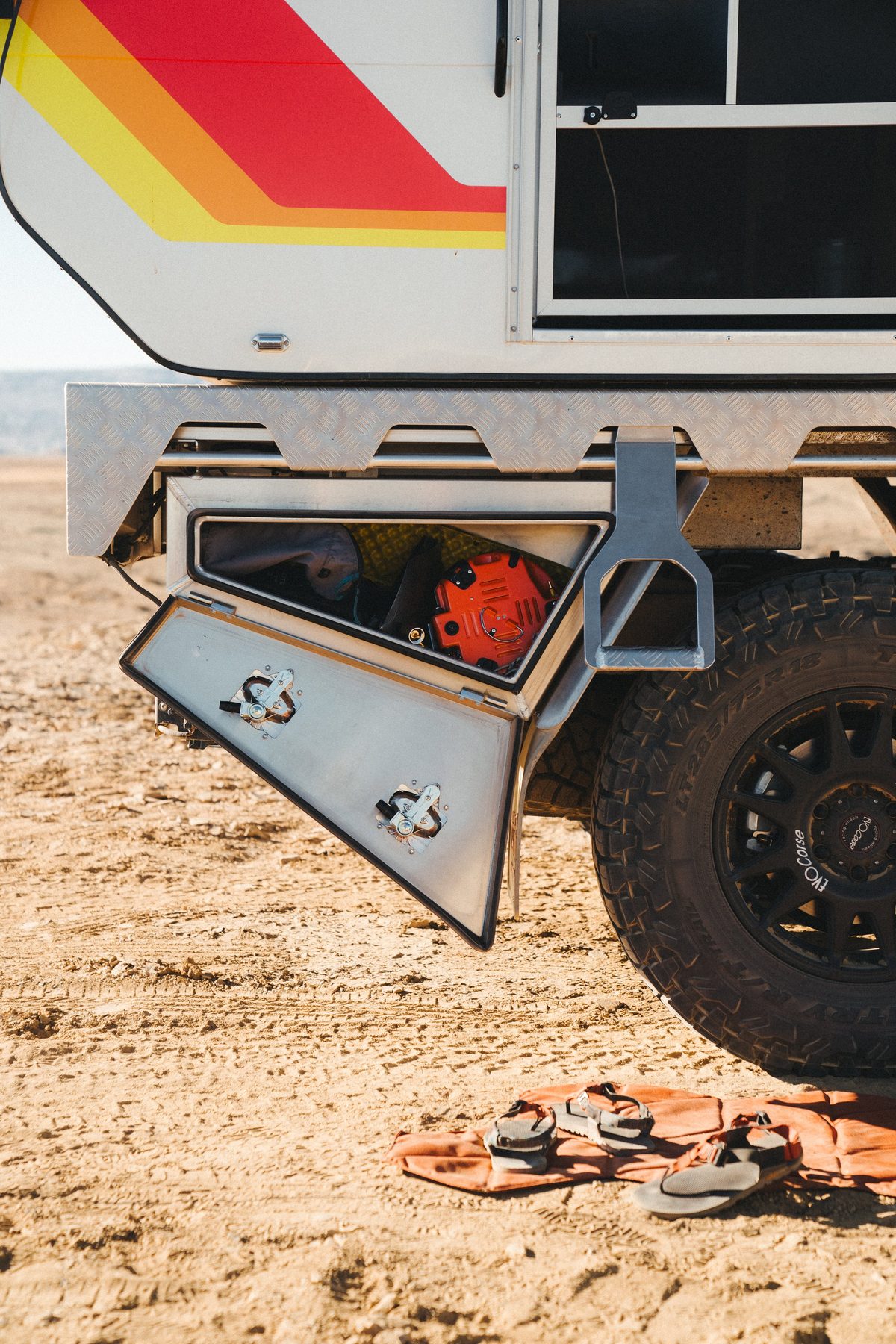
Gear lives in boxes along the flanks and in a drawer that comes out of the back, at the height of a person standing next to the truck, rather than in one deep box you climb into.
A chassis specified for weight it did not have yet
Springs, control arms, panhard bar, air bags and a stage two big brake kit all went on before the camper did.
Leaving the country
The rebuild exists because they are preparing to travel outside the US. Locking boxes in the tray, locking boxes in the cab, and a safe in the centre console follow from that.
The bed they threw away
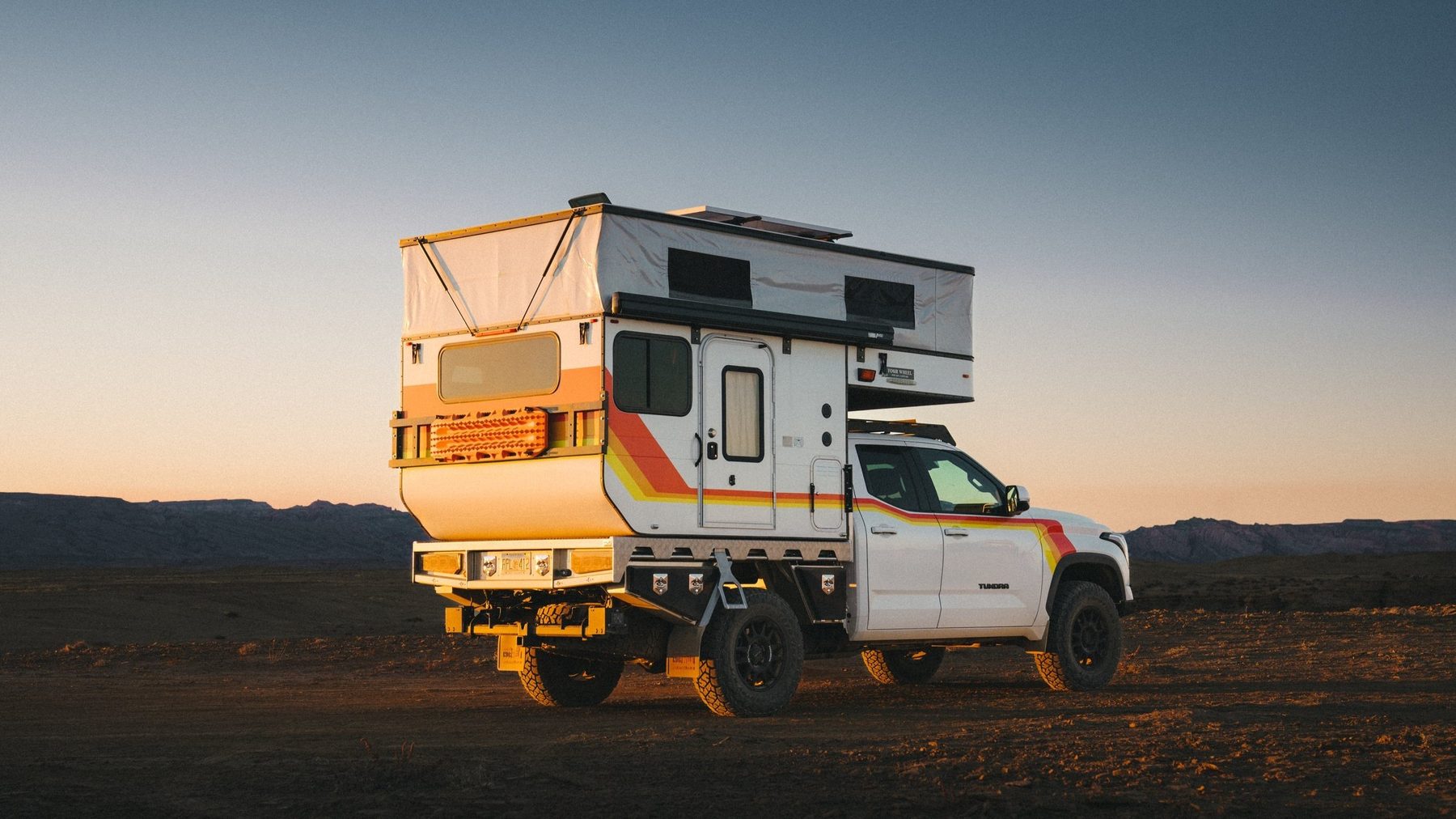
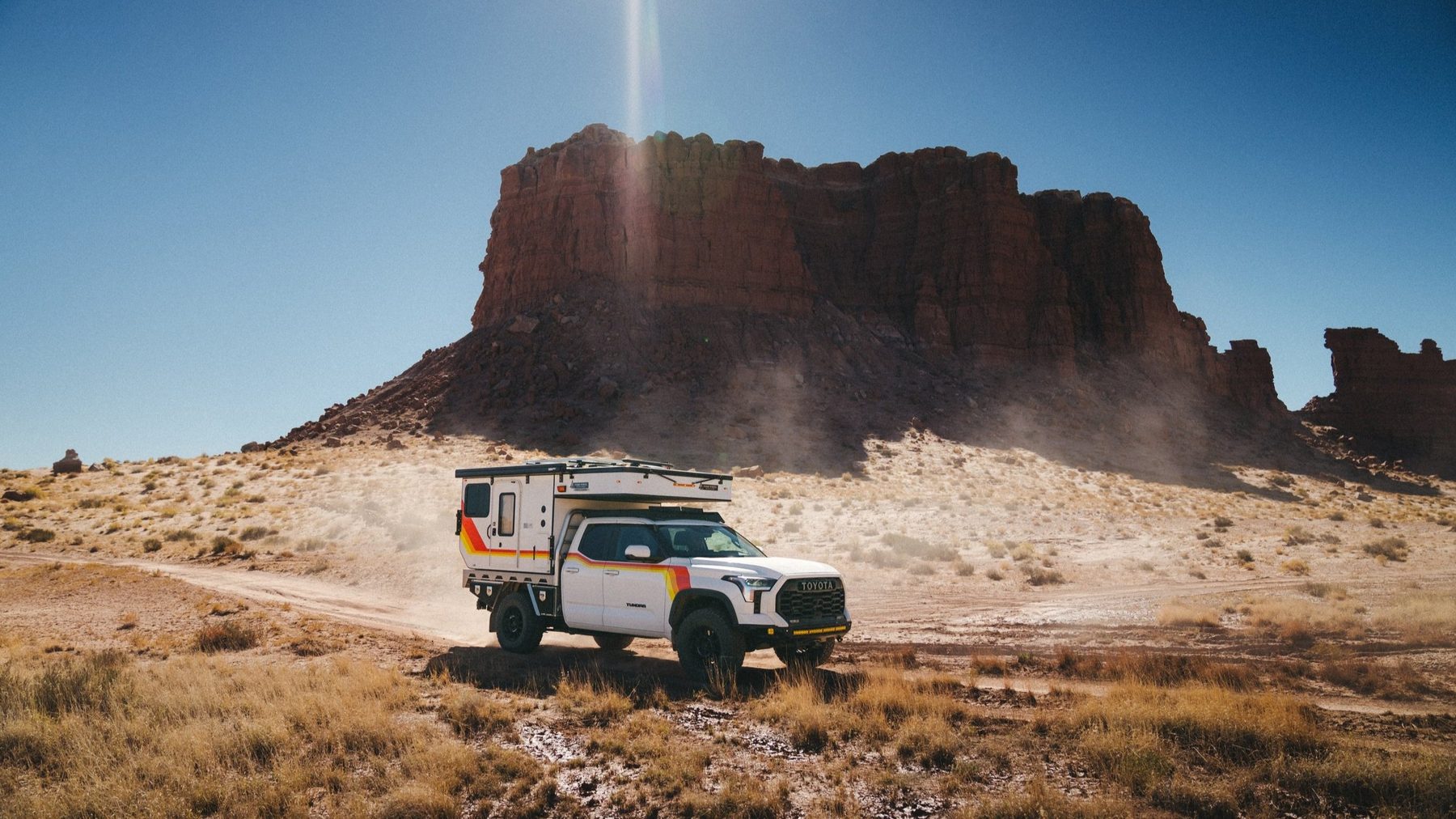
MAK and Owen have lived on the road since 2016 and have worked through a Honda Element, a Vanagon, a Sunrader, a Tacoma and a Tundra to get here. Jolene is a 2023 Tundra TRD Off-Road, bought new in Virginia Beach, driven to Main Line Overland in Philadelphia, and stripped of its bed before it was broken in. In its place is a Norweld aluminium tray with four boxes slung underneath, a drawer that pulls out of the back, and a water tank inside the structure. A Four Wheel Campers Hawk went on top of it in Sacramento.
The tray is the photograph. It is not the interesting decision, because a flatbed on a truck carrying a flatbed camper is close to a requirement, and most people who do it can tell you what it looks like rather than what it is for. The interesting decision is one row further forward.
The decision underneath it
The third-generation Tundra is sold as a double cab and as a CrewMax. The CrewMax has the bigger back seat, and for two people who live in their truck and work from it, more enclosed heated space is the obvious buy. They took the double cab, and when a mattress company asked them why, they answered in one sentence.
We went with a double cab rather than a crew max to keep as much of the camper's weight in front of the rear axle as possible.
A camper on a tray is a large mass on a lever. The rear axle is the fulcrum, and everything behind it presses down at the back and lifts at the front, taking steering weight off the front tyres and loading the rear springs harder than the raw number suggests. A shorter cab moves the cab's back wall forward, and with it the front edge of the tray and everything stacked on it. Nothing about the camper changed. Where it sits relative to the wheels did.
Then they deleted the rear seats and put locking aluminium boxes in the space. Taken together, the two moves say the cab was never being bought as accommodation. It was being bought as the point where the load starts.
Specified for weight it did not have yet
The build order is stated plainly on their own site: the suspension overhaul happened in preparation for the camper, not in response to it. Dobinsons springs and IMS shocks at both ends, adjustable upper and lower rear control arms, an adjustable panhard bar, adjustable sway bar links, and Air Lift Load Lifter 5000 air bags with internal bump stops. The rear spring is an 80 Series Land Cruiser part, because in 2023 nothing existed for this truck.
The part of that list worth stopping on is the PowerBrake stage two big brake kit. Adding a camper is usually treated as a springs problem. It is also a brakes problem, on every long descent, at a mass the factory system was not sized for, and it is the item most camper conversions never touch. Whether the owners or the shop reasoned their way to it, someone did.
The second time
Their previous truck, Roxanne, was a 2019 Tundra with a Norweld tray, a Four Wheel Campers Hawk flatbed, a ComeUp winch behind a Stealth Fighter bumper, EVO Corse wheels and Dobinsons suspension, built by the same shop. Jolene is the same system a generation later, down to one tray tier: Roxanne's parts list reads Deluxe Lite where Jolene's reads Deluxe. That is worth knowing before reading any of the choices above as insight: these are repeat decisions, made by people who have already lived with the results for four years and across Baja, the lower 48 and Alaska.
It also sets up the sharpest thing in the sources, which is not in the build page but in the comments underneath it. A reader asked which trim to start from. Owen told them to buy the cheaper one. He had paid roughly ten thousand dollars in package content to get an electronic rear locker and the extended-range tank, and said he would skip the locker if he did it again. A builder who publishes that alongside his own parts list is a builder whose parts list can be read at face value.
What we could not confirm
We have not weighed this truck or driven it. Everything here comes from what MAK and Owen published, one magazine feature, one brand interview and the shop's record of the previous truck. The photographs are GonDirtin's, from the owners' own build post.
No source gives a corner weight, an axle weight, a payload figure or a finished mass, which is the gap that matters most on a build whose logic is where the weight sits. Nobody states how far forward the double cab actually moves the tray against a CrewMax, so the size of the effect is unknown even though the direction is not. The amber lenses are recorded as fitted and never explained. The owners promised a video series covering the reasoning behind each decision; we have not watched it, and it is the obvious place to go next. Their own post calls Jolene their fifth rig while the magazine feature calls it their sixth, which turns on whether a six-month trip in a Honda Element counts as living on the road.
What it gets right
A flatbed tray usually gets explained as a look or as a mounting requirement for a camper. This one is explained as weight, and the explanation reaches further up the truck than the tray does. MAK and Owen chose the shorter cab for the same reason they chose the tray, and they have said so.
In MAK (Bound For Nowhere)’s own account
- They gave up cab length to move the camper's mass forward. This is the whole build in one sentence, and it is stated once, in an interview on a mattress company's blog.
“We went with a double cab rather than a crew max to keep as much of the camper's weight in front of the rear axle as possible.”
Source - The order of work is stated as deliberate: the chassis was rebuilt against the load it was about to carry, not the load it had.
“In preparation for the weight of our camper, the biggest overhaul happened in the suspension.”
Source - And again, about the truck as a whole.
“In order to prepare for the camper we planned to install, the truck had to undergo major modifications.”
Source - The reason for building a new truck at all is not that the old one wore out. They needed one they could take out of the country.
“we just found ourselves in the unique position of needing to prepare for traveling full time outside of the US”
Source - What they value about the tray is stated as access rather than capacity, even in a sentence that is mostly about capacity.
“Our Norweld flatbed has a drawer integrated into it that is pulled out from the rear and it holds SO MUCH STUFF! We love that it makes a lot of gear easy to access!”
Source - The camper is the same model as the one on their previous truck, and the reason given is that the old one was not a problem to be solved.
“Their thought was that if there was nothing wrong, why change?”
Source - The amber light bar is amber on purpose: they bought the standard 40 inch OnX6 Arc and changed the lenses. Their build page records the action and gives no reason for it.
“40” Baja Designs OnX6 Arc Amber Light Bar (524003) - swapped in amber lenses”
Source
Dirtbeam’s reading
Not stated by the builder. This is what we take the build to show.
- The cab and the bed are the same decision made twice. A crew cab moves the whole load bed rearward; a factory bed puts most of its usable volume behind the rear axle. Shortening the cab and flattening the bed both pull the load forward and down, and the tray's side boxes hang beside the frame rather than behind the axle. They connect the cab to the weight and never connect the tray to it.
- Deleting the rear seats finishes the argument rather than contradicting it. Having bought the smaller cab on weight grounds, they then gave up the seats it did have, so the second row is a dry lockable box and not passenger space. The double cab was never about carrying people, it was about where the tray could start.
- The tray reorganises storage by where you stand rather than by how much fits. The ARB twin compressor lives in a tray box because a compressor is used standing at a tyre; the 16 gallon water tank sits inside the tray structure rather than high in the camper. A factory bed sorts gear by volume and buries whatever went in first.
- The stage two big brake kit is a payload decision wearing performance clothes. A stock Tundra stops fine. A Tundra carrying a flatbed camper stops from a different mass, on longer descents, further from help, and this is the part of the build almost every camper conversion leaves alone.
- Everything that can be locked is locked: latching tray boxes, extruded aluminium locking boxes where the back seats were, a safe in the centre console. That is a specification for leaving a loaded truck somewhere you do not know, which is what shipping it abroad means.
What it gives up
The costs here are stated more often than not, and the sharpest one is Owen telling a reader in his own comments section to buy a different truck than the one he bought.
In MAK (Bound For Nowhere)’s own account
- Asked which trim to start from, Owen argues against his own. The locker cost him about ten thousand dollars in package content he did not want.
“We went with an TRD Offroad, however I would recommend starting with the SR5. We did the Offroad for the electronic rear locker, however the package required to get that and the extended range tank costs nearly $10,000 more. In hindsight, we would have just gone without the electronic rear locker.”
Source - They name size as the cost of the platform, in the same answer where they praise it, and they are specific about where it bites.
“The Tundra strikes a good balance of size and capability, although we wish it was even smaller. We go to a lot of places where size is a big factor in whether you will make it or not.”
Source - The front upper control arms are stock and named as unfinished rather than left to be discovered.
“Stock UCA's for now - will swap out for Dobinsons when they come out”
Source - The rear spring is an 80 Series Land Cruiser part, and they say why: the truck was too new to have its own.
“Because the truck is also a new model, there were not a lot of parts made for our specific truck on the market yet.”
Source - The build took a year, and most of that was not fabrication. Finding the truck itself meant flying across the country for one of three.
“The truck we selected (specs and configuration) was one of only 3 made that year. We had to fly across the country to secure it.”
Source - On cost, they give a rating rather than a number, and a comparison rather than a defence.
“$$$$$ - but in the end, it's our house and is cheaper than an actual house.”
Source
Dirtbeam’s reading
Not stated by the builder. This is what we take the build to show.
- Cutting the bed off a new truck is the one modification here that cannot be undone. It takes the tailgate, the factory tie-downs and the truck's resale as a truck with it, and it happened before the truck was broken in. They price the build in dollar signs and never price this part of it separately.
- The short cab costs them the only enclosed, lockable, heated space a pickup has, and the rear seat delete spends what was left. This is a two-person vehicle by construction. It cannot carry a third person, and no amount of later work changes that without undoing the reason the cab was chosen.
- No weight or payload figure appears in any source. A build whose stated logic is mass placement never publishes a mass, and the tray maker's own page for this vehicle recommends weighing the truck after fitment, so the number is one they have been told to go and get.
- The 80 Series rear spring dates the build rather than recommending it. Third-generation Tundra support has moved on since 2023, and a workaround adopted because nothing else existed is not a design choice to copy.
- The one thing the sources cannot settle is how much of this reasoning was theirs and how much was the shop's. Main Line Overland had built their previous truck, specialises in the suspension work, and would have known the load before they did. The decisions are credited to the owners everywhere; the expertise may not be only theirs.
The kit
- Lighting
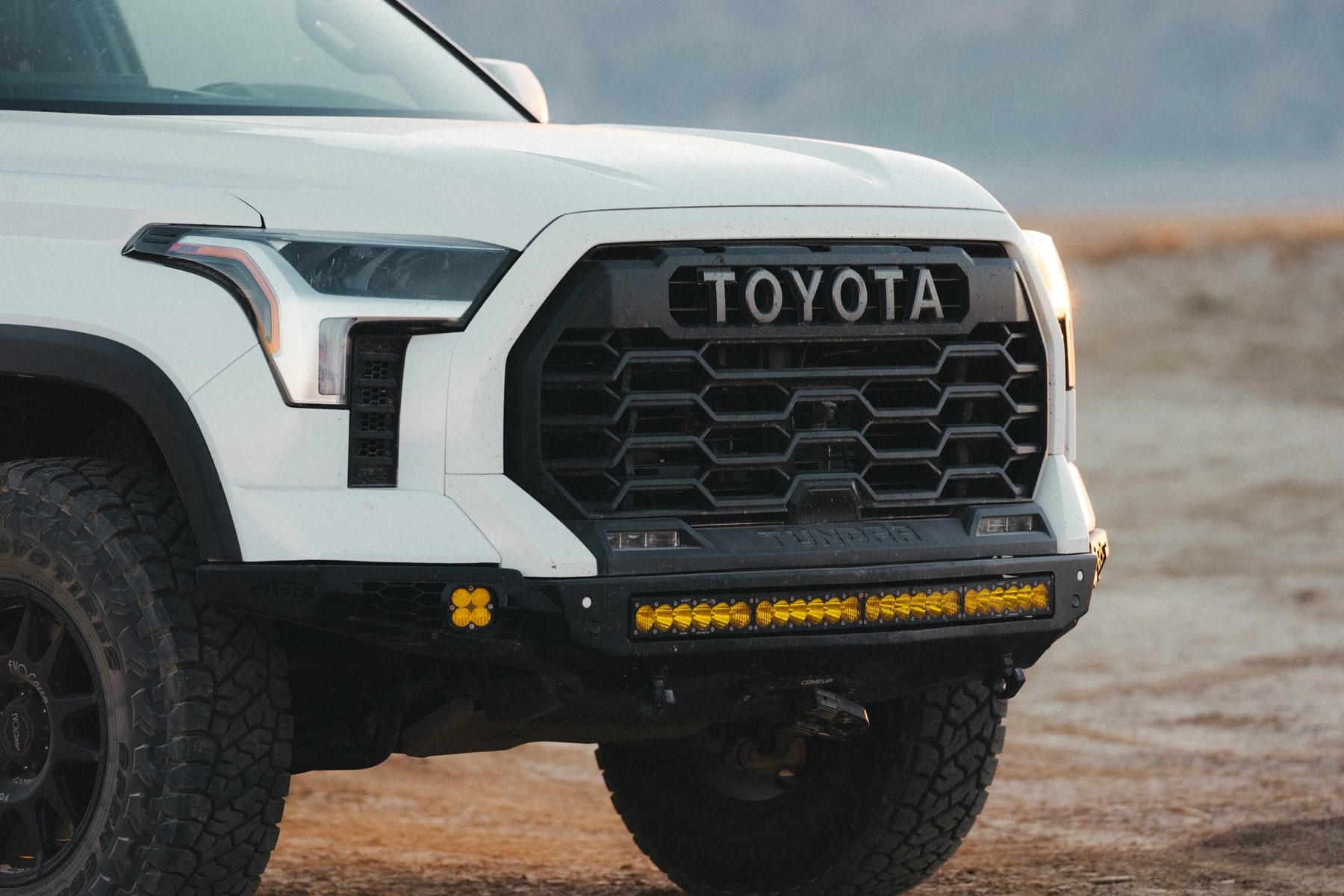
- A 40 inch Baja Designs OnX6 Arc mounted inside the Addictive Desert Designs Stealth Fighter bumper, below the hood line, with amber lenses fitted in place of the clear ones. Amber Baja Designs Squadron Sport combos sit at the bumper corners. The bar runs on a factory-style switch rather than an aftermarket panel. Nothing is mounted on the roof or the A-pillars, and nothing on the camper faces forward. Read against our ditch-lights guide, this is the low-and-amber answer to airborne dust arrived at twice over: the position keeps lit air out of the driver's sightline, and the lens colour reduces what scatters back out of it. They state that they swapped the lenses and never state why.
- Storage
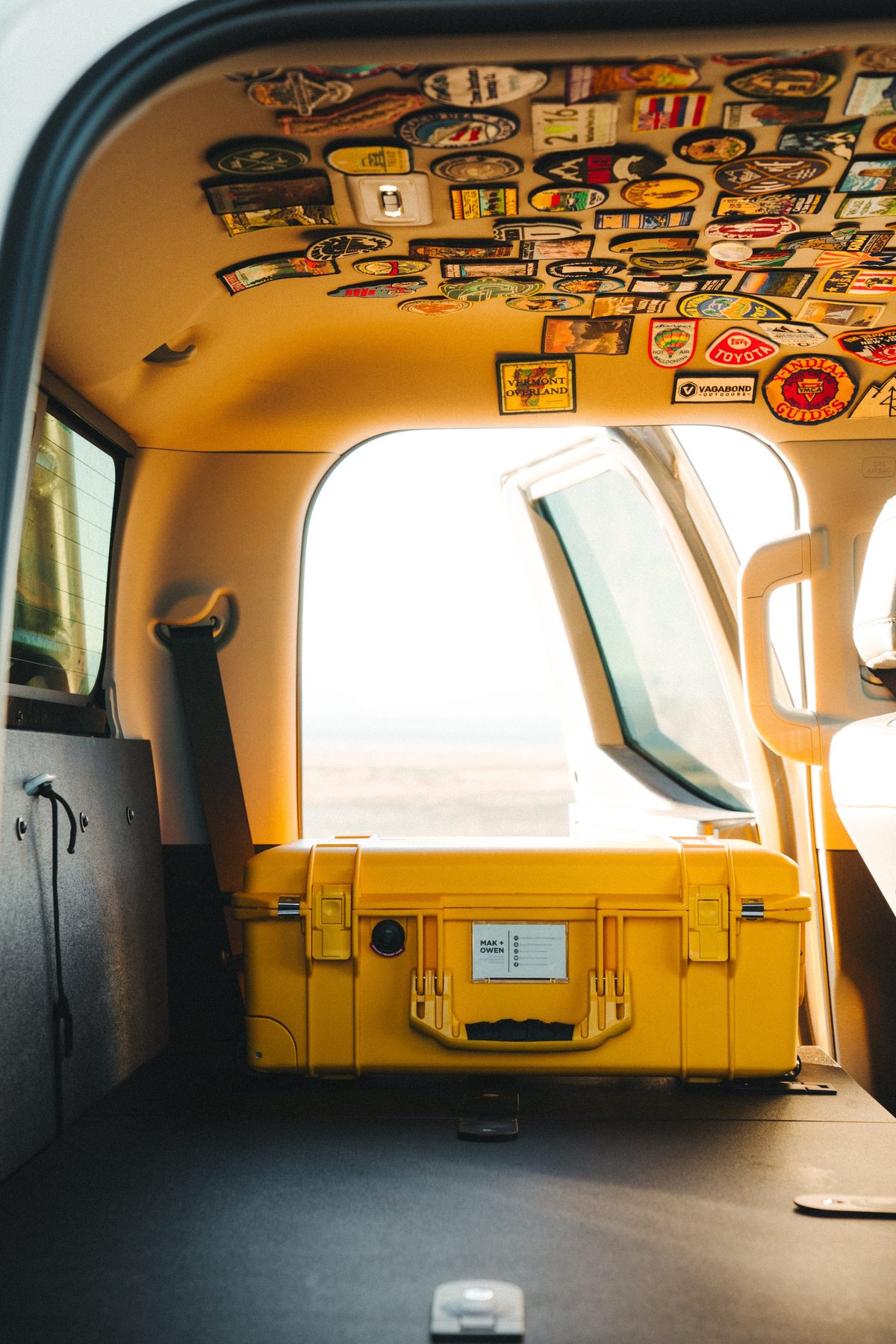
- A Norweld Deluxe flatbed tray in place of the factory bed, with four under-tray toolboxes, a drawer integrated into the tray that pulls out from the rear, a 16 gallon poly water tank and bolt-on flared mudguards. The ARB twin compressor is mounted inside one of the tray boxes. In the cab, the rear seats are gone and Terra-Quest Offroad extruded aluminium locking boxes stand in their place, with a locking safe in the centre console. A Prinsu cab rack carries the roof load and traction boards ride on a rack at the back of the camper. The pattern is that the heavy, frequently used things live low and outboard, at the height of someone standing next to the truck.
- Recovery
- An Addictive Desert Designs Stealth Fighter winch bumper carrying a ComeUp Seal Gen2 12.5rs and a Factor 55 Flatlink. MaxTrax on the camper's rear rack, and the ARB twin compressor in the tray for airing back up. The same winch and the same class of bumper were on the previous truck, which is the pattern across this whole build: parts that worked once were bought again.