
Bigger tires: what do they actually change?
The short answer
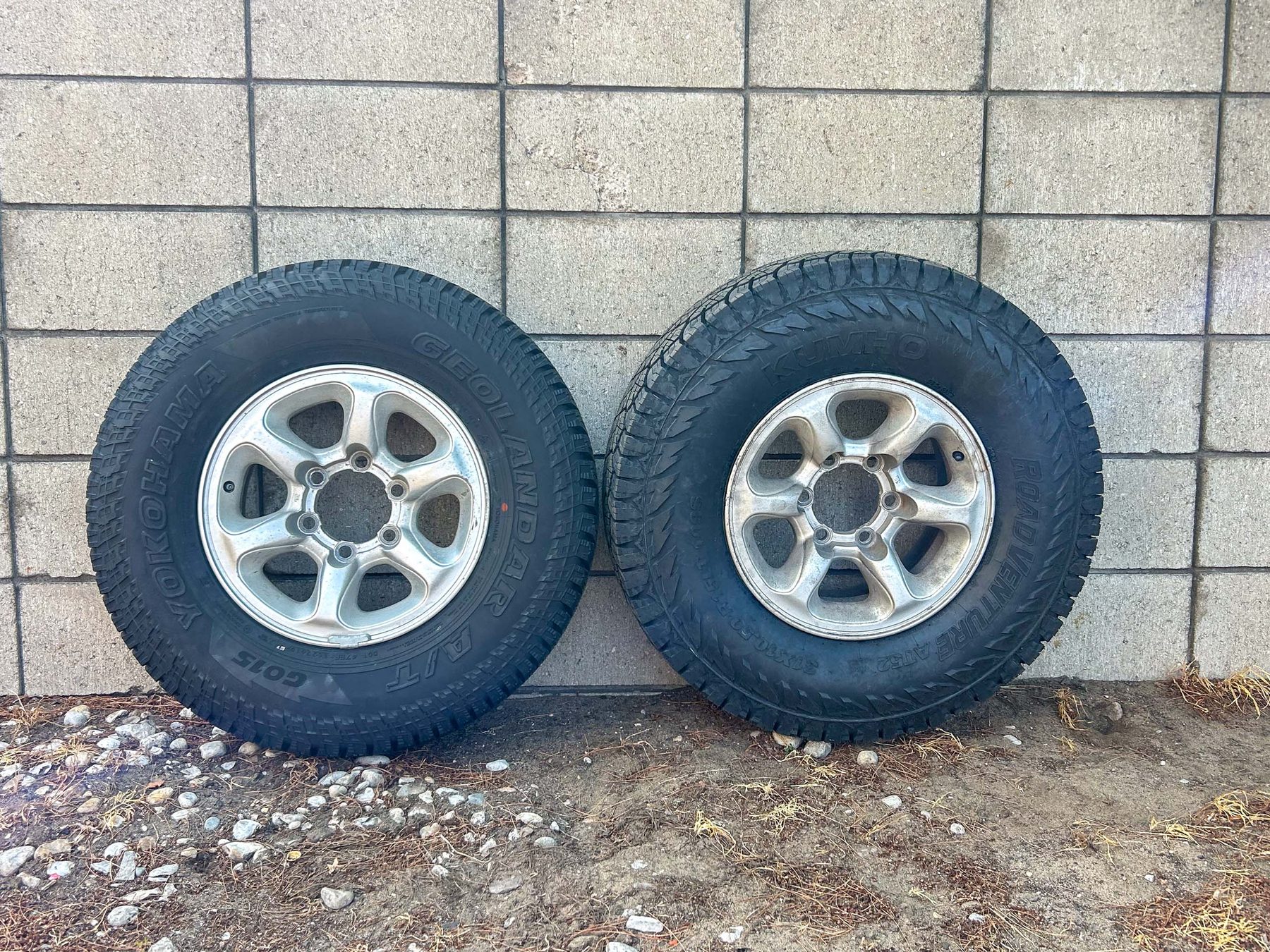
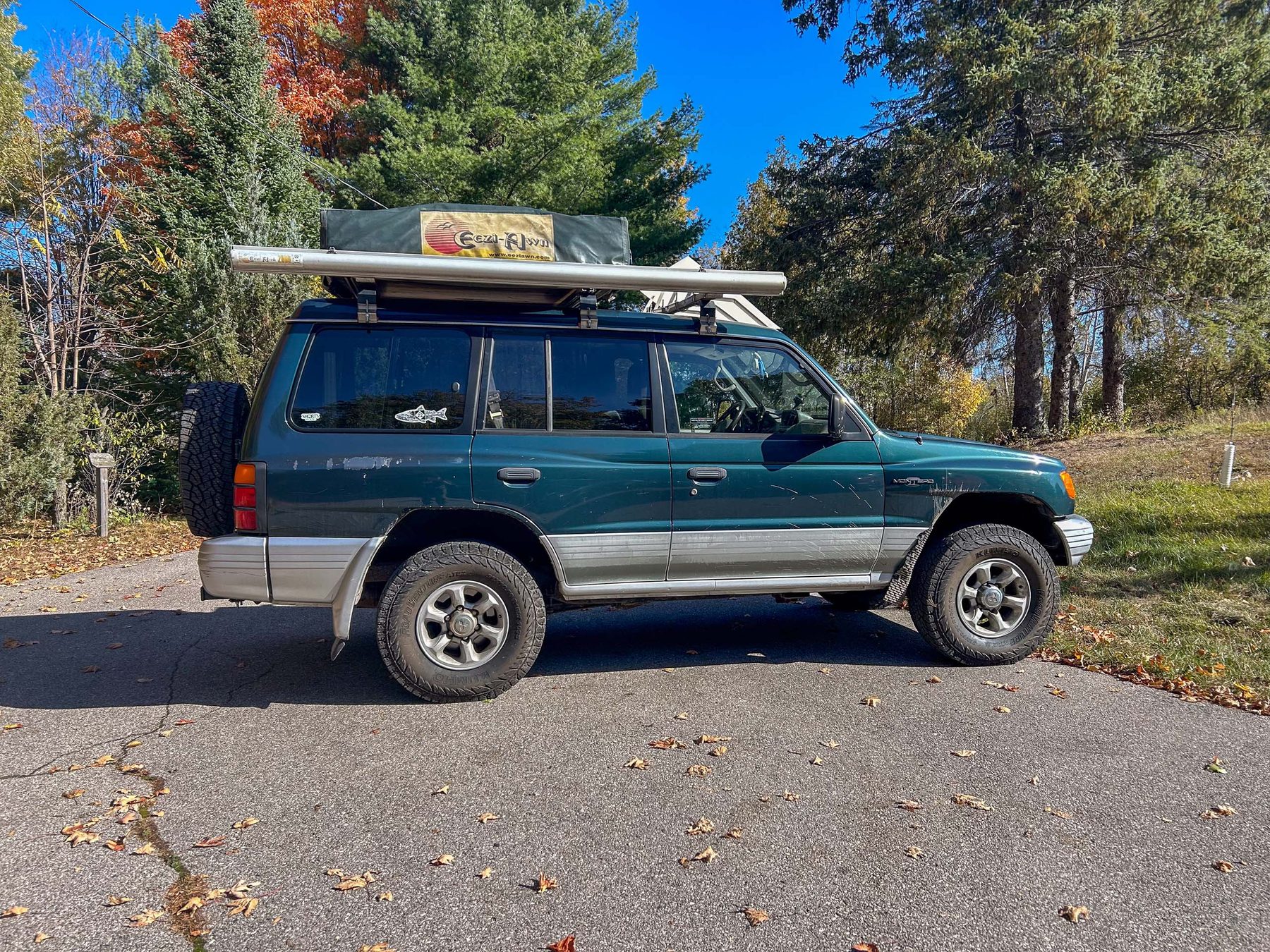
A bigger tire raises the axles by half of the diameter it adds, so a tire two inches taller gives one inch more clearance under the differential. In exchange it gears the vehicle taller by the same percentage it grew: the engine has less leverage, acceleration slows, and the speedometer and odometer read low. It is also usually heavier, and it can be rated to carry less. On Nathan Petroelje's 1998 Mitsubishi Montero, a tire 0.8 inch taller, a 3 percent step, added about 0.4 inch of clearance, slowed 0 to 60 from 13.7 to 14.5 seconds, and coincided with a drop from 19.5 to 16.7 mpg on one test loop, though the new tires were also a heavier, different model. One size up is a set of small costs. Two or three sizes up usually means new axle gears as well.
How much ground clearance do bigger tires add?
Half the increase in diameter. A tire's extra height is split above and below the axle, and only the half below lifts anything. That half is worth having, because on a vehicle with a solid axle the tire is the only thing that raises the differential. A suspension lift raises the body and leaves the axle where it was, which our glossary entries on ground clearance and lift kits show in diagrams.
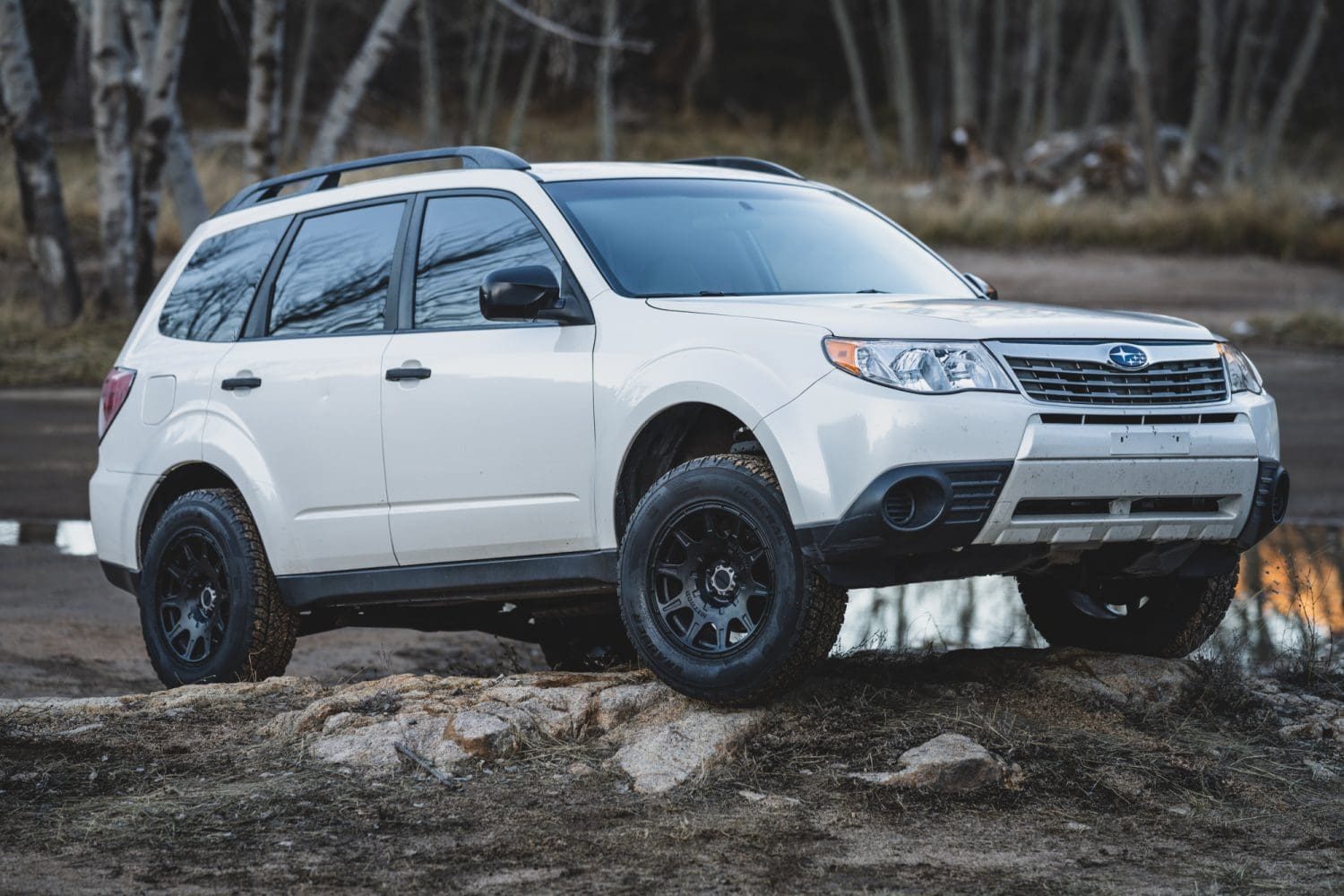
Two builds show how small the number is at a sensible size. Petroelje's Montero went from a tire of about 29.7 inches to one of 30.5, which is roughly 0.4 inch under the axle. Scott Brady's write-up of a lightly modified Subaru Forester for Expedition Portal does the same sum in a sentence: "The new tire is 28” in diameter, nearly an inch taller than the stock tire, which adds a half-inch of total ground clearance."
The gain is also not guaranteed. A big jump in tire size often needs a stronger axle to survive it, and a stronger axle has a bigger differential housing. In one comparison on a full-size truck, going from 37 to 40 inch tires should have added an inch and a half and added a quarter inch, because the axle fitted with the 40s hung an inch and a quarter lower.
Tire size calculator
Enter the size you run and the size you are considering. The sums are the ones worked by hand further down this page: half the change in diameter reaches the axle, and the speedometer, the odometer and the gearing all move by the same percentage as the diameter.
| Current | New | |
|---|---|---|
| Overall diameter | 31.6 in | 32.7 in |
| Difference | +1.1 in (+3.5%) | |
| Clearance under the axles | +0.55 in | |
| Turns per mile | 638 | 617 |
| True speed at an indicated 60 mph | 60 mph | 62.1 mph |
| Miles travelled per 100 on the odometer | 100 | 103.5 |
| Axle ratio, as the engine feels it | 3.73 | 3.60 |
| Axle ratio that restores the original gearing | 3.86 |
Read the last two rows together. The first is the gearing you will have after the swap, and the second is the ratio a gear shop would fit to put it back. Axle gears come in fixed steps, so the answer is the nearest ratio made for your axle.
A size on a sidewall is nominal. The Montero in the next section went from 265/70R15 to 31x10.5R15, which works out here as 29.6 to 31.0 inches, while the makers' tables list those two tires at 29.7 and 30.5. Where you have the maker's diameter, enter it in inches for the closer answer.
What does one size up cost? A measured example
Nathan Petroelje, an editor at Hagerty, wanted to know what a modest step up would cost on a truck with no power to spare, so he measured his own. He replaced 265/70R15 Yokohama all-terrains with 31x10.5R15 Kumhos on the same wheels, changed nothing else, and ran the same tests on each set. For fuel he drove a fixed loop on cruise control and filled at the same pump: "I refilled the tank with the same double-click method, noted the number of gallons pumped, and then divided the trip’s length as measured on Google Maps (79 miles) by the number of gallons". Acceleration was three timed runs on each set, averaged.
| 265/70R15 Yokohama | 31x10.5R15 Kumho | Change | |
|---|---|---|---|
| Diameter | 29.7 in | 30.5 in | +0.8 in, 2.7% |
| Weight, each | 37.4 lb | 43.8 lb | +6.4 lb |
| Maximum load, each | 2,469 lb | 2,270 lb | -199 lb |
| 0 to 60 mph | 13.7 s | 14.5 s | +0.8 s |
| Fuel economy, one loop | 19.5 mpg | 16.7 mpg | -2.8 mpg |
| Speedometer at a true 58 mph | 57 mph | Reads 1 mph low |
He judged those costs acceptable and kept the tires. Asked by a reader why he stopped at 31 inches, he answered: "if you go to the next most common tire size (33 inches), the recommendation is overwhelmingly to regear your differentials with the 4.90:1 units out of a Montero sport of similar vintage. That was obviously going to be a costly upgrade, so I stayed shy of upsizing that much this go-around."
What do bigger tires do to gearing?
They make every gear taller by the same percentage the tire grew. A taller tire covers more ground on each turn, so for a given road speed the engine turns more slowly, and for a given engine effort less force reaches the ground. A 3 percent taller tire behaves like axle gears 3 percent taller. On the road that shows up as slower acceleration and a transmission that shifts down sooner on hills. Off the road it shows up in low range, where a tall tire raises the slowest speed the vehicle can crawl at and takes away some of the engine braking on descents.
The table works the sums from a 31 inch tire, a common stock size on a mid-size truck. The last column is the axle ratio that would put the gearing back where it was, taking 3.73 as the starting ratio. The arithmetic is ours: multiply the old ratio by the new diameter and divide by the old.
| New tire | Clearance gained | Gearing and speedometer change | True speed at an indicated 60 | Ratio to restore 3.73 |
|---|---|---|---|---|
| 32 in | 0.5 in | 3.2% | 61.9 mph | 3.85 |
| 33 in | 1.0 in | 6.5% | 63.9 mph | 3.97 |
| 35 in | 2.0 in | 12.9% | 67.7 mph | 4.21 |
| 37 in | 3.0 in | 19.4% | 71.6 mph | 4.45 |
Axle gears come in fixed ratios, so the fix is the nearest one available, usually the next numerically higher one, such as 4.10 where the sum gives 3.97, to make up for the added weight. On a four-wheel-drive vehicle both axles have to be changed to the same ratio, which is why regearing costs what it does.
Do bigger tires hurt gas mileage?
Usually, and by more than the size alone accounts for. The Montero lost 2.8 mpg, about 14 percent, on its one loop. Brady reports "about one mpg" on the Forester, where the new tire was the same width as the old one, chosen for that reason: "The width is the same as stock, so the tire does not stick out past the fenders and yields similar gas mileage."
Height is the smaller part of it. The National Research Council's study of tires and fuel economy found that a 10 percent change in a tire's rolling resistance moves fuel economy by 1 to 2 percent, and that a tire's size is hard to separate from its weight and construction. A bigger off-road tire is typically wider, heavier and more aggressively treaded all at once. Car and Driver isolated weight and width by fitting one car with five wheel and tire packages of nearly the same height: from the lightest to the heaviest, fuel economy fell 10 percent. For mileage, look at the tire's weight and tread; a taller tire in the same width and tread is the mild version.
One trap when you measure your own: the odometer reads low on the taller tire, so mileage worked out from it looks worse than it is. Petroelje avoided it by taking the distance from a map.
Why is the speedometer wrong after a tire change?
Because it counts turns of the driveline and assumes the original tire. A taller tire travels further on each turn, so the speedometer and the odometer both read low by the same percentage as the change in diameter. Petroelje's read 57 at a true 58 after a 2.7 percent change. From a 31 inch tire to a 35, an indicated 60 is nearly 68. Most modern vehicles can be recalibrated, by a dealer or with a programmer. Do it: the same signal feeds the transmission's shift points and the stability control.
How much heavier is a bigger tire, and can it carry less?
Heavier by pounds per corner, and that weight counts for more than the same weight in the cab. It is unsprung, so the suspension has to control it over every bump, and it rotates, so the engine has to spin it up and the brakes have to stop it. The Montero's new tires weighed 6.4 pounds more each on Petroelje's scale. At the other end of the range, one comparison puts a 40 inch tire and wheel at about 145 pounds against 109 for a 37.
Carrying capacity does not grow with size. The Montero's taller tire is rated for 2,270 pounds where the one it replaced was rated for 2,469. Tall, wide sizes on small wheels are built for low pressure and light vehicles, and their load ratings reflect it. The federal standard requires a vehicle's maker to fit tires whose combined rating on each axle is at least the axle's weight rating, the GAWR on the door label. That rule does not bind an owner, and it is still the right test for a replacement: two tires' maximum load should come to no less than the axle rating they sit under. A loaded camper or a truck near its limits is where a bigger tire with a lower rating does harm.
Will a bigger tire fit?
That depends on width and wheel offset as much as height, and on where the tire goes at full steering lock with the suspension compressed, which a test fit in the driveway does not show. The Forester's owner kept the stock width, and the tire still "rubbed a lot" on a seam in the wheel well until a small lift went in, after which Brady reports "some minor rubbing". The same tire only just fits the spare well, and a spare that does not match is no spare on an all-wheel-drive car.
Brady's advice for a Subaru is the general rule for a crossover: "In general, Subarus perform best when stock or near-stock, so modifications should be limited to only subtle enhancements." One size up, in the stock width, is the change that costs least.
When do you need to regear?
There is no fixed line, and the people who have done it put it at about two sizes. Petroelje accepted a 3 percent change without regearing and names 33 inches, about 11 percent over stock on his truck, as the point where Montero owners overwhelmingly do. The signs that you have crossed it are a transmission that will not hold top gear on the highway, an automatic that hunts between gears on grades, and a low range that no longer crawls slowly enough. A truck with a small engine reaches that point sooner than one with torque to spare.
So the budget for a big tire is five tires, since the spare has to match, possibly wheels, a speedometer correction, and past a size or two a pair of axle gear sets and the labour to install them. The half inch of clearance from one size up is cheap. The second inch is where the spending starts.
What we do not know
We found no test that changes only tire height, with the same model, width and tread, and measures fuel economy and braking. The Montero test changes the model along with the size, and Car and Driver's holds height still. Nobody in these sources measured stopping distance on a taller tire.
Petroelje recorded higher engine speed at the same road speed on the taller tires, the opposite of what the gearing predicts, and suggested the torque converter. We cannot explain it and have left the reading out of the table. The Montero's axle ratio is not confirmed, so we have not worked his truck's gearing in numbers. The Forester's clearance and fuel figures are its writer's statements and were not measured.
Also in the field guide
Sources
- What, Really, Are the Costs of Upsizing the Tires on Your Adventure Rig? by Nathan Petroelje, Hagerty Media, read 2026-11-25October 2024. His own 1998 Montero, measured before and after. Kumho sent him four of the new tires for the story. The two sets are different models as well as different sizes, the fuel figure is one run on each, and the engine speed he recorded rose where a taller tire should lower it, which he puts down to the transmission. Readers raise all three in the comments, and his remark about regearing is in a reply there.
- Road Venture AT52, sizes and technical data, Kumho Tire USA, read 2026-11-25The maker's table for the new tire: diameter, weight, load and price.
- Yokohama Geolandar A/T G015, 265/70R15, Tiresize.com, read 2026-11-25A size database, used for the old tire because Yokohama's own table would not load.
- Tires and Passenger Vehicle Fuel Economy, Special Report 286, chapter 5, National Research Council, Transportation Research Board, 2006, read 2026-11-25
- Effects of Upsized Wheels and Tires Tested, Car and Driver, read 2026-11-25Five wheel and tire packages on one car at nearly the same overall diameter, so it shows what weight and width cost with height held still.
- The Differences Between Running 37 and 40 Inch Tires on Your Off-Road Rig by Harry Wagner, Driving Line, published by Nitto Tire, read 2026-11-25A tire maker's own magazine testing its own tires. Used for the clearance arithmetic and the weights.
- 49 CFR 571.110, tire selection and rims, Electronic Code of Federal Regulations, read 2026-11-25Binds the vehicle's maker and not its owner. It is the benchmark a replacement tire should still meet.
- Can I Get a Lift? Baseline Mods for the Subaru Forester by Scott Brady, Expedition Portal, read 2026-11-25The Forester's owner is not named and its figures are stated, not measured.