
Cybertruck vs Rivian off-road: what happens when a computer controls the power?
By Chad Sig · Published
The short answer
Both are electric, and in both, all-wheel drive is a software decision rather than a gearbox. The dual-motor Cybertruck has a motor on each axle and mechanical locking differentials front and rear; the tri-motor Cyberbeast has a mechanical front locker and a virtual rear locker, made by controlling its two rear motors, which switches itself on in certain modes and speeds and cannot be engaged by the driver. The quad-motor Rivian R1T and R1S put a motor on each wheel and use torque vectoring in place of lockers, which Rivian says gives substantially better torque control than a locking differential. The practical difference is control: a mechanical locker does one predictable thing when you ask it to, while a motor per wheel reacts faster and more finely but on the software's judgment. Neither adds grip a tire does not have, and both trucks' capabilities can change with an update: the Cybertruck's lockers were enabled over the air months after the first trucks were delivered.
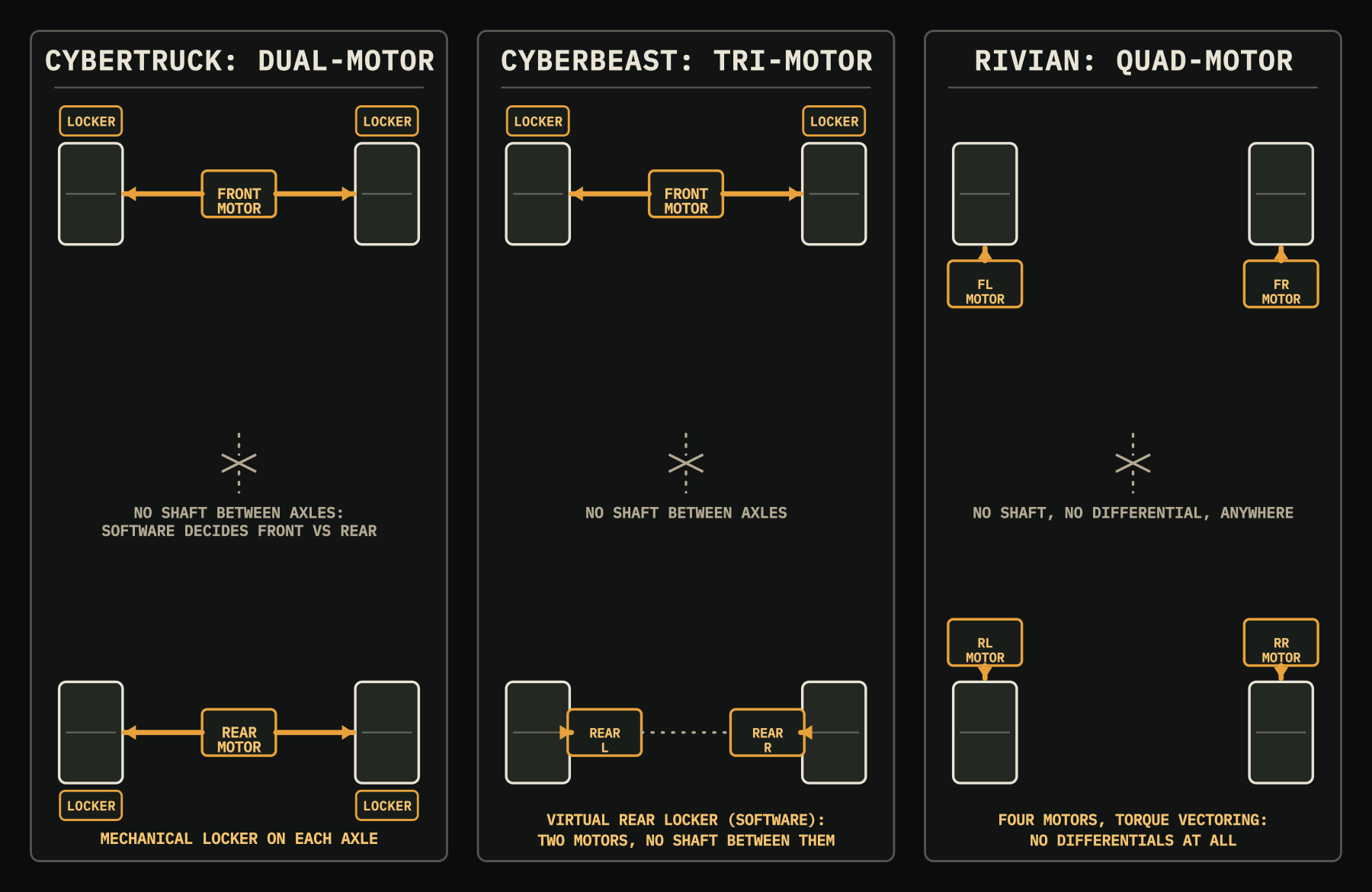
What changes when a computer controls the power?
In a conventional four-wheel drive, the engine turns one shaft and a set of gears and differentials divides that power between the wheels. The differentials behave according to their design, and when one wheel loses grip an open differential sends it the power, which is the whole reason lockers exist. Our page on AWD versus 4WD covers that in detail.
An electric truck with a motor on each axle has no shaft connecting front and rear. There is nothing to lock between them, because nothing joins them. How much the front pulls against the rear is whatever the controller tells each motor to do, many times a second. Go one step further, with a motor on each wheel, and the same is true side to side: no differential at all, just four motors taking instructions. The question stops being what hardware does the truck have, and becomes what the software does when a wheel slips.
How do the Cybertruck and Rivian compare off-road on paper?
The published geometry is close. Both trucks ride on adjustable air suspension, both reach about 26 degrees of breakover, and each wins some columns. The Cybertruck lifts higher and has the steeper approach, but only at a suspension setting it limits to walking pace. The Rivian has the better departure angle, wades deeper and is shorter between the wheels. None of these numbers says how either truck behaves on a real trail, and we have not found an independent test that puts them side by side on the same ground.
| Cybertruck | Rivian R1T | |
|---|---|---|
| Max ground clearance | 16.0 in | 14.9 in |
| Approach angle | 39.9° | 35.7° |
| Breakover angle | 26.0° | 26.3° |
| Departure angle | 27.6° | 29.9° |
| Wading depth | 32 in, in Wade Mode | 43.1 in |
| Wheelbase | 143.1 in | 135.8 in |
| Payload | Up to 2,500 lb | 1,764 lb |
| Side-to-side traction | Mechanical lockers front and rear (Cyberbeast: front locker, virtual rear) | A motor per wheel, no differentials |
How does the Cybertruck split its power?
Tesla's own off-road guide sets out two arrangements. The dual-motor Cybertruck has one motor per axle and mechanical locking differentials front and rear, so side to side it behaves like a conventional locked axle. The tri-motor Cyberbeast has one motor at the front with a mechanical front locker, and two motors at the rear, one per wheel, which Tesla uses to make what it calls a virtual rear locking differential.
On the Cyberbeast the rear locker switches itself on in certain modes and speeds, and Tesla says the driver cannot engage or disengage it.
That sentence is the whole subject in miniature. On a conventional truck a locker is a switch the driver owns: you lock it for the ledge and unlock it after. On the Cyberbeast the rear locker is a behaviour of the motor controller, and the software decides when it applies. Tesla's guide explains what a locked axle does: torque goes to the wheel with traction, and in extreme cases, such as when one wheel is in the air, all available torque is sent to the wheel on the ground. On a virtual locker, available has a narrower meaning, which the next sections explain.
The rest of the off-road system is software too. Overland mode is for sand, gravel and rock at low speed, with terrain settings for each; Baja mode is for high speed on dirt, with its own suspension and traction settings. The air suspension spans a published range from 7.93 inches of ground clearance at its lowest to 16 inches in Extract, the highest setting, which the truck limits to 10 mph to avoid hardware damage.
How does the Rivian split its power?
Rivian's quad-motor R1T and R1S carry two drive units, one per axle, each with an independent motor for each wheel. Rivian describes it as adjusting torque at all four wheels independently, which enables four-wheel torque vectoring: each wheel can separately help accelerate, slow or even turn the truck. With a motor per wheel there is no differential to lock, and Rivian's position is that it does not need one: it says quad-motors offer substantially better torque control than locking differentials. That is the maker's claim, and we have not found an independent test of it.
Rivian's dual-motor trucks sit closer to the Cybertruck: one motor per axle, torque biased toward the rear and shared continuously between front and rear, with the brakes at each wheel doing the side-to-side work. Rivian says that combination lets the dual-motor trucks crawl rocks and tow in places that could freeze a vehicle with an open differential. That is the brake-based approach mainstream 4x4s have used for years, run by an electric drivetrain.
Is a virtual locker as good as a real one?
It depends what you want from a locker, and the two answers pull in different directions. A mechanical locker gives certainty. Engaged, both wheels on the axle turn together, full stop, and the driver chose that. Its limits are that it is all or nothing and it hurts steering while it is on, which is why you unlock it after the obstacle.
A motor per wheel gives finesse. It can send exactly as much torque to each wheel as that wheel can use, change it continuously, and stay in that mode on a surface where a locked axle would scrub and push. Its limit is that you are trusting the controller's judgment, and on the Cyberbeast you cannot overrule it. We have not found an independent, instrumented test comparing a virtual locker with a mechanical one on the same obstacle, so we will not claim one is better. What we can say is what each asks of the driver: the mechanical one asks you to decide, the virtual one asks you to trust.
There is also a hard limit that follows from the layout. A locked axle is driven by one motor or one driveshaft, and when one wheel lifts, everything that axle has goes to the wheel still on the ground. With a motor per wheel, each wheel can only ever receive its own motor's torque. With one wheel of an axle in the air, the gripping wheel gets one motor's worth, roughly half of what a locked axle driven by a motor of the same total output would send it. The software cannot route the idle motor's torque across, because nothing connects them.
And motors and their electronics get hot under sustained high torque at low speed, which is exactly what a long rock crawl or a deep-sand slog asks for. Electric trucks manage this by limiting output when temperatures climb, so how a system behaves an hour into a hard trail can differ from how it behaves in the first five minutes. Manufacturers do not publish those limits, which is one more reason to treat off-road claims from any maker as claims until someone tests them.
Is this only an electric-truck thing?
No. The Cybertruck and the Rivian are the extreme end of a shift that has been running on combustion vehicles for years. Toyota's A-TRAC uses engine output and brake pressure to push drive force to the wheels with traction, and Toyota says the off-road result is equivalent to a locked centre differential with a limited-slip differential on each axle. Mercedes replaced the Sprinter van's driver-engaged 4x4, fixed at 35 percent front and 65 rear, with AWD that varies the split for itself, up to even. Ford's Transit AWD offers five drive modes, each a different set of rules applied to the same parts.
The difference with the electric trucks is how complete it is. A combustion 4x4 still has a transfer case and axles you can see, and the software works through them. An electric truck with a motor per wheel has nothing left for the software to work through. The drivetrain is the software.
What can software not do?
It cannot create grip. Every one of these systems works by sending torque to the tire that can use it, so when all four tires are on ice or in soft sand, the best controller in the world is sharing out nothing. Tires, tire pressure and weight still decide the outcome there, as they do for any vehicle.
It cannot move the truck's geometry past what the hardware allows. The Cybertruck's air suspension can raise it to 16 inches of clearance, but only at walking pace, and the length and width of the truck are the same at every height. And it cannot change the weight. Electric trucks are heavy for their size, which matters on soft ground and on the payload arithmetic that governs any loaded vehicle.
Brake-based traction control, on any vehicle, does its job with the brakes, so long slow sections turn into heat and wear. A motor per wheel avoids most of that by controlling torque directly, which is one of its real advantages.
What should you ask before buying a computer-controlled truck?
The old spec-sheet questions still matter: ground clearance, angles, tires. The new ones are about behaviour. Can I lock an axle myself, or does the truck decide? What does it do with one wheel in the air? Which off-road features depend on a software version, and can an update change them? What happens to those modes if the controller throws a fault a long way from a road? None of these have answers on a window sticker, which is exactly why they are worth asking.
Also in the field guide
Sources
- Cybertruck Off-Road Guide, Tesla, read 2026-09-24Tesla's own guide, version 2024.14.3. The source for the locker arrangement on each variant, the off-road modes, the ride heights, the angles, the wading depth and the wheelbase. tesla.com and the online owner's manual refused automated fetch; this PDF is served from Tesla's service site.
- The difference between R1 drive systems, Rivian, read 2026-09-24
- What is Quad-Motor drive?, Rivian, read 2026-09-24
- Tesla Cybertruck locking differentials enabled by software update, Motor1, read 2026-09-24Secondary. Reports that the lockers arrived after launch by over-the-air update.
- Tesla Cybertruck off-road review, InsideEVs, read 2026-09-24Secondary. Tested before the rear locker was enabled.
- Tesla Cybertruck delivery event specs, InsideEVs, read 2026-09-24Secondary, quoting Tesla's site at launch. Source for the payload figure.
- R1T, Rivian, read 2026-09-24Approach and departure angles, wading depth and wheelbase.
- What is the maximum ground clearance?, Rivian, read 2026-09-24
- What is the maximum breakover angle?, Rivian, read 2026-09-24Second-generation R1, 2025 on.
- What is the maximum payload?, Rivian, read 2026-09-24Second-generation R1T, Quad Max.
- Anti-lock braking and traction systems, including Active TRAC, Toyota Pressroom, read 2026-09-24
- Mercedes-Benz Vans USA unveils all-new Sprinter AWD system with an advanced engine lineup, Automotive World, reproducing Mercedes-Benz Vans USA, read 2026-09-24
- Adventure Comes Standard: Ford Pro Reveals New 2023 Ford Transit Trail Van, Ford Pro, via Business Wire, read 2026-09-24Read from an archived copy.